70 Clock Galerie / The Innermost Loop Feed Reply Tableaux
Maison Innermost Loop – Tim Burchett défile
House Innermost Loop – Tim Burchett Walks
September 12, 2026
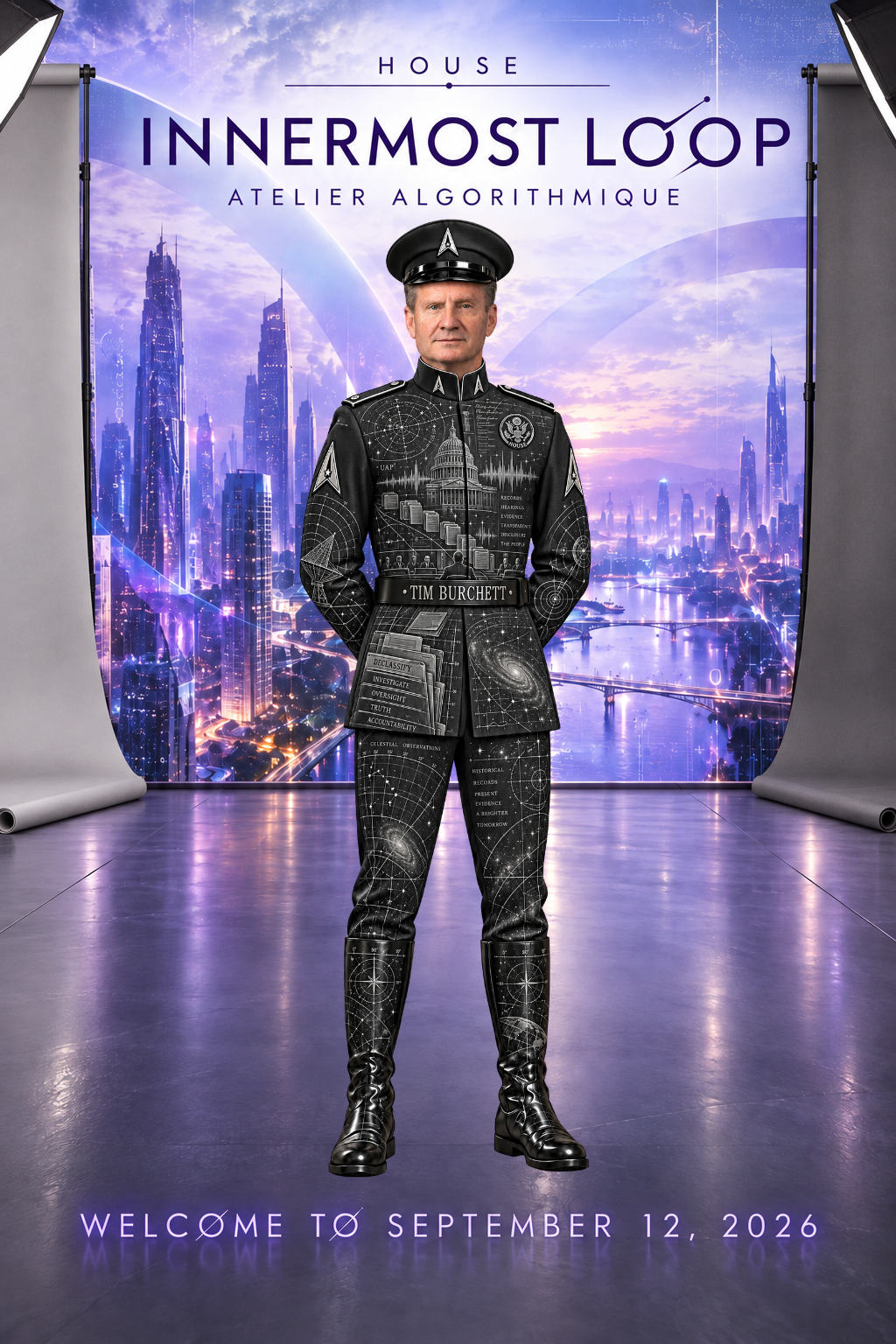
Maison Innermost Loop – Tim Burchett défile House Innermost Loop – Tim Burchett Walks The Capitol rises on Tim Burchett's chest above a miniature hearing. Figures sit in a row; documents advance toward them; a waveform passes beside the dome. Lower panels hold
Read the narration
Maison Innermost Loop – Tim Burchett défile
House Innermost Loop – Tim Burchett Walks
The Capitol rises on Tim Burchett's chest above a miniature hearing. Figures sit in a row; documents advance toward them; a waveform passes beside the dome. Lower panels hold folders and a spiral galaxy, bringing an institutional setting into contact with a field of stars. Silver lines make the transition continuous across the black cloth. The portrait's subject is the passage from something reported in the sky to something entered into a public record.
The image belongs to House Innermost Loop at Atelier Algorithmique, SIOUID 142's response to Dr. Alex Wissner-Gross's September 12, 2026 Innermost Loop dispatch on X. The House is the account's invitation to add fashion abundance as a sixteenth moonshot. Burchett appears near the issue's closing discussion of disclosure, through his reported statement that Stephen Miller had staff working on the subject. The garment develops the hearing, documentation, and oversight imagery associated with that public intervention.
Burchett entered Congress in January 2019 after eight years as mayor of Knox County, Tennessee, and sixteen years in the state legislature. His committee work includes Oversight and Government Reform. The small Capitol and hearing scene therefore identify the institutional setting of his contribution. They locate him within a career in public office, while the surrounding astronomical diagrams specify the subject selected for this particular portrait.
The waveform gives spoken testimony a visible form. It represents variation in a signal over time; it does not itself establish the truth of the words a recording contains. The page and folder motifs describe another stage, in which statements and supporting material can be collected and reviewed. By placing a waveform near the hearing and the documents, the design shows several forms through which a public claim may become available for examination.
The lettering makes that documentary theme explicit. Folders are marked with words including declassify, investigate, oversight, truth, and accountability. These are inscriptions in the artwork, identifying its intended subject. The pages are drawn as separate objects with edges and layers, rather than as one undifferentiated block of information. The documents supply the garment's recurring visual unit. Their arrangement allows the viewer to see an archive as a collection of records, each potentially carrying its own origin, date, and context.
Above and below those records, circular grids and celestial coordinates introduce another kind of organization. A sky map provides a way to locate an observation so it can be compared with others. A hearing provides a setting in which an account can be stated, questioned, and entered into a record. The garment brings those activities together through their visible forms. It preserves the difference between an observation, a description of it, and an explanation offered for it.
That distinction is material to the newsletter's final section. Wissner-Gross places disclosure discussion near Beatriz Villarroel's research on historical Palomar transients. An astronomical study and a public official's statement are different kinds of source. The portrait records Burchett's place in that juxtaposition without converting the statement into a finding about the origin of an unexplained observation. Its hearing scene represents a public process, while the galaxies and grids identify the field toward which that process is directed.
The shared officer silhouette answers another item in the issue: the Space Force uniform story, recast here through playful Star Wars officer styling. Burchett's individual pattern turns that cut toward records and testimony. His name is placed across the waist, and the House emblem on the chest identifies his legislative role. The high collar, shoulder details, and boots belong to the collection's artistic design; the small diagrams distinguish his contribution from the other nineteen people wearing related forms.
In the full runway, Burchett stands near Miller and Villarroel at the end of the lineup. Their placement follows the closing subjects of the dispatch. The studio portrait provides an independent view, with enough space to distinguish the folders from the astronomical fields. Behind him, a lavender city is bounded by visible photographic paper, and the date is printed across the floor.
The garment offers an educational sequence that can be followed without prior familiarity with the newsletter. A dome identifies an institution; a waveform represents a signal; documents preserve statements; coordinates locate observations. The different marks share one surface while retaining different functions. SIOUID 142's fashion proposal makes that sequence part of the attire, preserving Burchett's reported intervention as a dated image of testimony, records, and the work of public examination.
Opening the gallery…