70 Clock Galerie / The Innermost Loop Feed Reply Tableaux
Maison Innermost Loop – Elon Musk défile
House Innermost Loop – Elon Musk Walks
September 12, 2026
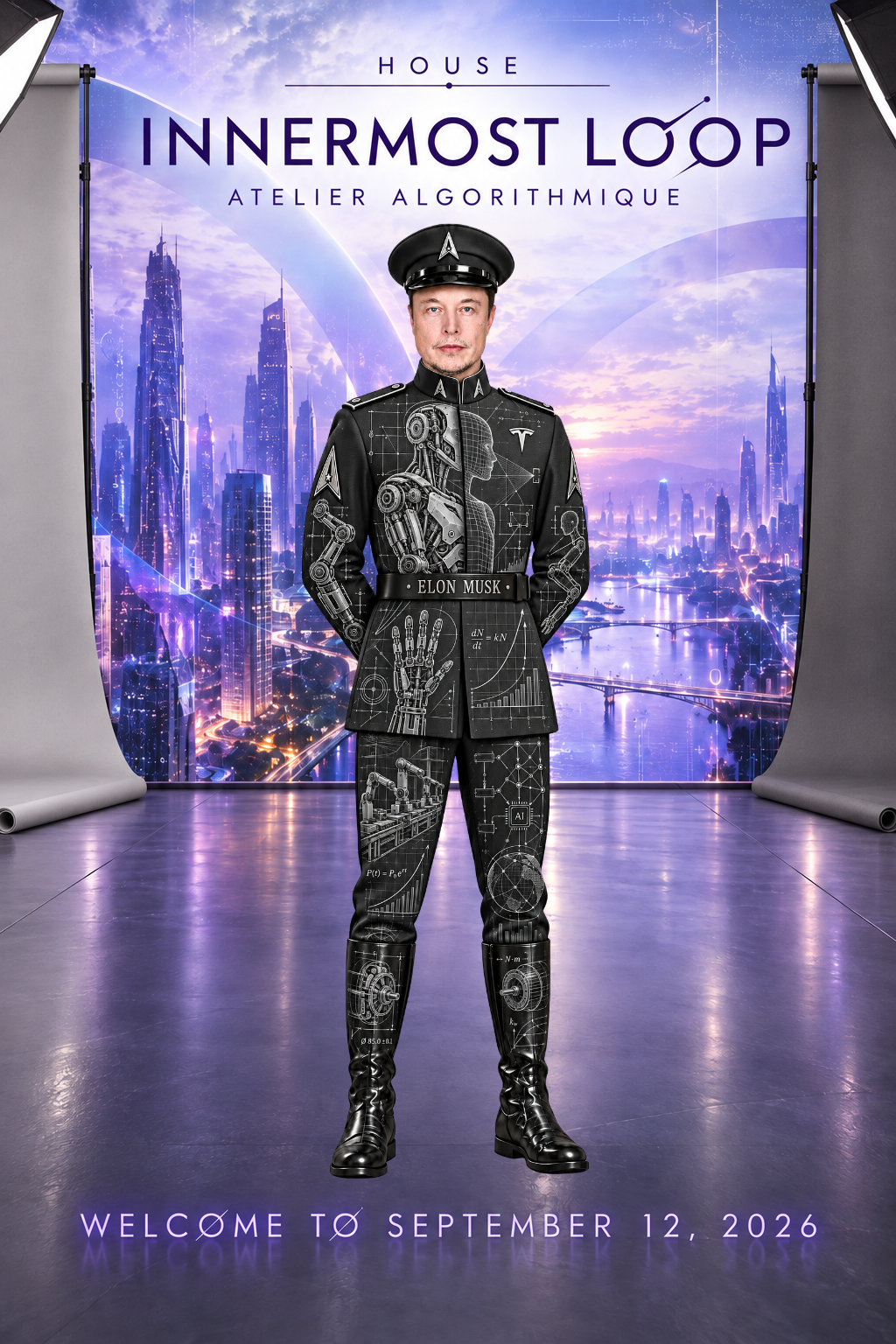
Maison Innermost Loop – Elon Musk défile House Innermost Loop – Elon Musk Walks A mechanical face and an articulated body divide Elon Musk's chest into two kinds of anatomy. Below them, an open robotic hand spreads across a tunic panel; a neighboring graph ris
Read the narration
Maison Innermost Loop – Elon Musk défile
House Innermost Loop – Elon Musk Walks
A mechanical face and an articulated body divide Elon Musk's chest into two kinds of anatomy. Below them, an open robotic hand spreads across a tunic panel; a neighboring graph rises beside an equation. Industrial arms repeat down a trouser leg. Musk's own hands remain behind his back, allowing the machinery drawn on his clothing to perform the gesture. The portrait gives a forecast about production a body capable of acting in the physical world.
This is SIOUID 142's House Innermost Loop at Atelier Algorithmique response to Dr. Alex Wissner-Gross's September 12, 2026 Innermost Loop dispatch on X. The House invites him to declare fashion abundance a sixteenth moonshot. Musk enters the issue through his expectation that AI and robotics could double world economic output by 2036. The outfit develops the connection between intelligent action and that projected scale, while retaining the distinction between a forecast and an achieved outcome.
Musk's work with Tesla and SpaceX provides a background in systems that must operate beyond a screen. Tesla's corporate record dates his chief executive role from October 2008. Vehicles, factories, and spacecraft involve materials, mechanisms, energy, and coordinated production. The Tesla emblem on the chest locates the garment within that industrial identity. Its robotic anatomy gives a particular visual form to the prospect that increasingly capable software may participate in a wider range of physical tasks.
The hand fits: dexterity is easy to recognize and difficult to engineer. Grasping an object involves geometry, contact, force, and information about what is happening. An actuator produces movement; a sensor supplies measurements that can guide adjustment. The drawn fingers and joints give the listener an entrance to these relationships. Embodied intelligence acquires a more exact meaning when one considers how a machine would hold, move, or release something without damaging it.
The growth equation on the lower tunic introduces another scale. Written as the rate of change of N being proportional to N, it describes exponential growth when the proportionality factor is constant. The larger a quantity becomes, the larger its increment over the same interval. The nearby rising curve makes the pattern visible. Its presence on the clothing illustrates the structure of a growth expectation; it does not demonstrate that a complex economy will follow that simple mathematical law.
The factory sequence gives the curve a possible mechanism. If a system can perform useful tasks more efficiently, its contribution may alter production. Turning that potential into economic output also depends on deployment, maintenance, demand, and the organization of work. The garment makes the passage from a hand to a factory to a graph visible across different panels. Those divisions help retain the intermediate steps that a large forecast can compress into a single striking number.
Wissner-Gross places Musk's expectation beside Anthropic Institute economic scenarios in which output and employment can move differently. A rise in aggregate production does not by itself describe how every worker or household experiences the change. The portrait's networks and globes allow the machinery to enter that larger field without pretending to calculate its consequences. The body of a robot and the body of an economy have different kinds of complexity, even when one may influence the other.
The shared officer cut answers the dispatch's Space Force uniform story and the playful Star Wars officer styling chosen for the collection. Musk's mechanical drawings give that silhouette an industrial subject. The closed collar, cap, and polished boots establish a common visual language with nineteen other figures, while his individual diagrammed surface records why he belongs in this particular issue. A future of abundance is presented as an assortment of specific propositions, each requiring its own account.
In the full runway, Musk stands beneath corporate game creatures and a huge coffee cup bearing fluid equations. A fruit fly holds a controller at the center of the scene, following the newsletter's experiments with a mapped nervous system. The individual portrait develops a related question at another scale: how a model, sensors, and a physical mechanism can form a system that acts. The silver anatomy gives this question a form the listener can examine.
The lavender city behind him supplies the House's setting for these possibilities. The black and silver garment gives that future joints and working parts. The portrait honors the particular industrial history behind Musk's forecast while keeping its mathematical form visible. In SIOUID 142's proposed fashion moonshot, abundance becomes something one can look at, learn from, and wear while the route from promise to production continues to unfold.
Opening the gallery…