70 Clock Galerie / The Innermost Loop Feed Reply Tableaux
Maison Innermost Loop – Jensen Huang défile
House Innermost Loop – Jensen Huang Walks
September 12, 2026
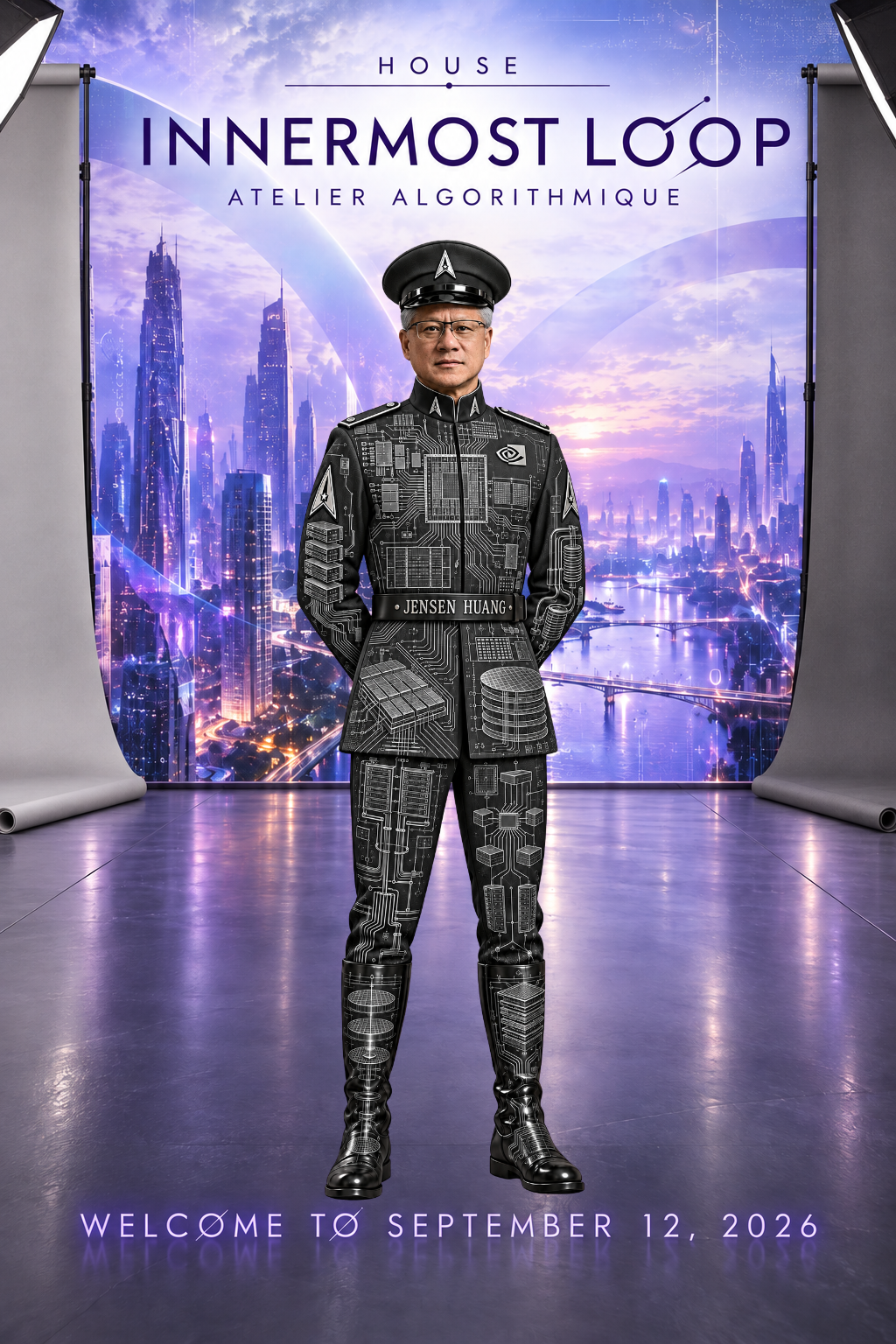
Maison Innermost Loop – Jensen Huang défile House Innermost Loop – Jensen Huang Walks Jensen Huang wears the machinery beneath the apparent immateriality of AI. A chip floorplan spreads across his chest; server racks descend along a sleeve; pipes carry the eye
Read the narration
Maison Innermost Loop – Jensen Huang défile
House Innermost Loop – Jensen Huang Walks
Jensen Huang wears the machinery beneath the apparent immateriality of AI. A chip floorplan spreads across his chest; server racks descend along a sleeve; pipes carry the eye toward cooling structures. Wafers and layered packages occupy the lower panels, while the boots continue the logic of assembly. Silver diagrams cover the familiar darkness of his clothing, transforming an executive's signature color into a detailed account of computational infrastructure.
The portrait is SIOUID 142's House Innermost Loop at Atelier Algorithmique response to Dr. Alex Wissner-Gross's September 12, 2026 Innermost Loop dispatch on X. The House proposes fashion abundance as a sixteenth moonshot: a technological future people can inhabit through things they enjoy wearing. Huang appears in the issue through his description of compute as capacity that can be allocated and rented. The outfit gives that economic idea a material body before considering what can be built with it.
Huang cofounded Nvidia in 1993. The company's history runs from graphics hardware toward accelerated computing and AI, with CUDA's introduction in 2006 opening GPU processing to a wider range of scientific work. That trajectory makes the garment's transformation especially appropriate. The public image of the black jacket acquires the internal structures of the business associated with it. The wearer is recognizable, but the decorative field invites the eye beyond recognition into the history of a computing platform.
A graphics processor can perform many operations in parallel. This organization, developed for demanding visual tasks, also supports calculations central to machine learning and scientific computing. Software provides the means to express and organize work on that hardware. The routes from the central chip show the relationship: a processor belongs within a system of memory, communication, and coordinated activity.
The wafer disks take the story toward manufacture. Semiconductor devices are fabricated across a wafer before individual dies are separated and packaged. Packaging connects the die to other components and contributes to the handling of power and heat. The stack of layers on the outfit makes this intermediate work visible. It is a useful corrective to the idea that a finished chip simply appears between an abstract design and a functioning AI system.
The racks, pipes, and cooling loops continue that movement outward. A data center arranges computing equipment with the power, networking, and thermal systems needed to keep it operating. Heat must be moved away from components; information must move among them. The small exploded assemblies on the boots give these requirements the precision of technical illustration. The garment treats the overlooked work of integration as worthy of the same close attention as the central processor.
This is why the look fits the particular newsletter. The dispatch places enormous infrastructure commitments beside stories about chip production, energy supply, and local conditions for data centers. Huang's description of rentable compute links those material systems to an economic service. A customer may access capability through a remote interface while the physical equipment remains elsewhere. The clothing reunites that separated experience, placing the apparent service and the machinery supporting it within one visible outline.
The day's mathematical announcement gives the infrastructure a further purpose. Thousands of coordinating agents working on a difficult proof require computation; lower costs can change who is able to attempt such work. But usable abundance includes more than possession of chips. Systems have to be connected, maintained, and made accessible. Huang's outfit makes the route from manufactured parts to available capability the subject of the portrait, giving the listener a sequence to follow through an otherwise overwhelming scale.
The shared officer silhouette comes from the newsletter's Space Force uniform story and the playful Star Wars officer styling chosen for the collection. Huang's scientific surface distinguishes his role within that common cut. In the larger runway, a Nvidia-branded creature occupies the technological sky while Huang stands in the human formation below. Its lavender city supplies the collection's prospect of abundance, but the garment shows what that prospect needs beneath its lights.
The resulting homage is specific to a career that helped turn graphics processing into a general instrument of discovery. The familiar black clothing becomes a wearable technical atlas, with each change of scale exposing another layer of work. SIOUID 142's fashion invitation takes pleasure in that complexity. Huang wears a future with components, connections, and a material history, giving the intelligence age the texture of something that has to be made.
Opening the gallery…