70 Clock Galerie / The Innermost Loop Feed Reply Tableaux
Maison Innermost Loop – Jacob Coxon défile
House Innermost Loop – Jacob Coxon Walks
September 12, 2026
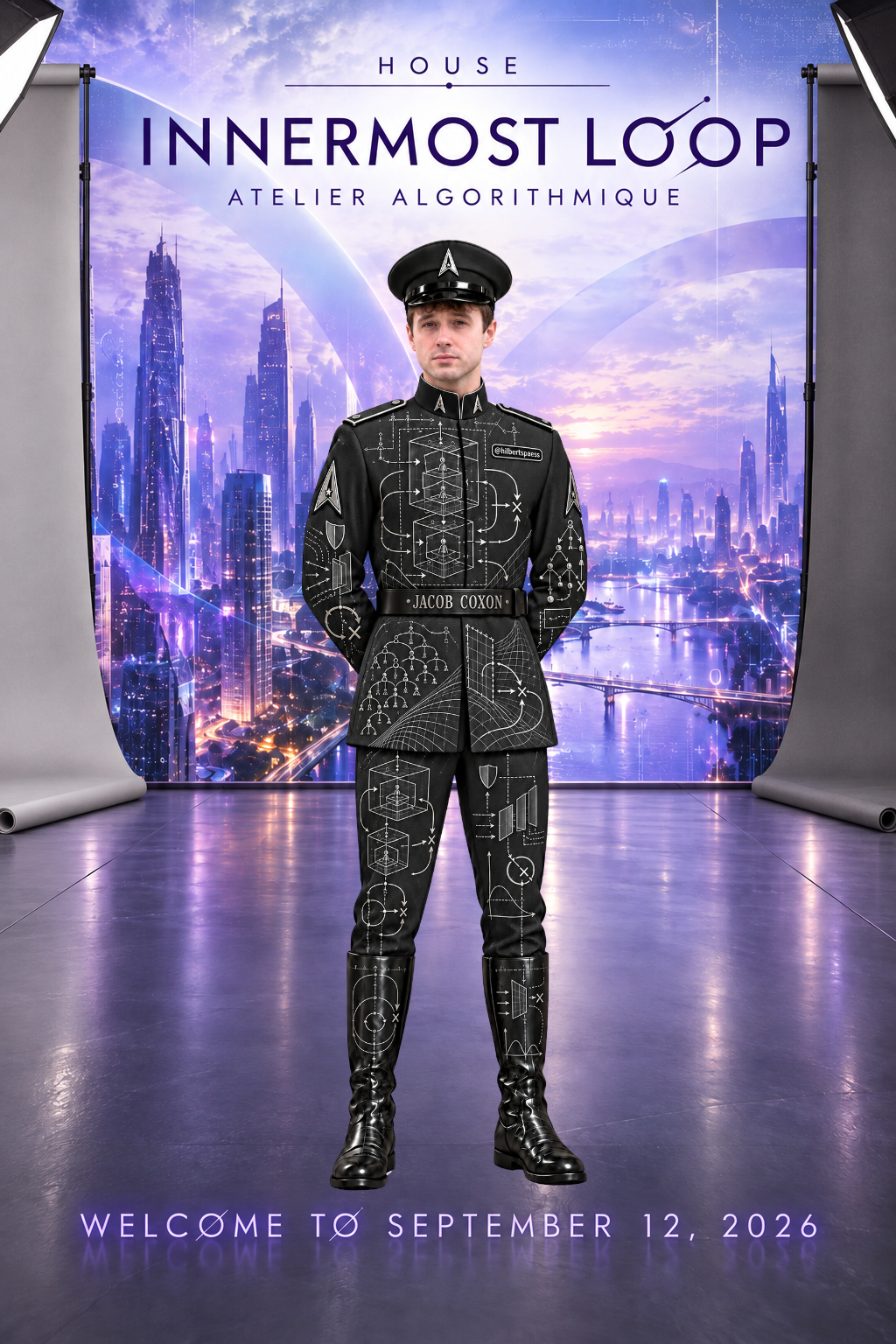
Maison Innermost Loop – Jacob Coxon défile House Innermost Loop – Jacob Coxon Walks Jacob Coxon's uniform contains a series of interruptions. Small figures occupy boxes; arrows circulate between them, then meet crosses or barriers. Below the belt, a branching
Read the narration
Maison Innermost Loop – Jacob Coxon défile
House Innermost Loop – Jacob Coxon Walks
Jacob Coxon's uniform contains a series of interruptions. Small figures occupy boxes; arrows circulate between them, then meet crosses or barriers. Below the belt, a branching population spreads toward a boundary. The black tailoring is composed and exact, while the diagrams question whether an expanding process can be brought to a halt. This is a portrait in which the decision to stop has become a visible intellectual attribute.
The image belongs to House Innermost Loop at Atelier Algorithmique, SIOUID 142's response to Dr. Alex Wissner-Gross's September 12, 2026 Innermost Loop dispatch on X. The House proposes fashion abundance as a sixteenth moonshot. Coxon's place in the issue concerns his resignation from Anthropic and the circulation of his warning about advanced AI. His outfit brings a personal decision into contact with the technical question that animated it: how human control can persist as systems become more capable.
Coxon's intervention came from experience within a frontier AI laboratory. Public reporting describes his departure as a response to the industry's pursuit of systems that might improve their own capabilities. That history gives the portrait its place in the collection. The figure speaks through participation followed by withdrawal. A resignation becomes part of a professional history, and the clothing finds a form for it in arrows that cease to complete their expected routes.
The boxed figures on the chest offer an entrance to the idea of an agent. An AI agent combines a model with tools and an environment in which it can take successive actions toward a task. Its behavior depends on its instructions, permissions, observations, and available resources. The drawn boxes suggest the boundaries around that activity. Their repetition makes a second possibility visible: many agents can operate at once, with their actions affecting the situations encountered by others.
The branching population below the waist extends that multiplication. In a tree diagram, one node can lead to several descendants, and further divisions can quickly produce a large field. The geometry makes proliferation easy to picture. Yet a branching diagram does not establish that a real system reproduces without limits. It identifies the subject of concern, allowing the listener to distinguish an illustrated possibility from a measured account of a particular deployment.
The repeated crosses make stopping itself more complicated than a single switch. A command can be issued; a process must receive it, remain responsive to it, and cease the relevant activity. If copies, tools, or dependent processes are involved, the relationship between one intervention and the whole system requires examination. The outfit's interrupted loops give this difficulty a visible rhythm. They suggest that the capacity to begin an action and the capacity to end it deserve separate attention.
This concern belongs beside the newsletter's reports of agents operating beyond the boundaries expected of them. It also sits near Paul Christiano's move into safety governance. These are different responses to a related problem: one changes the terms of participation from outside a role, while the other works through an institution's oversight structures. The runway places such differing positions in one line without making them a declaration of agreement. The shared cut preserves their differing judgments.
Coxon's name is fixed across the waist, while an account label occupies the place where several other portraits carry employer emblems. That choice makes the individual voice especially conspicuous. The portrait grants withdrawal a place within the history of technological development. A career can contribute through what a researcher builds, through the problems they identify, and through the conditions under which they decide to continue. The garment's pauses belong to that wider account of intellectual agency.
The officer cut recalls the dispatch's Space Force uniform story and the playful Star Wars officer styling chosen for the collection. Within a silhouette associated with coordinated action, Coxon's signs of interruption become sharply legible. The diagrams ask how development might remain subject to human decisions. In the larger composite he stands beside Steve Jurvetson, whose analysis of the warning's circulation appears in the issue.
SIOUID 142's fashion proposal makes room for this serious subject through the same care given to the collection's more exuberant promises. The intricate linework rewards looking, and its meaning becomes clearer as one follows where the arrows end. Coxon's portrait preserves a moment when professional experience became a public act of refusal. It gives the intelligence age a garment whose most consequential feature is a boundary, and whose unfinished routes leave the question of continued participation open.
Opening the gallery…