70 Clock Galerie / The Innermost Loop Feed Reply Tableaux
Maison Innermost Loop – Ted Cruz défile
House Innermost Loop – Ted Cruz Walks
September 12, 2026
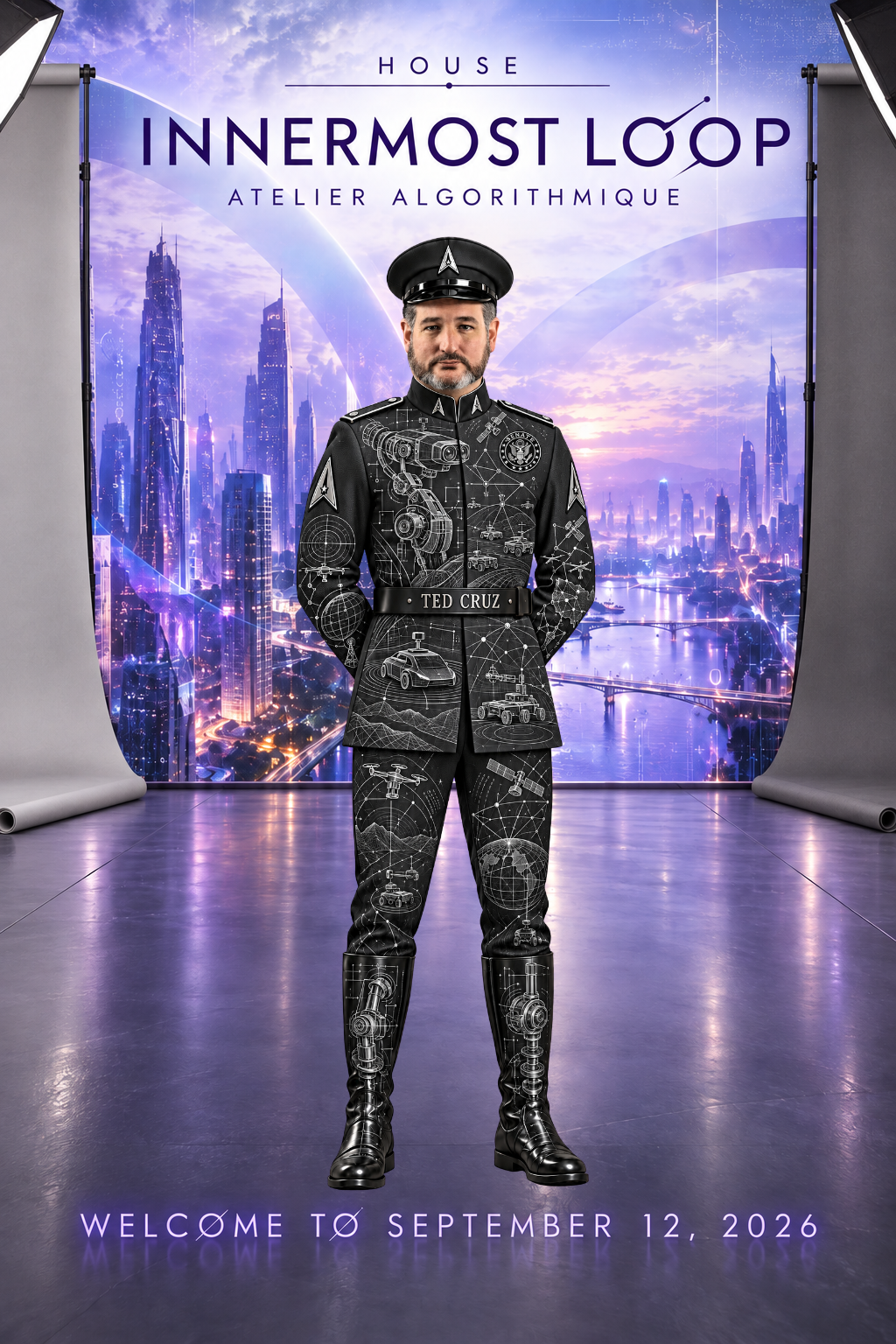
Maison Innermost Loop – Ted Cruz défile House Innermost Loop – Ted Cruz Walks An articulated robot occupies Ted Cruz's chest beneath a Senate emblem. Silver mechanical joints lead the eye toward vehicles, drones, radar patterns, and orbiting instruments. Acros
Read the narration
Maison Innermost Loop – Ted Cruz défile
House Innermost Loop – Ted Cruz Walks
An articulated robot occupies Ted Cruz's chest beneath a Senate emblem. Silver mechanical joints lead the eye toward vehicles, drones, radar patterns, and orbiting instruments. Across the black uniform, systems for sensing and movement share a single field. Cruz's own hands are held behind his back. The contrast gives the technical drawings particular prominence: the portrait identifies a public official through technologies addressed in the day's political discussion.
The image was made by SIOUID 142 for House Innermost Loop at Atelier Algorithmique, responding to Dr. Alex Wissner-Gross's September 12, 2026 Innermost Loop dispatch on X. The House is the account's proposed sixteenth moonshot of fashion abundance. Cruz appears through remarks favoring American leadership in AI and robotics. The reported remarks combine national competition with support for guardrails. The garment places that discussion within a visible ensemble of machines, networks, and institutional identification.
Cruz has represented Texas in the United States Senate since 2013 and became chairman of the Senate Committee on Commerce, Science, and Transportation in 2025. Before entering the Senate, he served as solicitor general of Texas. This background locates his role in the portrait: he participates through legislation, oversight, and public argument rather than through the design of the machines depicted. The Senate seal gives that distinction a precise visual address.
The committee's remit includes fields represented across the clothing, among them communications, transportation, and space. The garment therefore brings several areas of public responsibility onto one body. A wheeled vehicle, a satellite, and a connected network belong to different technical settings, even when AI can be applied within each. Their arrangement reflects how a broad technological development can enter several existing institutional areas at once.
The mechanical arm on the torso makes the connection between computation and physical action explicit. A robotic system may combine sensors, control software, and actuators that move its parts. The controller uses observations to select actions; motors and mechanisms carry those actions into the world. AI can contribute to perception or planning within that process. The drawing provides a compact visual account of embodiment, with joints replacing the more abstract impression of intelligence as words appearing on a screen.
The surrounding sensing diagrams extend the account. Radar uses reflected radio waves to obtain information about objects; satellites can support communication, navigation, and observation. The concentric rings on the cloth belong to that visual vocabulary. Their repetition across the shoulders, legs, and boots connects the robot to an environment it would need to perceive. The outfit's technical imagery thus includes both action and the information on which action depends.
Wissner-Gross's dispatch places Cruz's remarks near discussion of safety governance and alongside reports of increasingly capable agents. Those are related subjects, but they ask different questions. A performance result describes what a system can accomplish under specified conditions. Governance concerns the arrangements under which systems are developed and used. The portrait shows both levels through the proximity of the machinery and the Senate emblem, without depicting a particular bill or an adopted technical standard.
Another newsletter item supplies the shared silhouette: its Space Force uniform story, developed here through playful Star Wars officer styling. SIOUID 142 carries that reference into a collection of twenty scientific uniforms, each differentiated by its subject's contribution. In Cruz's version, the robot and sensing equipment make national technological competition the chosen iconographic theme. The clothes are the account's artistic design, rather than a uniform worn by the senator in the reported event.
The studio makes those choices legible. The lavender city is printed on a backdrop whose paper edges remain visible. The black figure stands in front of it with both boots planted. In the corresponding runway composite, Cruz appears among researchers, industrialists, and other public figures beneath a vast cup bearing fluid equations. This closer portrait gives his particular place in that crowded dispatch the scale of a full-length image.
The route from emblem to mechanism carries the lesson. The viewer can identify an institution, then distinguish a robot from its sensors and the network connecting it to other systems. Fine linework joins these elements across seams without making them one device. The date on the studio floor fixes that selection to September 12, 2026, preserving a record of the moment when a public argument about AI was translated into a garment of mechanical attributes.
Opening the gallery…