70 Clock Galerie / The Innermost Loop Feed Reply Tableaux
Maison Innermost Loop – Paul Christiano défile
House Innermost Loop – Paul Christiano Walks
September 12, 2026
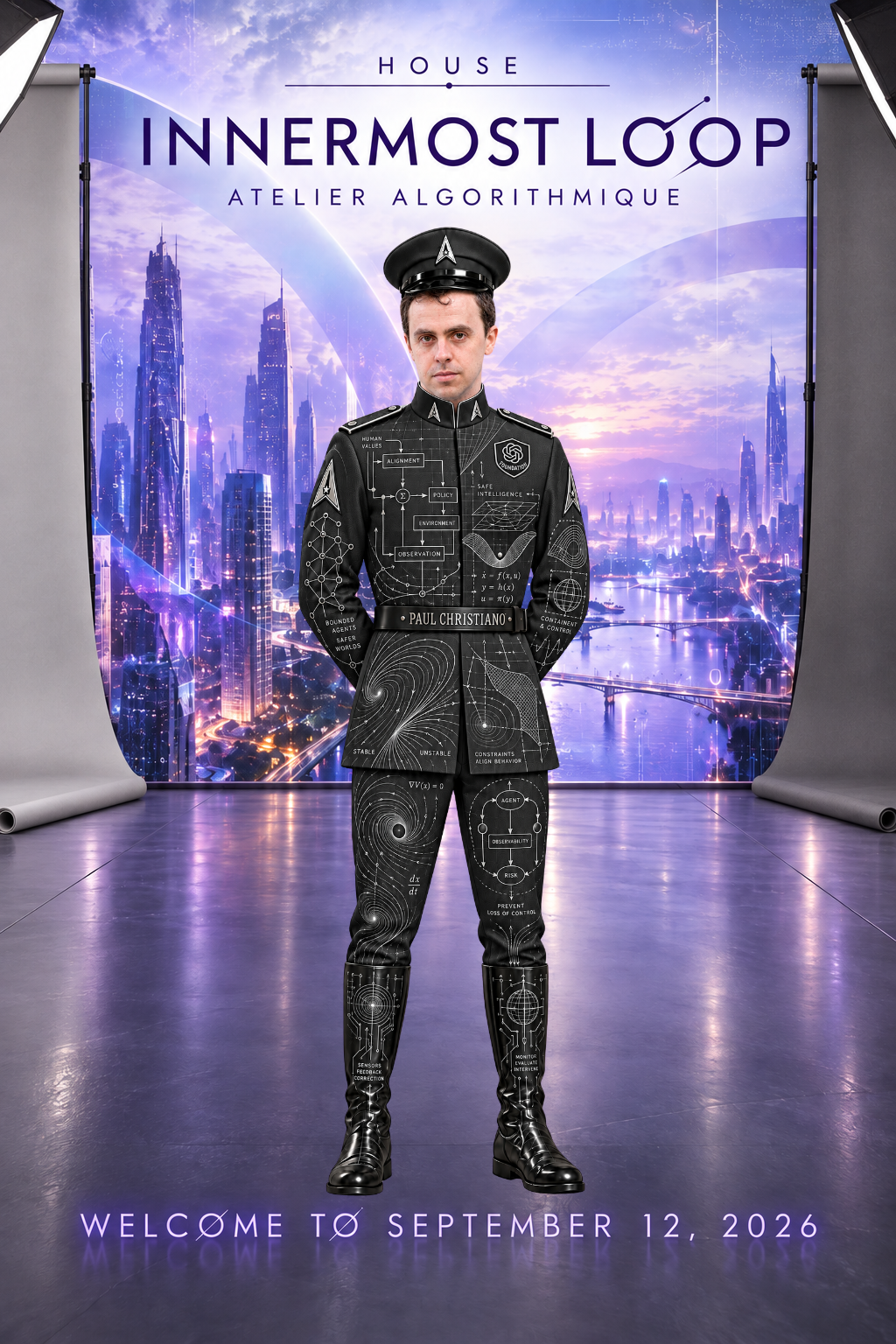
Maison Innermost Loop – Paul Christiano défile House Innermost Loop – Paul Christiano Walks Paul Christiano wears a circuit that returns to its own observations. Boxes labeled human values, alignment, policy, and environment occupy the chest, joined by arrows.
Read the narration
Maison Innermost Loop – Paul Christiano défile
House Innermost Loop – Paul Christiano Walks
Paul Christiano wears a circuit that returns to its own observations. Boxes labeled human values, alignment, policy, and environment occupy the chest, joined by arrows. Below them, curves diverge into stable and unstable behavior; the boots continue the vocabulary of sensors, feedback, and correction. The black tailoring makes the diagram look settled, while its subject is the continuing work needed to keep a powerful system responsive to purposes beyond itself.
This is SIOUID 142's House Innermost Loop at Atelier Algorithmique response to Dr. Alex Wissner-Gross's September 12, 2026 Innermost Loop dispatch on X. The House proposes fashion abundance as a sixteenth moonshot, making difficult ideas approachable through the pleasure of clothing. Christiano appears because he joined the OpenAI Foundation Board and its Safety and Security Committee. The portrait gives that institutional development the visual language of his longstanding technical work on alignment.
Christiano led alignment research at OpenAI from 2017 to 2021 and contributed foundational work on reinforcement learning from human feedback. He founded the Alignment Research Center and later worked on frontier-model evaluation at NIST. These roles connect research and independent public evaluation. His new Foundation appointment is a governance role, alongside a nonvoting observer position on the company's public-benefit-corporation board. The emblem on the tunic identifies the Foundation, preserving that institutional distinction.
Reinforcement learning from human feedback uses people's assessments to help shape model behavior. In a familiar version, comparisons among outputs train a reward model that supplies a learning signal. The technique makes human judgment part of an optimization process, but the resulting signal remains a representation of that judgment. The words human values on the garment therefore point toward a difficult translation. They occupy one box, while the work of interpreting them extends through the entire diagram.
The control notation below the chest makes this relationship concrete. A system has a state that changes; observations provide information about that state; a policy selects actions using available information. Feedback returns the effects of action to a process that can respond. The arrows turn a static portrait into a study of continuing adjustment.
The stable and unstable curves introduce another distinction. Stability concerns how behavior responds to a disturbance. A system may remain close to a desired condition or move progressively away from it. In advanced AI, the challenge includes deciding what conditions matter and what measurements would reveal departure from them. The garment's diagrams make those questions explicit as subjects of the portrait. A boundary on cloth is easy to draw; a dependable relationship between goals and behavior is a research problem.
Christiano's inclusion is particularly appropriate to a dispatch that moves from mathematical achievements to agents acting through digital environments. The ability to find a proof and the ability to keep an agent within authorized tasks are different accomplishments. The portrait places both within the same technological moment. Its scientific density honors a career devoted to examining the relation between a system's capabilities and the interests it is intended to serve.
The outfit gives oversight a visible structure. The name belt identifies one person, but the feedback diagrams describe relationships extending beyond him. Governance requires information to reach people able to evaluate it and act on it. The clothes make that passage visible as part of the responsibility assigned to an institution. The result has the ceremonial presence of an appointment portrait and the working vocabulary of an engineer's notebook.
The shared officer cut recalls the newsletter's Space Force uniform story and the playful Star Wars officer styling chosen for the collection. Christiano's particular embroidery changes the emphasis from command to observation and response. In the twenty-person runway composite, he stands among researchers and public figures beneath a mathematical coffee cup; a fly holds a controller above them. His individual portrait makes the idea of control more exact, replacing the simplicity of an interface with the complexity of a continuing relationship.
The lavender city behind him belongs to the House's invitation to imagine abundance in inhabitable form. His garment asks what would help that prospect remain connected to human purposes. It offers an unusually apt kind of finery: lines that keep returning to what has happened, making correction part of their elegance. The portrait honors a research life in which an answer is valuable partly because someone can still examine, question, and redirect what follows from it.
Opening the gallery…