70 Clock Galerie / The Innermost Loop Feed Reply Tableaux
Maison Innermost Loop – Dwarkesh Patel défile
House Innermost Loop – Dwarkesh Patel Walks
September 12, 2026
Maison Innermost Loop – Dwarkesh Patel défile House Innermost Loop – Dwarkesh Patel Walks Pages open across Dwarkesh Patel's chest, then dissolve into streams of small marks and connected nodes. The black tunic carries a sequence: writing becomes data, data en
Read the narration
Maison Innermost Loop – Dwarkesh Patel défile
House Innermost Loop – Dwarkesh Patel Walks
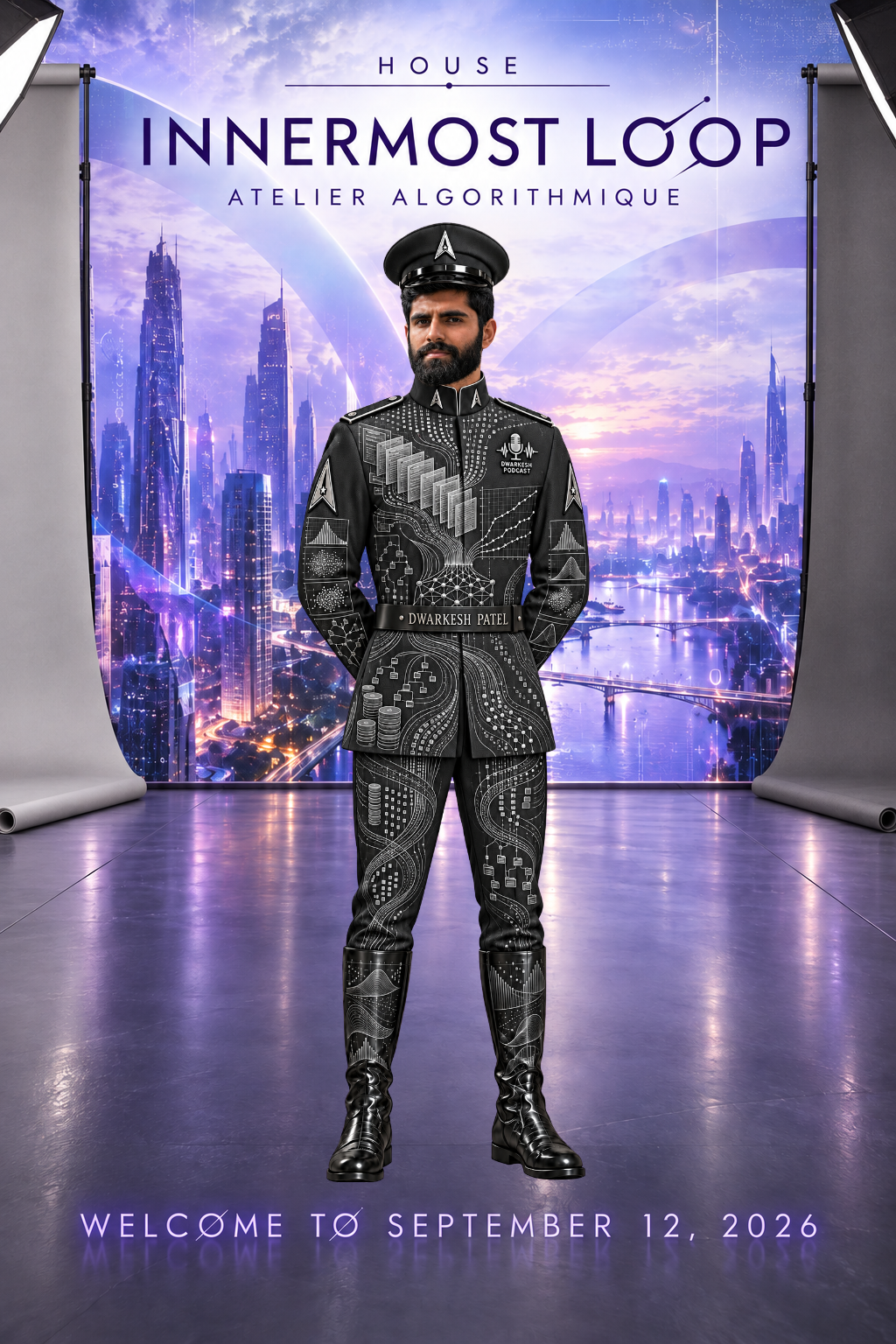
Pages open across Dwarkesh Patel's chest, then dissolve into streams of small marks and connected nodes. The black tunic carries a sequence: writing becomes data, data enters a network, and curves record changing performance. At the shoulder, a microphone identifies the Dwarkesh Podcast. The outfit portrays an interviewer through a question characteristic of his practice: what, beneath an impressive answer, actually produced the result?
The portrait responds to Dr. Alex Wissner-Gross's September 12, 2026 Innermost Loop dispatch on X. SIOUID 142 presents it through House Innermost Loop at Atelier Algorithmique, the account's invitation to make fashion abundance a sixteenth moonshot. Patel appears because of his analysis with Jerry Han of how much pretraining progress came from improved data. The garment makes their investigation visible as a passage from the authored page to the apparent intelligence of a machine.
Patel's public work combines extended interviews with written investigations into AI, science, and the forces shaping technological change. The microphone makes this history part of the look. An interview creates room for an expert to explain assumptions and follow a difficult chain of reasoning. In the analysis cited by the newsletter, Patel and Han take an experimental route: they compare combinations of model recipes and datasets associated with different years. Asking better questions becomes a designed comparison.
Their study examines pretraining from 2019 to 2025 at relatively small computational scales. Within its tested setting, improvements in data contributed more to compute efficiency than changes in model recipes. Model innovations still help make larger scales usable. This distinction matters to the clothing. The pages and the network share a surface because the result concerns their relationship. Data and model structure participate together, even when an experiment seeks to distinguish their contributions.
Pretraining adjusts a model's parameters through exposure to many examples. A token is a unit used to represent text, often a word fragment, rather than necessarily a whole word or a whole idea. The tiny marks streaming from the pages offer a visual entrance to that conversion. The garment preserves the page's recognizable shape before showing the smaller units. It allows the listener to retain a sense of authored material as it passes into a system designed to process it at another scale.
The distributions on the sleeves extend the analysis. A distribution describes how observations are spread across possible values; its shape can reveal concentration, variation, or unusual cases. The rising curves beside the pages suggest a different task, comparing performance. These are separate kinds of evidence. Their placement makes the clothes read almost like an illustrated research notebook, where a claim must be considered alongside the way its inputs were selected and its outputs measured.
That inquiry belongs naturally within the day's larger mathematical story. The dispatch juxtaposes impressive AI results with questions about research provenance and the understanding of proofs. Patel's outfit turns attention toward what systems have encountered before producing their answers. A brilliant output can invite admiration immediately; examining its intellectual diet takes longer. The visual movement from pages to tokens gives that slower question a form as compelling as a glowing chip or a futuristic skyline.
The database cylinders below the waist reinforce the role of collection and curation. A dataset is assembled through choices about inclusion, filtering, duplication, and representation. Those choices can change what a model learns to do. They also connect Patel's subject to the activity of this portrait itself. The artwork selects a contribution from a dense newsletter, preserves its context, and gives it a form that can be revisited. Both the research and the curation make selection consequential.
The officer silhouette answers another item in the issue, its Space Force uniform story, recast here through playful Star Wars officer styling. Within that shared cut, Patel's pages and microphone establish a distinct intellectual identity. In the twenty-person runway, he stands between mathematical formalization and alignment research; the individual studio allows his question about data to occupy the whole foreground.
The look's pleasure lies in watching one form become another without losing sight of its origin. A page is still recognizable at the top of the sequence; a network gathers its transformed material below. Patel's contribution is honored as a practice of opening the mechanism to inquiry. His clothes make curiosity into an attribute, and they give the intelligence age a fittingly demanding accessory: a willingness to ask what went into the answer.
Opening the gallery…