70 Clock Galerie / The Innermost Loop Feed Reply Tableaux
Maison Innermost Loop – Jerry Tworek défile
House Innermost Loop – Jerry Tworek Walks
September 12, 2026
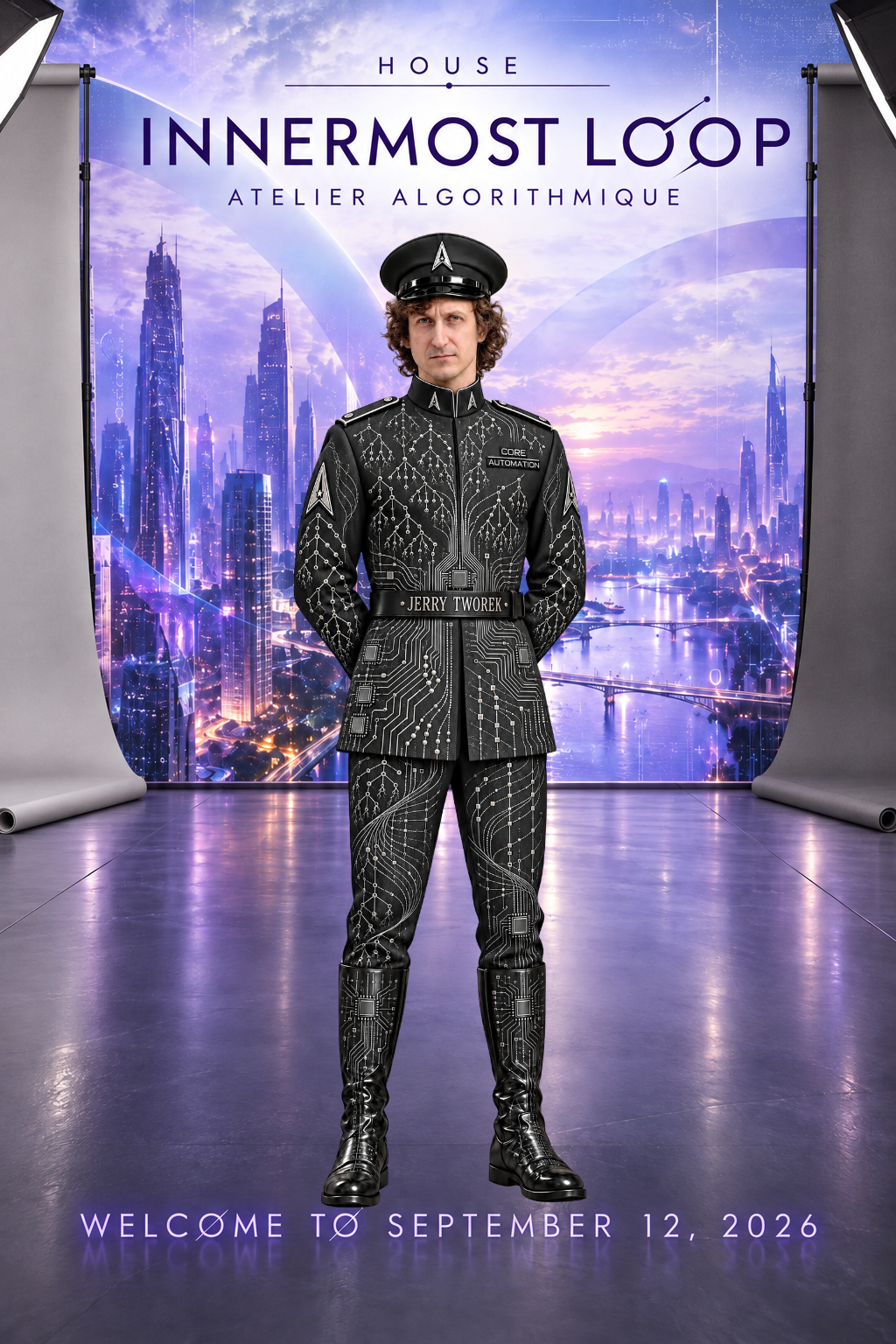
Maison Innermost Loop – Jerry Tworek défile House Innermost Loop – Jerry Tworek Walks Jerry Tworek's tunic grows a forest from circuitry. Across the chest, branching nodes rise from tightly gathered conducting lines. The pattern continues through the lower pan
Read the narration
Maison Innermost Loop – Jerry Tworek défile
House Innermost Loop – Jerry Tworek Walks
Jerry Tworek's tunic grows a forest from circuitry. Across the chest, branching nodes rise from tightly gathered conducting lines. The pattern continues through the lower panels and trousers toward chips embedded in the design of the boots. Their roots are computational routes. The body stands still within them, giving a metaphor of proliferation the controlled outline of a formal studio portrait.
This is SIOUID 142's House Innermost Loop at Atelier Algorithmique response to Dr. Alex Wissner-Gross's September 12, 2026 dispatch on X. The House is an invitation to make fashion abundance a sixteenth moonshot, giving technological ideas a functional and enjoyable public form. Tworek enters the issue through a dark-forest analogy amid discussion of rapidly advancing AI and mathematical discovery. His clothing turns that reference into a particular construction: the forest is made from the architecture of computation itself.
Tworek's background gives those branches a history. OpenAI's published credits list him among the leaders of o1, its series of reasoning models introduced in September 2024. Those models were designed to spend more time working through a problem before responding. The career connection makes the two kinds of linework on his outfit especially fitting. One resembles the paths through which a process develops; the other resembles the hardware that permits those paths to be explored.
A tree diagram begins with a node and divides into further possibilities. It can represent alternatives in a search, a hierarchy of tasks, or a sequence of dependencies. A circuit has another function: its physical connections support the movement and processing of signals. Tworek's garment joins these visual languages without making them identical. The chest offers a proliferation of possible routes, while the dense parallel traces below return that apparent freedom to a manufactured support.
The dark-forest image makes the branching more ambiguous. It suggests an environment where much remains out of view, and where other participants may have aims that are difficult to infer. The newsletter's compressed reference does not supply a complete theory of that environment. The portrait develops its visible possibilities: each branch can be followed locally, yet the whole network exceeds what the eye comfortably holds at once. Complexity becomes a condition of looking before it becomes an argument about machines.
The date gives this metaphor its particular force. The dispatch places extraordinary mathematical claims beside questions about their provenance, then moves toward agents acting through tools and software environments. An agent can pursue a task across successive actions rather than merely return a single answer. In a group, those actions can also affect the situations encountered by other agents. The tiny repeated nodes on Tworek's chest make that multiplication available to the viewer as a pattern with many potential centers of activity.
The diagram also leaves room for an important distinction between connectedness and transparency. A visible line tells us that two points have a relationship; it does not reveal everything passing between them or determine what a participant will do. That is why the forest suits a day concerned with both capability and trust. Its branches are beautifully explicit as ornament, while the behavior they suggest remains something to investigate. The look gives uncertainty an orderly appearance without pretending to remove it.
The chest patch reads Core Automation. It belongs to the identity assigned by the artwork, while Tworek's name is repeated clearly at the belt. This separation allows his history in reasoning research to remain present without turning every emblem into a claim about an employment date. The clothing is a portrait through selected attributes. Its most specific attribute is the passage from branching possibilities to circuits, the act of turning an open field of tasks into processes a machine can carry out.
The officer cut develops the newsletter's Space Force story through playful Star Wars styling. Tworek's computational forest gives the repeated silhouette its own subject. In the runway he stands beneath the mathematical coffee cup; this studio view lets the eye follow the roots down toward their chips, where the proliferating branches meet their manufactured supports.
SIOUID 142's fashion invitation makes that discovery enjoyable. The uniform is disciplined enough to hold the eye; its interior is intricate enough to reward another look. Tworek's contribution to the history of reasoning models becomes a wearable meditation on the growing complexity of the systems around them. The portrait keeps the pleasure of connection beside the work of understanding it, as the forest continues to branch beyond any single path we choose to follow.
Opening the gallery…