70 Clock Galerie / The Innermost Loop Feed Reply Tableaux
Maison Innermost Loop – Andreas Thom défile
House Innermost Loop – Andreas Thom Walks
September 12, 2026
Maison Innermost Loop – Andreas Thom défile House Innermost Loop – Andreas Thom Walks A lock interrupts the geometry of Andreas Thom's uniform. Around it, polyhedral networks, database cylinders, and rows of mathematical notation occupy a black surface edged i
Read the narration
Maison Innermost Loop – Andreas Thom défile
House Innermost Loop – Andreas Thom Walks
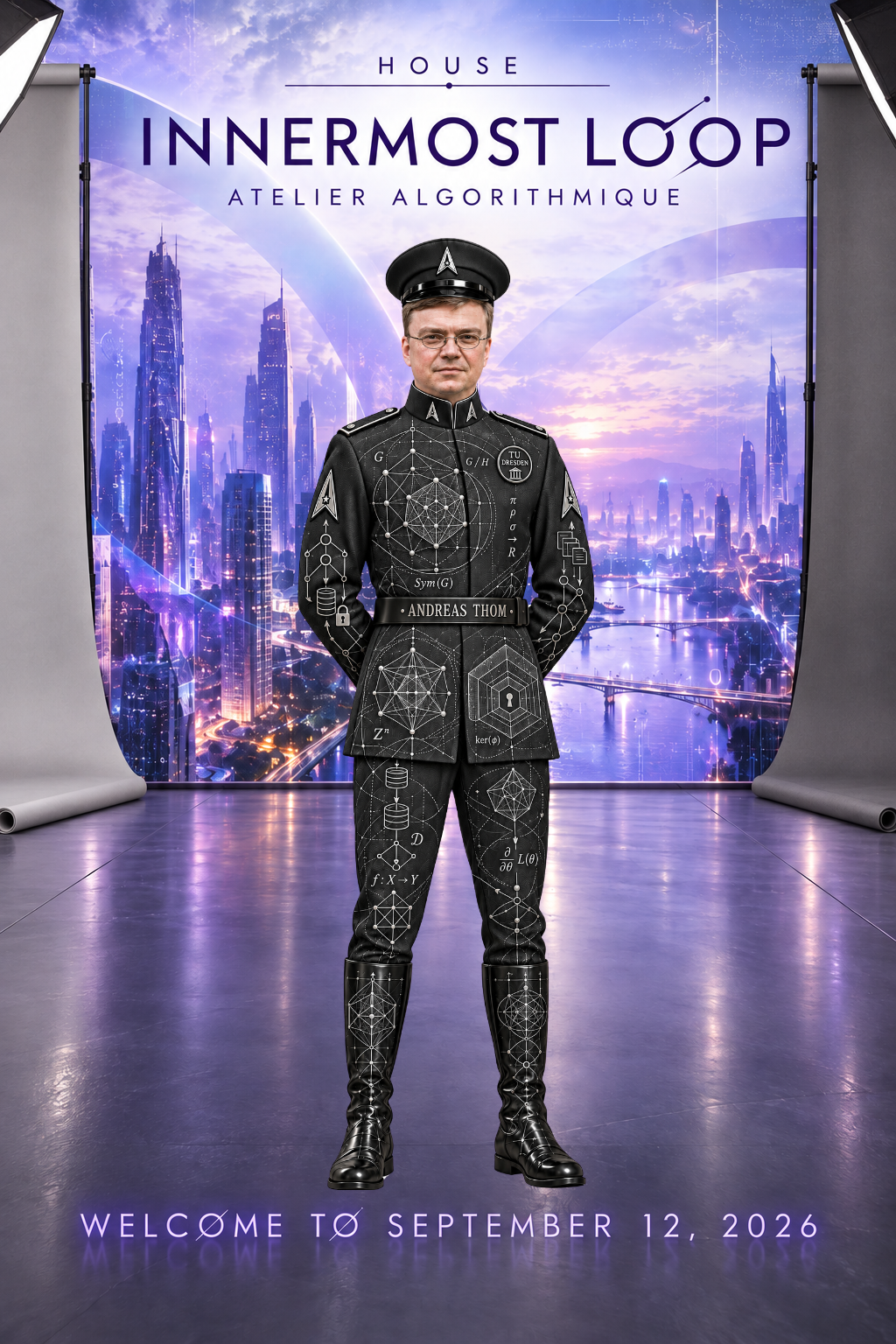
A lock interrupts the geometry of Andreas Thom's uniform. Around it, polyhedral networks, database cylinders, and rows of mathematical notation occupy a black surface edged in silver. Arrows lead from pages toward structures that can store or transform information. The effect begins as intellectual ornament, then becomes more exact: this is a portrait concerned with relationships and with the boundaries through which those relationships are allowed to change.
The work answers Dr. Alex Wissner-Gross's September 12, 2026 Innermost Loop dispatch on X. SIOUID 142 presents it through House Innermost Loop at Atelier Algorithmique, an invitation to add fashion abundance as Wissner-Gross's sixteenth moonshot. Thom appears in the newsletter's discussion of researchers seeking clarity about the possible influence of their inputs on AI systems. His outfit connects that contemporary concern to the mathematical structures that have shaped his career.
Thom holds the geometry chair at the Technical University of Dresden. His research spans geometric group theory, operator algebras, and related areas. These subjects examine structures, operations, and the ways one mathematical setting can be represented within another. The network across his chest is therefore a specific intellectual attribute. Its web of points and connections gives the viewer a starting intuition for a world in which relationships can matter more than the appearance of an individual point.
The letter G and the notation Sym of G introduce the language of groups and symmetry. A group is a collection with an operation satisfying rules that include an identity and inverses. Rotations preserving a geometric figure provide a familiar example. A quotient, suggested by G over H, forms a new structure from an appropriate relation to a subgroup. For this quotient to be a group, the subgroup must be normal. The small symbols offer several routes into the same intellectual habit: specifying which transformations preserve the relationships that define a thing.
Lower down, the notation for a kernel appears near an enclosing geometric form. For a group homomorphism, the kernel consists of elements sent to the identity; it records part of what a transformation collapses. Nearby, an integer lattice suggests a space organized by regularly placed coordinates. These references make the outfit unusually apt for Thom. The cloth presents the study of structure through several kinds of enclosure, mapping, and repetition, while the wearer remains calmly fixed at their meeting point.
The lock introduces a different kind of rule. Mathematical admissibility and human permission are distinct subjects, but the garment brings them close enough to compare. A system may be technically capable of accepting, retaining, or transforming a document; the relationship under which that document was supplied is a further matter. Pages, arrows, and database icons make that distinction available as a visible sequence. The eye can follow the route, then encounter the mark that asks what governs passage.
This is the portrait's connection to the day's dispute over mathematical research inputs. Wissner-Gross places questions about provenance beside extraordinary claims of machine-generated discovery. Provenance means an account of origin and transmission: where material came from and how it reached its present form. Its pages retain separate edges even as arrows draw them toward a larger store, allowing an individual contribution to remain visible within aggregation.
The wider newsletter also describes the importance of training data and the increasing reach of agents. Those themes sharpen the significance of the boundary. As systems become more capable of transforming information into useful results, the path by which information enters them deserves a more precise description. The mathematical diagrams do not settle that question. They provide a disciplined setting in which the difference between an operation and the terms of its use can be seen.
The shared officer cut develops the newsletter's Space Force story through playful Star Wars styling. Thom's university emblem and name belt give it an individual address. In the runway he stands among mathematicians beneath the fluid-equation cup; here the geometry and lock bring the question of permitted transformation into a concentrated encounter.
The House's fashion proposition finds an educational pleasure in this scale change. A viewer can first enjoy the precision of the tailoring, then discover why a quotient, a kernel, and a database belong to different kinds of explanation. Thom is dressed in the rigor of distinctions. The portrait's invitation is to carry that rigor into a world where information moves with growing speed, so that an abundance of transformations can remain accompanied by an intelligible account of their relationships.
Opening the gallery…