70 Clock Galerie / The Innermost Loop Feed Reply Tableaux
Maison Innermost Loop – Tristan Buckmaster défile
House Innermost Loop – Tristan Buckmaster Walks
September 12, 2026
Maison Innermost Loop – Tristan Buckmaster défile House Innermost Loop – Tristan Buckmaster Walks Two histories travel across Tristan Buckmaster's uniform. Vortices turn through the black fabric, while linked pages descend along the sleeves. On one panel, a th
Read the narration
Maison Innermost Loop – Tristan Buckmaster défile
House Innermost Loop – Tristan Buckmaster Walks
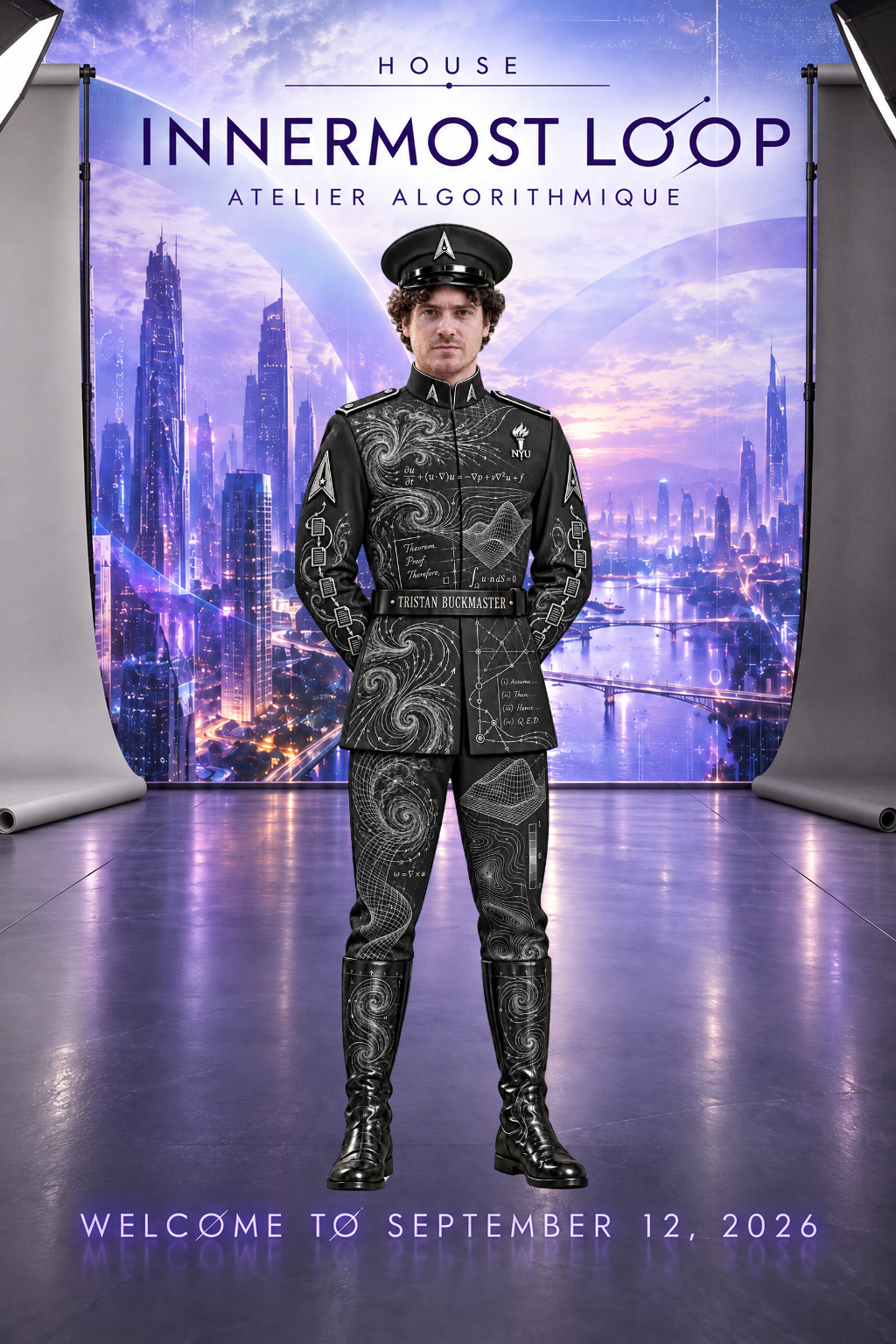
Two histories travel across Tristan Buckmaster's uniform. Vortices turn through the black fabric, while linked pages descend along the sleeves. On one panel, a theorem leads toward a proof; elsewhere, a mesh gives shape to the fluid under investigation. Silver lines make discovery and documentation equally visible. The portrait joins a moving subject to the record of how it was understood.
SIOUID 142 created this look for House Innermost Loop at Atelier Algorithmique, responding to Dr. Alex Wissner-Gross's September 12, 2026 Innermost Loop dispatch on X. The House invites him to make fashion abundance his sixteenth moonshot. Buckmaster's place in the issue concerns both research on fluid singularities and the history surrounding a major AI mathematics announcement. His clothing makes those two subjects meet without allowing the controversy to consume the mathematics.
Buckmaster is a professor at New York University's Courant Institute. His research examines singularity formation, incompressible flows, and wave turbulence. Earlier work used convex integration, a method that can construct unexpectedly irregular solutions, to investigate nonuniqueness in fluid equations. His joint work with Vlad Vicol helped earn the 2019 Clay Research Award. The turbulent ornament belongs to a research life preceding the disputed headline.
The distinction between smooth and weak solutions helps explain that background. A classical solution has the regularity needed to interpret its derivatives in the usual way. A weak solution satisfies an appropriately reformulated version of the equations, allowing less regular behavior. Establishing existence, uniqueness, or smoothness asks different questions about a model. The garment's contrasting surfaces give those distinctions visual room: a neat grid can neighbor an intricate whirl without claiming that both represent the same mathematical condition.
On a trouser leg, notation identifies vorticity as the curl of velocity. Vorticity describes local rotation within a flow, making it especially appropriate beside the spirals. Across the torso, fluid equations coexist with documentary marks, including a sequence ending in Q.E.D., the traditional indication that an argument is complete. The clothing places what is being studied beside the means of establishing a result. Its beauty comes from their interweaving, rather than from treating mathematical symbols as interchangeable decoration.
The newsletter discusses Buckmaster's collaboration with Levent Alpöge on finite-time blowup with smooth forcing in related fluid systems. Their published account credits a program developed by Diego Córdoba and Luis Martínez-Zoroa and describes substantial assistance from language models. It also emphasizes the work needed to turn checked arguments into readable mathematics. The small pages on the sleeves make that labor unusually tangible. A proof travels through drafts, explanations, and other people's scrutiny before it becomes an enduring part of a field.
The record also contains disagreement. Buckmaster described communications with OpenAI and questioned how the company's parallel effort had developed. He explicitly said he did not know whether their data had been used. OpenAI's updated statement says his Codex prompts from the preceding two months could not have influenced its system, including through training. The portrait can preserve these differing accounts without deciding them. Its documentary imagery honors the importance of a traceable history beside a spectacular announcement.
That is why the name across the waist matters as much as the university emblem above it. An affiliation places a researcher institutionally; a name identifies a person whose contribution must be situated among collaborators and predecessors. The pages link individual effort to public knowledge. In the intelligence age, a machine-checked conclusion can arrive quickly while the work of attribution and explanation continues at a different pace.
The officer cut develops the newsletter's Space Force story through playful Star Wars styling. Buckmaster's fluid diagrams and proof pages give the common silhouette his particular history. In the runway he stands beside Alpöge beneath the Navier–Stokes coffee cup; here the individual portrait gives their mathematical context room for closer examination.
This is a fitting form of homage because it restores a career to an event. The listener encounters a researcher already immersed in the difficult behavior of fluids, using new tools within an older mathematical enterprise. SIOUID 142's couture makes that continuity pleasurable to follow. The swirling lines carry the excitement of discovery; the pages carry its memory. Together, they dress a future in which greater capability still leaves room for the human work of understanding how knowledge came to be.
Opening the gallery…