70 Clock Galerie / The Innermost Loop Feed Reply Tableaux
Maison Innermost Loop – Levent Alpöge défile
House Innermost Loop – Levent Alpöge Walks
September 12, 2026
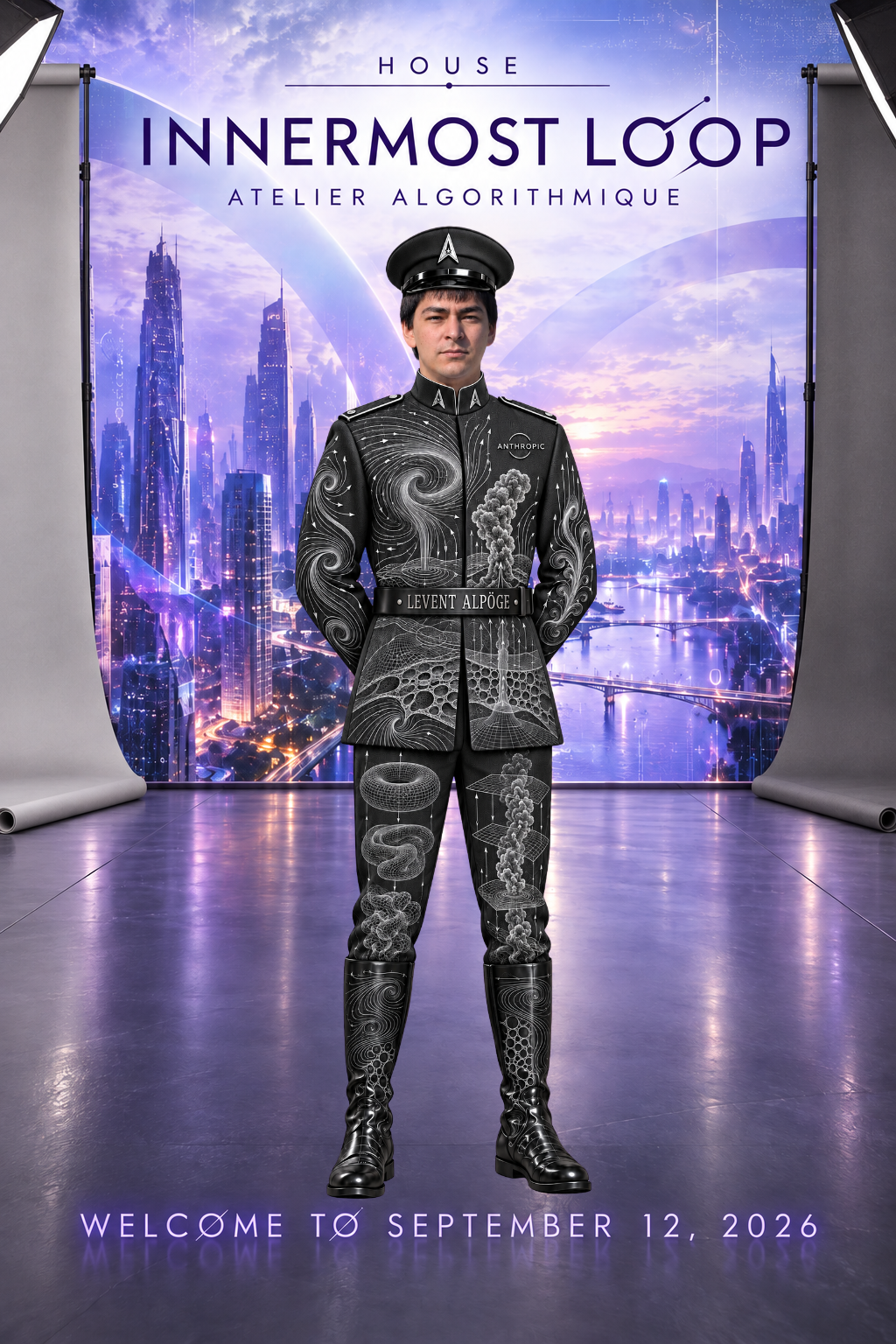
Maison Innermost Loop – Levent Alpöge défile House Innermost Loop – Levent Alpöge Walks Levent Alpöge wears several kinds of motion. A vortex turns across the chest, a plume rises beside it, and porous cells open below the belt. Farther down, mesh surfaces twi
Read the narration
Maison Innermost Loop – Levent Alpöge défile
House Innermost Loop – Levent Alpöge Walks
Levent Alpöge wears several kinds of motion. A vortex turns across the chest, a plume rises beside it, and porous cells open below the belt. Farther down, mesh surfaces twist through changing planes. The narrow black silhouette holds these restless forms with the precision of a scientific plate. At first glance, the clothes seem united by turbulence; closer attention reveals that their unity depends on preserving differences.
The portrait is SIOUID 142's response to Dr. Alex Wissner-Gross's September 12, 2026 Innermost Loop dispatch on X. It belongs to House Innermost Loop at Atelier Algorithmique, the account's invitation to add fashion abundance as a sixteenth moonshot. Alpöge appears because of his collaboration with Tristan Buckmaster on fluid equations. His look makes that contribution distinct within a day dominated by the larger Navier–Stokes announcement.
Alpöge's background makes the breadth of the outfit especially fitting. His Princeton doctorate concerned points on curves; his mathematical work includes number theory and arithmetic statistics, which studies how number-theoretic objects behave across whole families of examples. He also held a junior fellowship in Harvard's Society of Fellows. On his own website, he recalls early work applying graphics hardware to medical computer vision, then a turn toward mathematics, and a return to computing after encountering GPT-4. His subsequent work at Anthropic belongs to that continuing movement between disciplines.
The garment's changing visual regimes can be read through this history. A researcher trained to examine arithmetic structures now contributes to questions about moving fluids with the help of language models. The connection is not that every field uses the same techniques. It is that new tools can change which problems a collaboration is able to approach. The outfit keeps several kinds of structure in conversation, giving intellectual movement a more particular form than a generic circuit pattern could provide.
The three fluid families deserve their distinctions. Incompressible Euler equations describe an idealized fluid without viscosity. Boussinesq systems connect motion to a transported quantity, often representing temperature or density effects. Porous-medium models study flow constrained by a permeable environment. The vortex, rising plume, and open cells give the listener visual entrances to these different assumptions. Changing the assumptions changes the mathematical question, even when every picture seems to depict something flowing.
Alpöge and Buckmaster's work addressed finite-time blowup with smooth forcing in related models. Here forcing means an externally specified influence within the equations. Smoothness describes regularity of that influence; it does not automatically guarantee that the resulting motion remains well behaved. This is why the controlled tailoring suits the subject. Order in one part of a formulation can coexist with extreme behavior elsewhere. The quiet outline and active interior establish that tension before any equation is read aloud.
Buckmaster described their effort as a personal collaboration, using multiple language models and building on a research program developed by Diego Córdoba and Luis Martínez-Zoroa. That history matters beside the affiliation emblem on Alpöge's chest. An employer's symbol identifies one part of a career, while the intellectual path can extend through different people, institutions, and tools. The named belt restores the individual collaborator beneath the corporate shorthand.
The porous cells offer a particularly useful philosophical image. A medium is not simply the empty setting in which something happens; its structure helps determine what passage is possible. So too with research. Available notation, computational tools, and colleagues shape the routes an inquiry can take. This is an analogy drawn from the garment, rather than an equation between social and physical systems. Its appeal comes from making the influence of a surrounding structure visible on a human scale.
The shared officer cut develops the newsletter's Space Force story through playful Star Wars styling. Alpöge stands beside Tao and Buckmaster in the runway, beneath a coffee cup carrying Navier–Stokes notation. This individual view lets the vortex, plume, and lattice retain their differences within that collective mathematical occasion.
Fashion here becomes a modest form of mathematical education. A viewer begins with a swirl and learns why a plume and a porous lattice cannot simply stand in for it. Alpöge's own movement between mathematics and computing gives that lesson a biographical depth. The portrait makes a place for abundance in the multiplicity of approaches: more ways to ask a question, more means of examining it, and more pleasure in keeping the differences legible.
Opening the gallery…