70 Clock Galerie / The Innermost Loop Feed Reply Tableaux
Maison Innermost Loop – Terence Tao défile
House Innermost Loop – Terence Tao Walks
September 12, 2026
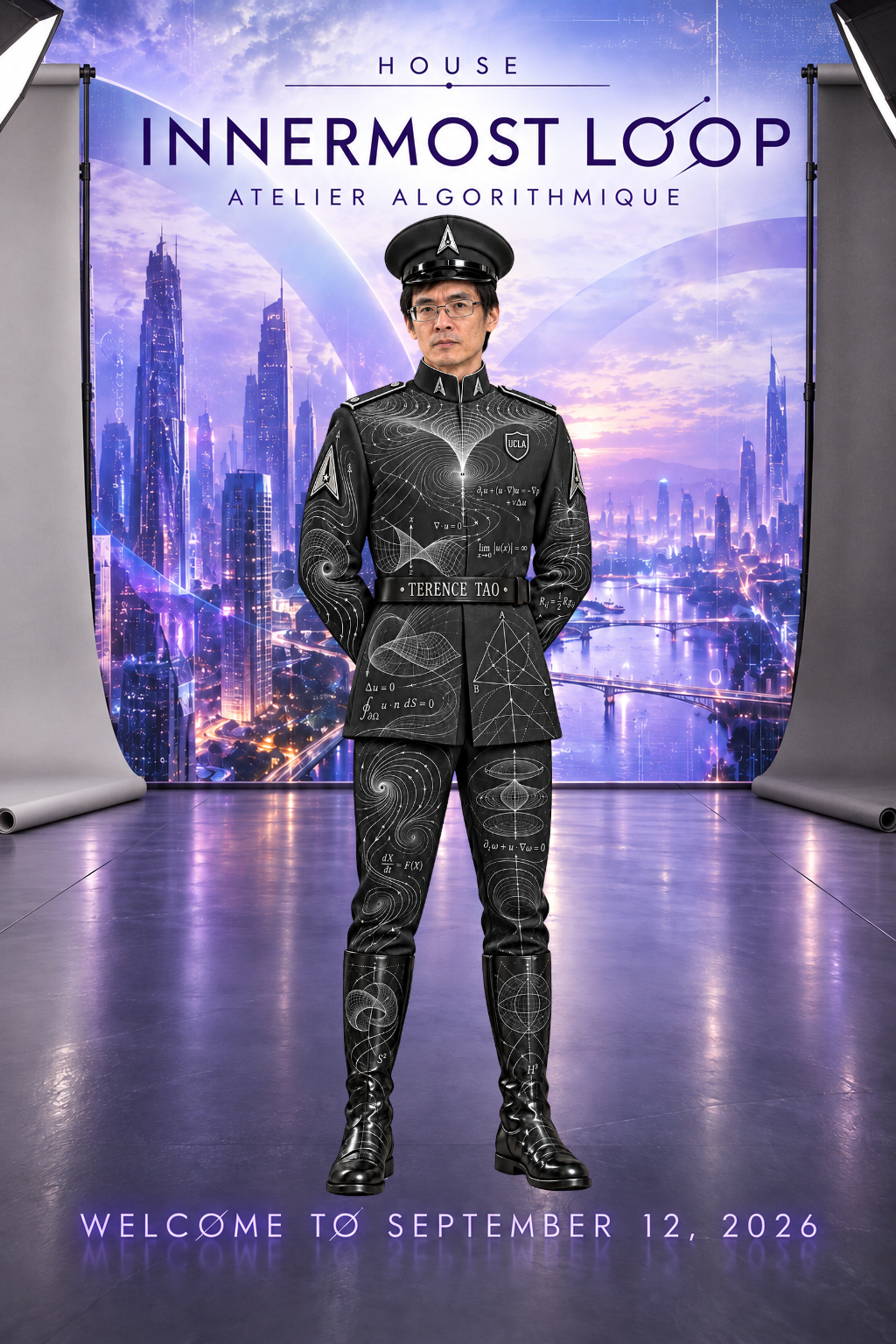
Maison Innermost Loop – Terence Tao défile House Innermost Loop – Terence Tao Walks A narrowing funnel draws the eye into Terence Tao's tunic. Around it, pale contours, geometric constructions, and repeated sections unfold across black cloth. The figure remain
Read the narration
Maison Innermost Loop – Terence Tao défile
House Innermost Loop – Terence Tao Walks
A narrowing funnel draws the eye into Terence Tao's tunic. Around it, pale contours, geometric constructions, and repeated sections unfold across black cloth. The figure remains composed, hands held behind his back; the garment does the demonstrating. What first resembles ceremonial dress gradually becomes an invitation to follow a shape, compare its views, and notice how a difficult idea can become more intelligible through successive representations.
SIOUID 142 created this portrait for House Innermost Loop at Atelier Algorithmique in response to Dr. Alex Wissner-Gross's September 12, 2026 dispatch on X. The account proposes the House as a sixteenth moonshot devoted to fashion abundance, making scientific change visible and enjoyable through clothing. Tao's role in the newsletter concerns mathematical understanding at a moment when machines can produce arguments faster than a community can absorb them. His outfit places explanation at the center of intellectual distinction.
Tao is a UCLA mathematician whose work ranges across harmonic analysis, partial differential equations, combinatorics, and number theory. He received the Fields Medal in 2006. That breadth matters to the portrait because its many geometric languages are held together without becoming one repeated emblem. A curved surface and an arrangement of intersecting lines can illuminate different aspects of a problem.
His public research blog adds another dimension to this history. Mathematical expertise there becomes an ongoing practice of exposition: setting out a question, locating it among related results, and explaining the distinctions on which an argument depends. In the dispatch, his discussion of Alpöge and Buckmaster's work helps readers approach several fluid equations. The portrait honors that orienting labor. Its diagrams make a place to begin, rather than simply announcing that the wearer already knows the answer.
The funnel evokes singularity formation. In this context, blowup means that a relevant mathematical quantity ceases to remain bounded in finite time under the problem's assumptions. It need not mean a physical explosion. The shape offers an intuition of increasing concentration, while the surrounding grids suggest ways to examine that intuition.
The issue places such explanation beside the distinction between a formal certificate and a readable proof. Lean checks arguments expressed within its formal language. A successful check is a powerful form of logical assurance, but a researcher may still need to discover why the construction works and what it makes possible next. The garment's repeated cross-sections can be read as stages in that further work. Each returns to a related form, changing the angle from which it becomes available.
Tao's concern, reported in the newsletter, that good problems are a nonrenewable resource gives these images another resonance. A problem can organize a community's attention over decades, teach techniques, and provide a setting in which new ideas emerge. Once solved, it acquires a different role. This does not end mathematical discovery; it changes the work of choosing what deserves attention. The portrait's richness resides in the paths around its central funnel as much as in the apparent destination at its narrowest point.
That distinction makes the academic dress code a playful choice. The peaked cap and precise shoulder lines suggest a settled hierarchy, while the mathematical surface keeps opening questions. Tao's name is fixed across the waist; the intellectual territory associated with it remains expansive. The outfit allows recognition and curiosity to coexist. Someone who knows only his reputation can begin with the person, then discover that the clothes encourage a more patient encounter with his practice.
The officer cut develops the newsletter's Space Force story through playful Star Wars styling. Tao's diagrams give that shared silhouette an exact intellectual character. The divergence-free condition on the tunic expresses incompressibility: locally, fluid is not being created or accumulating through compression. A nearby Laplace equation concerns another condition. The Laplacian adds second spatial derivatives, measuring local variation around a point in the field. Their coexistence invites the viewer to distinguish the symbols, just as exposition distinguishes related problems.
The portrait's philosophical interest lies in this redistribution of attention. If answers become easier to generate, comprehension may acquire a different kind of value: the ability to connect a result to a body of knowledge and to another person's understanding. The silver lines make that possibility attractive without making it effortless. Tao is clothed in the routes by which a difficult subject becomes shareable, and the pleasure of the look belongs to the pleasure of beginning to see.
Opening the gallery…