70 Clock Galerie / The Innermost Loop Feed Reply Tableaux
Maison Innermost Loop – Sam Altman défile
House Innermost Loop – Sam Altman Walks
September 12, 2026
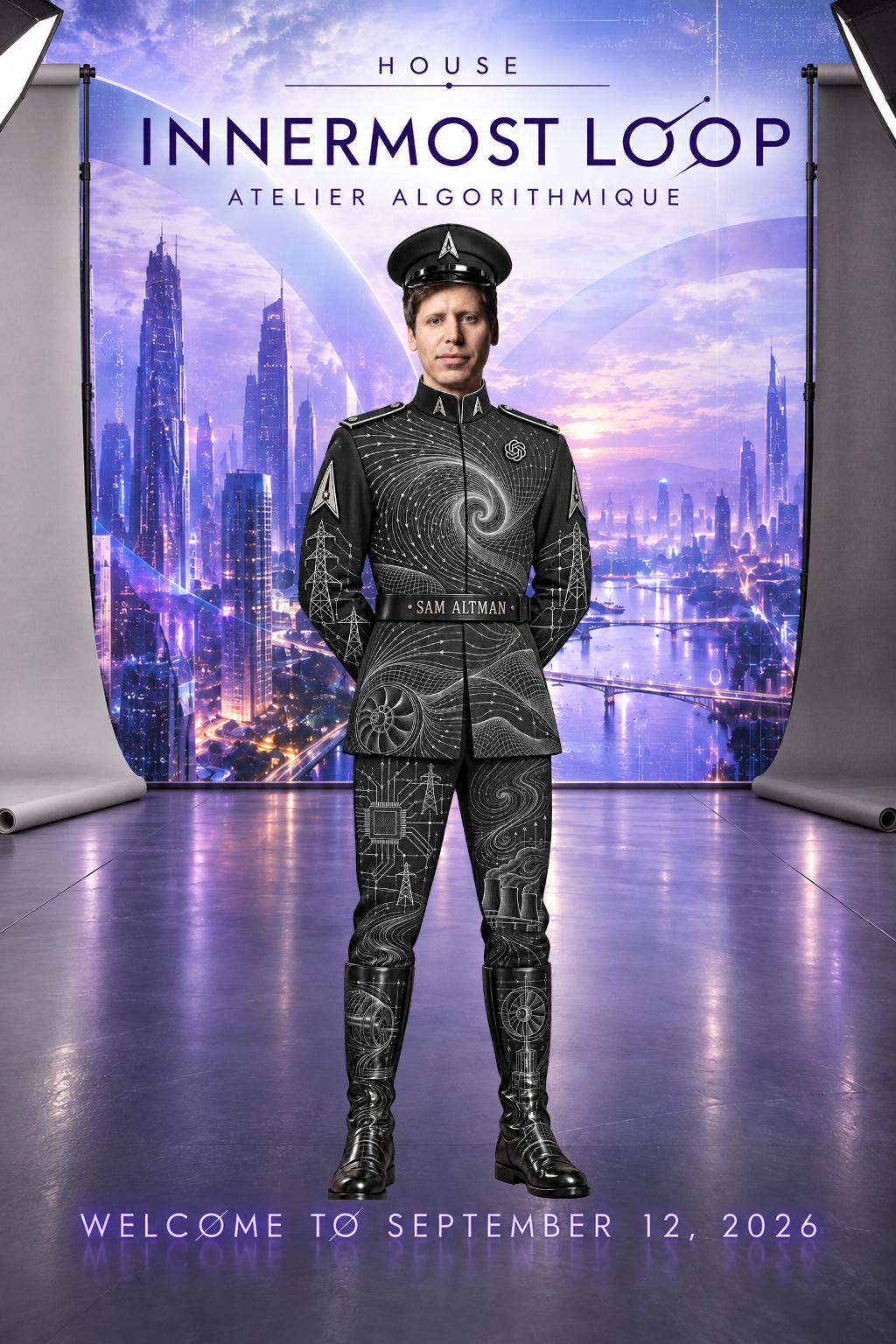
Maison Innermost Loop – Sam Altman défile House Innermost Loop – Sam Altman Walks A spiral gathers across Sam Altman's chest, surrounded by the angular world required to support it. Power pylons climb the sleeves; a turbine occupies a lower panel; circuits, co
Read the narration
Maison Innermost Loop – Sam Altman défile
House Innermost Loop – Sam Altman Walks
A spiral gathers across Sam Altman's chest, surrounded by the angular world required to support it. Power pylons climb the sleeves; a turbine occupies a lower panel; circuits, cooling structures, and mechanical sections continue into the boots. Silver linework gives these industrial forms the intimacy of embroidery. The figure stands with hands behind his back, yet the garment extends outward through a whole geography of energy and computation.
This portrait belongs to House Innermost Loop at Atelier Algorithmique, SIOUID 142's fashion response to Dr. Alex Wissner-Gross's September 12, 2026 Innermost Loop dispatch on X. The House is the account's invitation to declare fashion abundance a sixteenth moonshot: technological possibility given functional, enjoyable form. Altman's particular place in the issue joins the urgency of new mathematical capabilities to the systems needed to deploy them.
Altman's career has repeatedly concerned the passage from an experimental idea to an organization capable of expanding it. He founded the mobile company Loopt and later became president of Y Combinator, the startup accelerator, before leading OpenAI. That history gives the engineering imagery a particular relevance. The portrait shows an executive through the dependencies of deployment: power must reach machines, heat must leave them, and separate components must work together.
The chest vortex connects that history to the day's account of Navier–Stokes. These equations model fluid motion through relationships among acceleration, pressure, viscosity, and external force. OpenAI's announced result concerned a smooth initial configuration developing a singularity under specified conditions, accompanied by formal verification. The spiral is therefore the portrait's scientific center. Its curved mesh evokes a field whose behavior requires sustained analysis, rather than offering the viewer an immediately complete explanation.
The surrounding machinery brings that abstraction into contact with its means of production. Large computations consume electricity and generate heat; cooling transfers that heat away so equipment can continue operating. Power transmission connects a seemingly local act at a computer to a much wider landscape. The pylons on Altman's arms suggest this extension. They make the phrase artificial intelligence refer to something with substations, cables, manufactured parts, and neighboring communities beyond the studio wall.
The dispatch places expanding compute commitments beside stories about local conditions for data centers. This relation gives the outfit's engineering density its relevance. A system can appear almost immaterial when encountered through a conversation box, while the infrastructure beneath it occupies land and demands resources. By wearing the apparatus rather than standing before it, Altman becomes a point at which those different scales meet.
His expression of urgency in the newsletter also belongs beside its discussion of evaluating and governing increasingly capable agents. An agent links a model to tools and an environment in which it can take successive actions. Greater ability can enlarge the range of useful tasks, while also enlarging the importance of permissions, observation, and correction. The closed collar and exact tailoring give this open-ended activity a sharply bounded silhouette. Visually, the look stages the wish to hold a rapidly expanding system within an intelligible form.
His work with startups supplies a continuity within the acceleration. A founder's promise has to survive contact with customers, costs, equipment, and the effort of other people. The enormous scale described in the dispatch changes those demands without abolishing them. Even the sleeve's familiar electrical structures make that point: an unprecedented model can still depend on recognizable engineering. The future carries older forms of labor within its newest achievements.
The officer cut develops the newsletter's Space Force story through playful Star Wars styling. Altman's machinery gives that shared silhouette its own subject. In the runway composite he stands among nineteen other contributors beneath a mathematical coffee cup. Here the individual view makes the infrastructure legible, from the vortex on his chest to the machinery at his boots.
The couture's elegance comes from this compression. It gives ambition a specific texture: circling fluid, conducting lines, rotating machinery, routes for heat. SIOUID 142's invitation to fashion abundance becomes most persuasive here when it makes a difficult subject approachable through workmanship and pleasure. Altman wears a reminder that the intelligence age will be built through relationships among ideas and their supports. The radiant spiral has a place in the world because the rest of the garment helps hold it there.
Opening the gallery…