70 Clock Galerie / The Innermost Loop Feed Reply Tableaux
Maison Innermost Loop – Noam Brown défile
House Innermost Loop – Noam Brown Walks
September 12, 2026
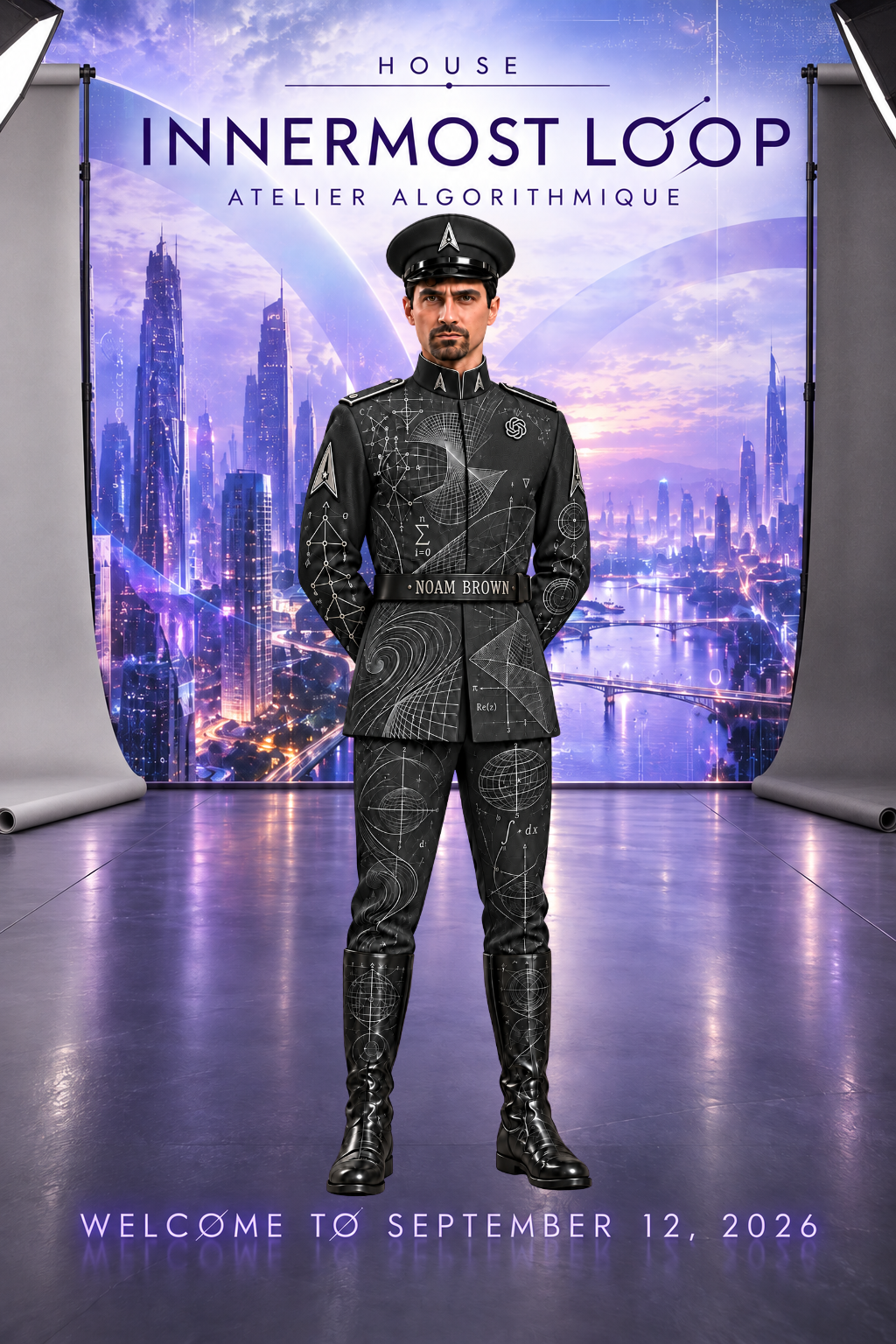
Maison Innermost Loop – Noam Brown défile House Innermost Loop – Noam Brown Walks Noam Brown's clothing appears to think while its wearer remains still. Silver branches divide across the black tunic, spreading into curved wireframes and networks. The cap, clos
Read the narration
Maison Innermost Loop – Noam Brown défile
House Innermost Loop – Noam Brown Walks
Noam Brown's clothing appears to think while its wearer remains still. Silver branches divide across the black tunic, spreading into curved wireframes and networks. The cap, closed collar, and polished boots give the figure a ceremonial outline; the lines within that outline keep choosing new directions. His name anchors these possibilities to a career. The garment turns reasoning into an attribute that can be worn.
The portrait responds to Dr. Alex Wissner-Gross's September 12, 2026 Innermost Loop dispatch on X. SIOUID 142 presents Brown through House Innermost Loop at Atelier Algorithmique, an invitation to make fashion abundance Wissner-Gross's sixteenth moonshot. Brown enters this day's newsletter through his expectation that mathematical capabilities of extraordinary power might become accessible for twenty dollars a month within a year.
Brown's route to advanced reasoning passed through games in which the relevant information is incomplete. During his Carnegie Mellon doctorate, he and Tuomas Sandholm developed Libratus and Pluribus, systems that defeated leading poker players. Poker requires decisions without seeing an opponent's cards, so the problem includes uncertainty about what other participants know and intend. The branching marks on the outfit are particularly apt for this background: each visible route implies alternatives, including routes left unexplored.
At Meta's research laboratory, Brown also helped develop CICERO, an AI system that combined strategic reasoning with natural-language negotiation in Diplomacy. At OpenAI he became a foundational contributor to reasoning models such as o1. Across these settings, intelligence involves more than producing a fluent sentence. It includes considering consequences, allocating effort, and adapting an action to a situation. The clothing's circuits and decision structures give those less visible activities the prominence usually reserved for a portrait's face.
A branch is a useful introduction to search. At a given stage, a system may consider several possible next steps, evaluate their consequences, and concentrate further computation where it seems promising. Reinforcement learning can improve a strategy through feedback from outcomes. The common question is how to spend limited effort well. The lines across his sleeves make thought look patient and distributed.
His forecast appears beside the dispatch's account of an AI-generated mathematical proof and the work of researchers trying to understand related fluid equations. The important distinction is between obtaining a result and making its reasoning available for inspection. In a formal proof assistant such as Lean, an argument must be represented with sufficient precision for the system to check its logical steps. The garment's orderly meshes suggest this wish to make a difficult passage traversable, while its branching paths retain the uncertainty of discovery.
Inexpensive access changes who may enter that passage. A student outside a major research center could acquire tools that once required unusual institutional resources. Yet the ability to summon assistance would still leave questions to formulate and explanations to assess. Brown's portrait can be read as an image of this redistribution of intellectual equipment. The elaborate surface belongs to a named researcher, but the prospect described in the newsletter is that some of its powers may cease to be scarce possessions.
There is a biographical echo in another of the day's stories. Before his doctoral research, Brown worked on algorithmic trading and at the Federal Reserve Board. Wissner-Gross's own header tableau shows a fly confronting financial charts, following experiments that connected a modeled fly nervous system to trading signals. The connection makes the day's juxtaposition unusually playful: market decisions and game decisions return in altered bodies. Neither an insect interface nor a beautiful diagram establishes profitable judgment; both make us reconsider how decisions are constructed.
The shared officer cut develops the newsletter's Space Force story through playful Star Wars styling. Within it, Brown's mathematical marks become unusually specific. Sigma denotes a sum; the gradient points toward the direction of steepest increase in a scalar field; Re of z selects the real part of a complex number. These belong to different mathematical operations. Together with the branches, they make a varied vocabulary of reasoning visible.
Its branching structure belongs to the history that brought Brown into the newsletter, and its refinement gives the promised abundance an inviting form. The question it leaves with the listener is how widely the capacity for sustained reasoning can be shared. On this surface, the future does not arrive as a single answer. It opens, line by line, into further possible paths.
Opening the gallery…