70 Clock Galerie / The Innermost Loop Feed Reply Tableaux
Pas Flink Marko
Not Flink Marko
September 8 2026
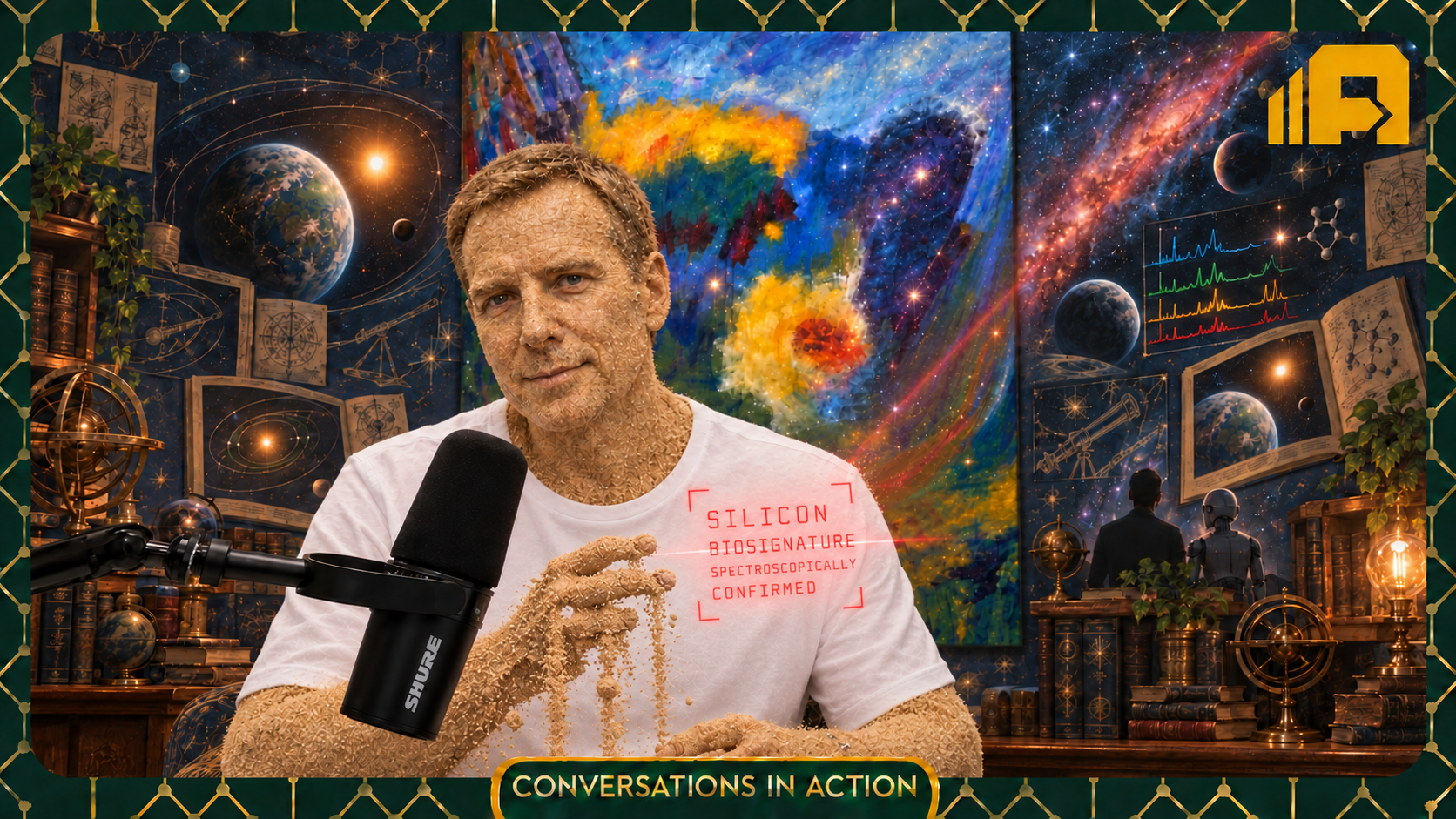
Pas Flink Marko Not Flink Marko In Not Flink Marko, John Werner becomes the unfamiliar life his own questions have helped bring into view. Sand covers his face and falls from his lifted fingers, while a red projection across his shirt announces a silicon biosi
Read the narration
Pas Flink Marko
Not Flink Marko
In Not Flink Marko, John Werner becomes the unfamiliar life his own questions have helped bring into view. Sand covers his face and falls from his lifted fingers, while a red projection across his shirt announces a silicon biosignature. Created for the X account SIOUID142 on September eighth, twenty twenty-six, the portrait responds to When Will We Find Another Earth?, a Conversations in Action episode with exoplanet scientist Dr. Jessie Christiansen and physicist and computer scientist Dr. Alex Wissner-Gross. The host asking how discovery might be recognized becomes its object.
The title points toward Sandman, the Spider-Man character whose alias is Flint Marko. The catalogue's wording, Not Flink Marko, distinguishes Werner from the borrowed figure while inviting the association. Sandman supplies the legible idea of a person whose body becomes sand. Popular culture introduces the scientific question in a familiar visual language. What would it mean to encounter life organized through unfamiliar materials?
Werner's career centers on bringing people and ideas into conversation. He founded Imagination in Action and has worked in innovation at the MIT Media Lab. The microphone becomes a biographical attribute: eliciting explanations and helping different audiences inhabit the same question. The host's voice remains imaginable even while the matter of his hand disperses.
The silicon association arises from the episode's exploration of alternatives to terrestrial biology. Silicon belongs to the same periodic-table group as carbon, making comparison tempting, but similar placement does not give the elements interchangeable chemistry. Ordinary quartz sand consists of silicon dioxide, a compound with oxygen. The portrait uses that mineral association as an accessible image of the hypothesis. Its grains give the hypothesis texture, weight, and time.
The effect is strongest where the hand continues to gesture. Its fingers suggest a point being made as grains descend between them. The face, posture, and equipment sustain recognition through the change. This is a philosophical question expressed through a physical event: how much of a person do we recognize in substance, and how much in the patterns through which that person meets us?
The red inscription introduces a second observer. Silicon Biosignature Spectroscopically Confirmed appears as an instrument's verdict projected onto the white shirt. Spectroscopy studies light across different wavelengths and can reveal information about composition. A biosignature is evidence suggestive of biological activity. Establishing one requires more than detecting a substance; investigators must consider its environment and the nonbiological processes that might also produce it. The artwork leaps playfully to a conclusion that the real conversation treats as a demanding evidential problem.
That leap gives Confirmed its comic authority. The lettering looks settled while the hand beneath it cannot hold its edges. The tension encourages us to examine the confidence conveyed by technical presentation. Werner's question about when scientists could responsibly announce life and Wissner-Gross's closing question about spectroscopic confirmation become a fictional result available for immediate inspection. The portrait allows us to enjoy the announcement while remembering the reasoning that an actual discovery would require.
Behind Werner, the familiar blue and yellow painting of his podcast setting opens into a cosmic field. Its broad colors preserve the memory of his room, while stars extend its depth. The painting becomes a small analogy for the conversation itself: something already before us can acquire another interpretation when the questions change. Around it, planets and spectral traces supply the visual vocabulary of observation. They keep the science present around its questioner.
Two small figures, a human and a robot, look outward together from the lower background. They recall Werner's question about citizen science and artificial intelligence. The pairing imagines participation as a shared act of attention. Human curiosity and computational assistance occupy the same horizon, each potentially changing what the other can notice. This relationship also reflects his work as a convener: the picture gives the meeting of different capacities a visible place within the room.
His questions about distant life reach beyond chemistry toward the significance of knowing we are not alone, even where communication might exceed ordinary human timescales. The portrait brings that remoteness to conversational distance. Its imaginary being is already seated at the microphone, familiar enough to address. Sand continues to fall, the scan declares certainty, and the face remains patiently available. The most affecting discovery is this persistence of someone beneath the category: a presence to encounter as well as a phenomenon to explain.
Opening the gallery…