70 Clock Galerie / The Innermost Loop Feed Reply Tableaux
Docteur Méthane, Chasseur d’Exoplanètes
Exoplanet Hunter Doctor Methane
September 8 2026
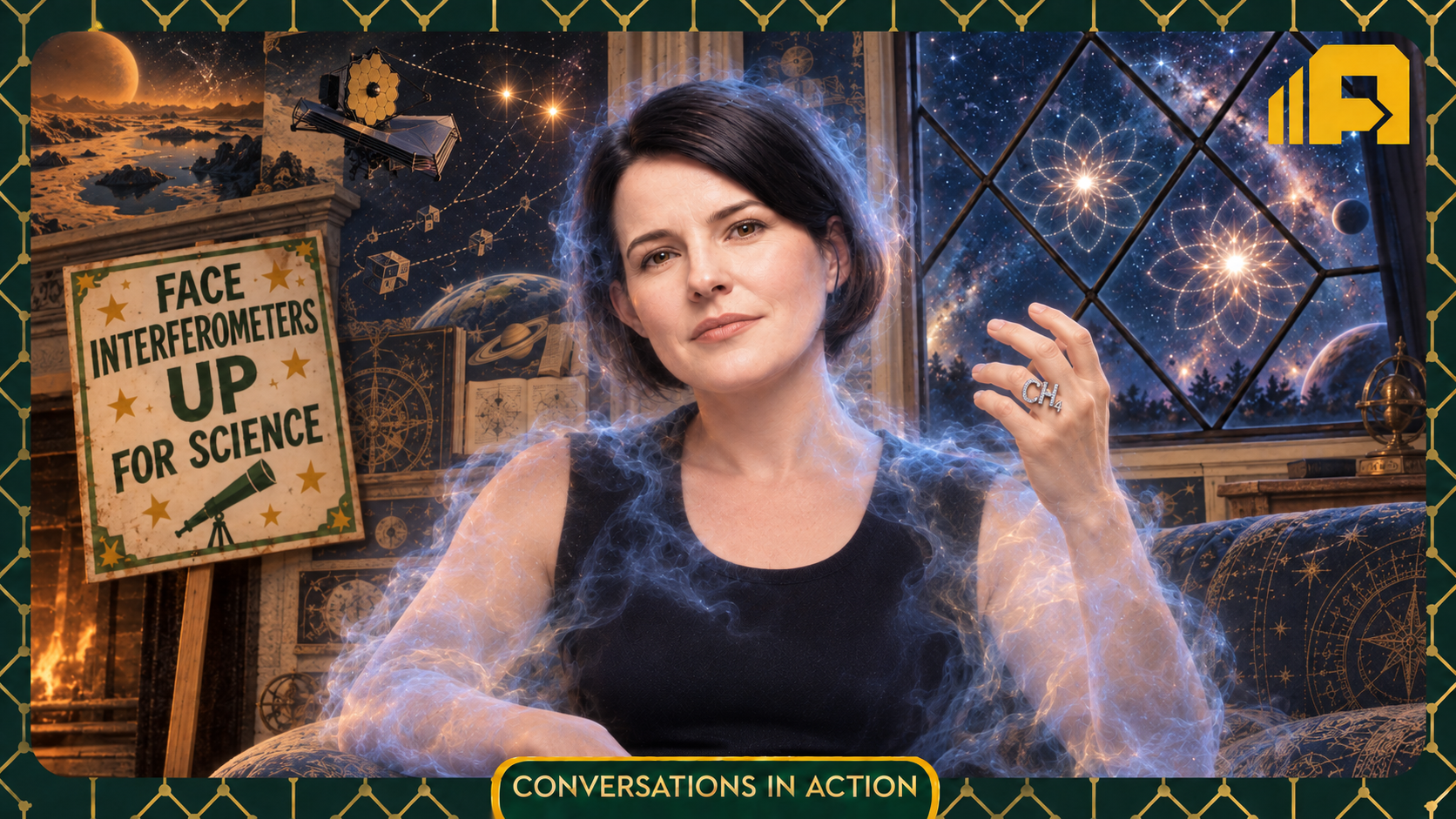
Docteur Méthane, Chasseur d’Exoplanètes Exoplanet Hunter Doctor Methane Exoplanet Hunter Doctor Methane transforms Dr. Jessie Christiansen into an intimate embodiment of the worlds she helps us imagine. The astrophysicist sits within a blue atmosphere, her lik
Read the narration
Docteur Méthane, Chasseur d’Exoplanètes
Exoplanet Hunter Doctor Methane
Exoplanet Hunter Doctor Methane transforms Dr. Jessie Christiansen into an intimate embodiment of the worlds she helps us imagine. The astrophysicist sits within a blue atmosphere, her likeness clear while vapor loosens the boundaries of her shoulders and arms. Created for the X account SIOUID142 on September eighth, twenty twenty-six, this portrait responds to When Will We Find Another Earth?, an episode of Conversations in Action in which she joins Dr. Alex Wissner-Gross and host John Werner. The expert in finding unfamiliar worlds has become one herself.
An exoplanet is a planet orbiting a star beyond our Sun. Christiansen's work has helped turn such worlds from exceptional discoveries into populations that can be studied and compared. She is chief scientist of the NASA Exoplanet Science Institute at Caltech's IPAC, and her research includes data from Kepler's extended K2 mission and the Transiting Exoplanet Survey Satellite, known as TESS. Her expertise includes what a survey might have missed, placing this fantasy beside a career devoted to evidence.
Doctor Methane names a particular possibility raised in the conversation. On Earth, water provides the liquid environment for the chemistry of life. Could another solvent sustain a different biology under different conditions? Saturn's moon Titan, with surface liquids including methane and ethane, makes the question concrete. Methane contains carbon; imagining it in place of water does not automatically imply life without carbon. Non-aqueous life asks us to reconsider the medium of living processes.
Her ring makes the chemistry personal. C H four, sparkling across her lifted fingers, denotes a molecule containing one carbon and four hydrogen atoms. Portrait jewelry has long connected a sitter with loyalties, affiliations, and remembered attachments. Here it attaches the scientist to an idea, worn with the ease of something thoroughly understood. Her gesture suggests an explanation still unfolding.
The surrounding blue vapor performs a different task. Methane itself is colorless, and the scientific proposal concerns a possible liquid solvent. The image gives that invisible chemical association an expressive atmosphere. It lets the body extend into the room while preserving the person. The portrait turns an alien-life question into a meeting with someone, replacing remoteness with the scale of a conversation.
At the window, two radiant flowers carry a more exact connection to her research. Her mission concept SHERA stands for Searching for Habitable Exoplanets with Relative Astrometry. Astrometry measures stellar positions; relative astrometry compares them with one another. An orbiting planet can produce a tiny motion in its star, and nearby multiple-star systems offer possibilities for extraordinarily precise comparisons. SHERA proposes using shaped diffraction patterns to make such measurements. The artwork translates that account into stellar blossoms held within the window's dark geometry.
The flowers bring a method of discovery into the portrait's architecture. Christiansen's involvement in planning future observatories, alongside her work with existing surveys, gives this detail a biographical force: past observations become the experience from which better questions and instruments are designed. The view beyond the window is both a cosmic prospect and a suggestion of the patient measurements needed to reach it.
The placard at the left turns patience into advocacy: Face Interferometers Up for Science. It playfully condenses the episode's exchange about commercial space activity and the possibility of directing more of its capacity toward astronomy. An interferometer combines signals from separated instruments; doing so in space requires demanding coordination. The sign enlarges a complex proposal into a public imperative. Its domestic placement makes it look like a cause brought home, an artistic invention that gives research priorities a human presence.
Up is the crucial word. It asks what growing technical capability should be for. Earth observation has considerable value, yet a civilization surrounding itself with instruments can also choose to widen their scientific horizon. The scientist's altered body and her placard express complementary ambitions: be open to unfamiliar forms of life, and build the means to investigate them. One expands the imagination; the other asks for attention, resources, and practical work.
The calm face holds these ambitions together. The cosmic charts, chemical jewel, and flowered stars return us to a career spent making distant possibilities answerable to observation. Humor makes that discipline approachable. For a moment, the planet hunter becomes the nearest strange world, and the viewer is invited to greet discovery with both delight and the willingness to learn what would count as evidence.
Opening the gallery…