70 Clock Galerie / The Innermost Loop Feed Reply Tableaux
Docteur Plasma aux Chips Croustillantes
Doctor Plasma Potato Chip Crisps
September 8 2026
Docteur Plasma aux Chips Croustillantes Doctor Plasma Potato Chip Crisps Doctor Plasma Potato Chip Crisps turns Dr. Alex Wissner-Gross's intellectual curiosity into a wonderfully improbable appetite. Electrical filaments cross his face and hand as he lifts a p
Read the narration
Docteur Plasma aux Chips Croustillantes
Doctor Plasma Potato Chip Crisps
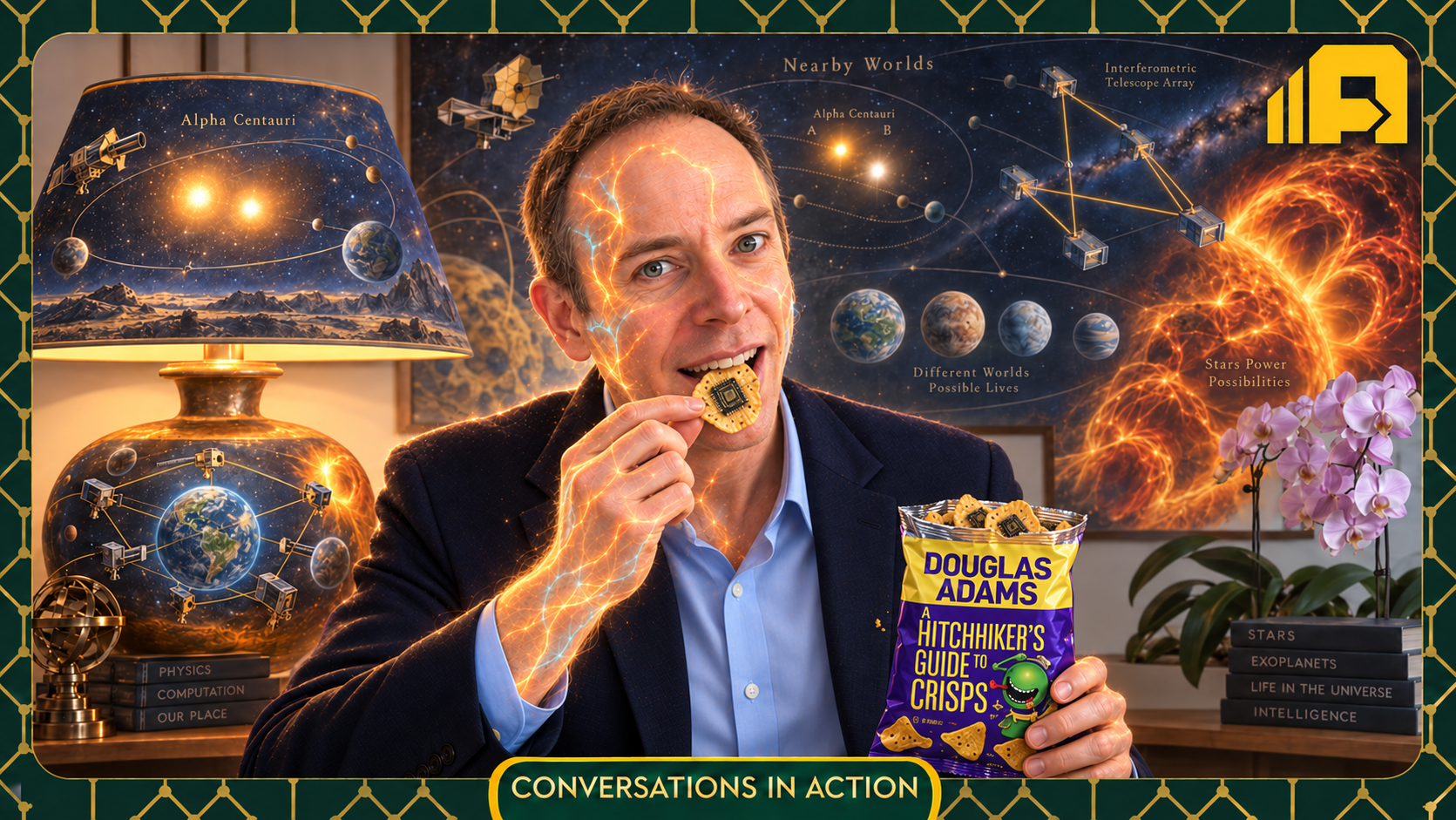
Doctor Plasma Potato Chip Crisps turns Dr. Alex Wissner-Gross's intellectual curiosity into a wonderfully improbable appetite. Electrical filaments cross his face and hand as he lifts a potato crisp containing a miniature computer chip. Made for the X account SIOUID142 on September eighth, twenty twenty-six, the portrait responds to When Will We Find Another Earth?, a Conversations in Action episode with exoplanet scientist Dr. Jessie Christiansen and host John Werner. Its extravagance joins unfamiliar life, space telescopes, artificial intelligence, and Douglas Adams.
The ungainly abundance of the title is part of its charm. Doctor acknowledges scientific authority; plasma exchanges ordinary bodily matter for an ionized state; potato chip crisps piles American and British snack vocabulary onto the ambiguity of a chip. The thinker probing the universe appears ready to bite into computational hardware.
Wissner-Gross's history makes the fusion especially apt. At MIT he studied physics, mathematics, and electrical science and engineering; his doctorate at Harvard explored territory including machine learning and programmable matter. His subsequent work brings artificial intelligence into contact with physical systems. The circuitry embedded in the crisp can therefore be read as an affectionate compression of a career: the mathematical, the electronic, and the material arrive together at the mouth. His questions repeatedly cross the borders separating those disciplines.
In the episode, he pushes speculation beyond terrestrial chemistry toward the possibility of organized life in plasma. Plasma contains electrically charged particles whose collective behavior is shaped by electromagnetic fields. Stars give us familiar examples of this state of matter. Whether anything resembling life could arise within it remains a speculative question. The portrait grants that question his own face. Fine orange and blue pathways illuminate the forehead, cheek, and fingers without consuming the likeness. Recognition survives, inviting us to consider whether the identity of a mind need depend on the material we expect beneath its skin.
The packet supplies the human scale. Douglas Adams's name crowns A Hitchhiker's Guide to Crisps, an adaptation of The Hitchhiker's Guide to the Galaxy. Christiansen's allusion to the corner-shop journey and the enormity of space prompts Wissner-Gross's appreciation of Adams. The bag makes literary memory tangible; the hybrid snack makes the wordplay visible.
Adams's disproportion between vast systems and ordinary inconvenience is particularly appropriate here. An interstellar perspective can make everyday desires seem absurd, yet those desires provide a scale through which people begin to imagine immensity. This scientist of plasma still wants a snack. It also makes curiosity seem nourishing: a new idea is something he appears ready to take in, test, and enjoy.
The lamp develops the episode's argument through a different transformation. Its shade carries an imagined Alpha Centauri panorama, while its rounded base surrounds Earth with cooperating spacecraft. One surface addresses nearby worlds; the other addresses the infrastructure from which we might study them. These are interpretive murals, not an inventory of discovered planets. Their placement is precise: an object that illuminates a room becomes an image of devices that collect light across space. Familiar domestic architecture supports an enlarged scientific horizon.
Behind him, the interferometric telescope array extends that thought. Combining signals from separated collectors can reveal information beyond the reach of an individual instrument, provided demanding requirements of alignment and timing can be met. The picture gives visual form to his question about directing growing space capability toward discovery. Its network echoes the paths across his skin: observation and organization share a visual language.
The deepest connection is to the problem of recognizing what nobody has yet learned to expect. More observations help only if the search can make sense of their surprises. His interest in artificial intelligence enters here as a possible means of exploring unfamiliar physical signatures and connections across specialties. The microchip crisp condenses that ambition into comedy. Meanwhile, the orchid beside him supplies life in a form everyone recognizes, patiently flowering beside a hypothesis no one has demonstrated.
The work's warmth comes from holding expertise, speculation, and play in the same expression. The Innermost Loop, Wissner-Gross's daily dispatch on technological change, gives this portrait a wider intellectual neighborhood: increasing capability should enlarge what people can discover and enjoy. Here the intelligence age acquires neither a slogan nor a monument, but a curious face, a radiant hand, and a very peculiar bite.
Opening the gallery…