70 Clock Galerie / The Innermost Loop Feed Reply Tableaux
Vie Non Aqueuse
Non-Aqueous Life
September 8 2026
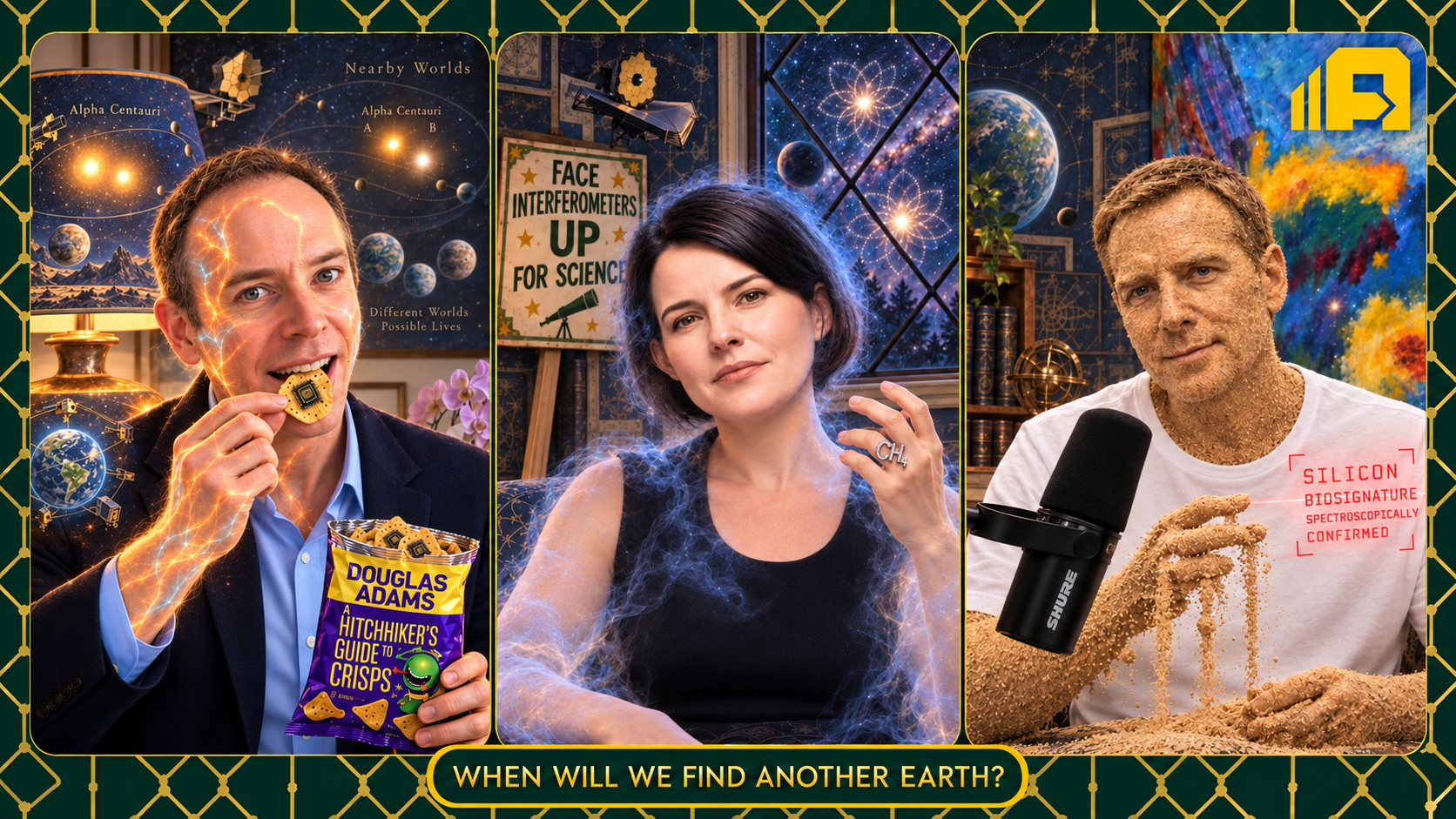
Vie Non Aqueuse Non-Aqueous Life In Non-Aqueous Life, a scientific conversation becomes a portrait of its own possibilities. Physicist and computer scientist Dr. Alex Wissner-Gross glows with electrical filaments; exoplanet astrophysicist Dr. Jessie Christians
Read the narration
Vie Non Aqueuse
Non-Aqueous Life
In Non-Aqueous Life, a scientific conversation becomes a portrait of its own possibilities. Physicist and computer scientist Dr. Alex Wissner-Gross glows with electrical filaments; exoplanet astrophysicist Dr. Jessie Christiansen is edged in blue vapor; host John Werner sheds sand from his fingers. Created for the X account SIOUID142 on September eighth, twenty twenty-six, this tableau responds to When Will We Find Another Earth?, an episode of Conversations in Action from Imagination in Action. The speakers have become the unfamiliar beings their discussion invites us to consider.
Non-aqueous means involving a medium other than water. The title opens a question about the limits of earthly expectations: must life elsewhere depend on the same chemistry as life here? Christiansen considers liquid methane as a possible alternative solvent and silicon as a speculative alternative to carbon. Wissner-Gross extends the inquiry toward plasma. These departures operate at different levels: a solvent, a chemical foundation, a state of matter. Their coexistence gives the three-panel portrait its intellectual structure. Each face remains recognizable while the material carrying it changes.
Christiansen occupies the center because her work gives these possibilities an observational foundation. As chief scientist of the NASA Exoplanet Science Institute, she works with the difficult passage from detecting distant planets to understanding their populations. Experience with unfamiliar worlds has become, through the picture's affectionate fiction, the ability to inhabit an unfamiliar body without losing one's conversational ease.
The ring on her raised hand reads C H four: one carbon atom and four hydrogen atoms. Methane still contains carbon; replacing water does not necessarily replace carbon-based chemistry. Saturn's moon Titan supplies a real setting for this speculation through its methane and ethane lakes. The translucent blue body is the artwork's theatrical translation of the idea. Colorless methane has acquired a visible atmosphere so that a listener's question can become a viewer's encounter.
Behind her, the placard Face Interferometers Up for Science carries the conversation into public advocacy. It condenses an exchange about whether commercial space infrastructure might support astronomical observation as well as looking toward Earth. Interferometry combines signals from separated instruments, demanding precise coordination. The slogan makes that intricate ambition sound delightfully actionable. Its force is also philosophical: abundance in orbital hardware becomes meaningful through the purposes people choose for it. The two stellar flowers at the window recall her SHERA mission concept, which seeks planets through exquisitely small changes in the relative positions of stars.
At the left, Wissner-Gross gives this expansive inquiry an appetite. The snack bag adapts Douglas Adams's Hitchhiker's Guide to the Galaxy into A Hitchhiker's Guide to Crisps. Its source is the episode's literary exchange about cosmic distances and the walk to a corner shop. The crisp at his mouth contains a miniature electronic chip. Food and computation meet in a single bite, appropriate to a thinker whose work joins artificial intelligence with the physical world. His speculative plasma body makes the pun stranger still: what would nourishment mean for an intelligence organized through different matter?
The astronomy painted across his lamp links the nearest stellar neighborhood with the spacecraft around our own planet. Alpha Centauri names the destination of curiosity; coordinated instruments name a possible means of pursuing it. A household source of illumination becomes a meditation on gathering distant light. The orchid preserves an immediate example of living complexity beside the extravagant plasma hypothesis. Familiar life remains present while the human imagination travels beyond it.
At the right, Werner's granular skin borrows the visual vocabulary of Sandman, the comic-book character Flint Marko. The microphone preserves his role as the person asking what a discovery would mean. A red projection declares a silicon biosignature spectroscopically confirmed. This is the fiction's triumphant announcement. In science, a substance detected through light would still require interpretation and the exclusion of nonbiological explanations before it could establish life. The falling hand makes certainty seem momentarily less solid than its lettering.
The green and gold frame holds these speculative bodies within the familiar geometry of a remote conversation. Its triptych arrangement invites sustained attention. Beneath them, When Will We Find Another Earth? becomes a question about recognition as much as discovery. The picture makes the unknown sociable. Three people remain close enough to hear, while each asks us to enlarge the meaning of the life we would know how to welcome.
Opening the gallery…