70 Clock Galerie / The Innermost Loop Feed Reply Tableaux
Rosie Cordero-Stutz Défile – Maison de la Boucle la Plus Profonde
House Innermost Loop – Rosie Cordero-Stutz Walks
September 7 2026
Rosie Cordero-Stutz Défile – Maison de la Boucle la Plus Profonde House Innermost Loop – Rosie Cordero-Stutz Walks Rosie Cordero-Stutz wears the city inside a shield. Her emerald costume gathers homes, civic buildings, neighborhood routes, and palms into prote
Read the narration
Rosie Cordero-Stutz Défile – Maison de la Boucle la Plus Profonde
House Innermost Loop – Rosie Cordero-Stutz Walks
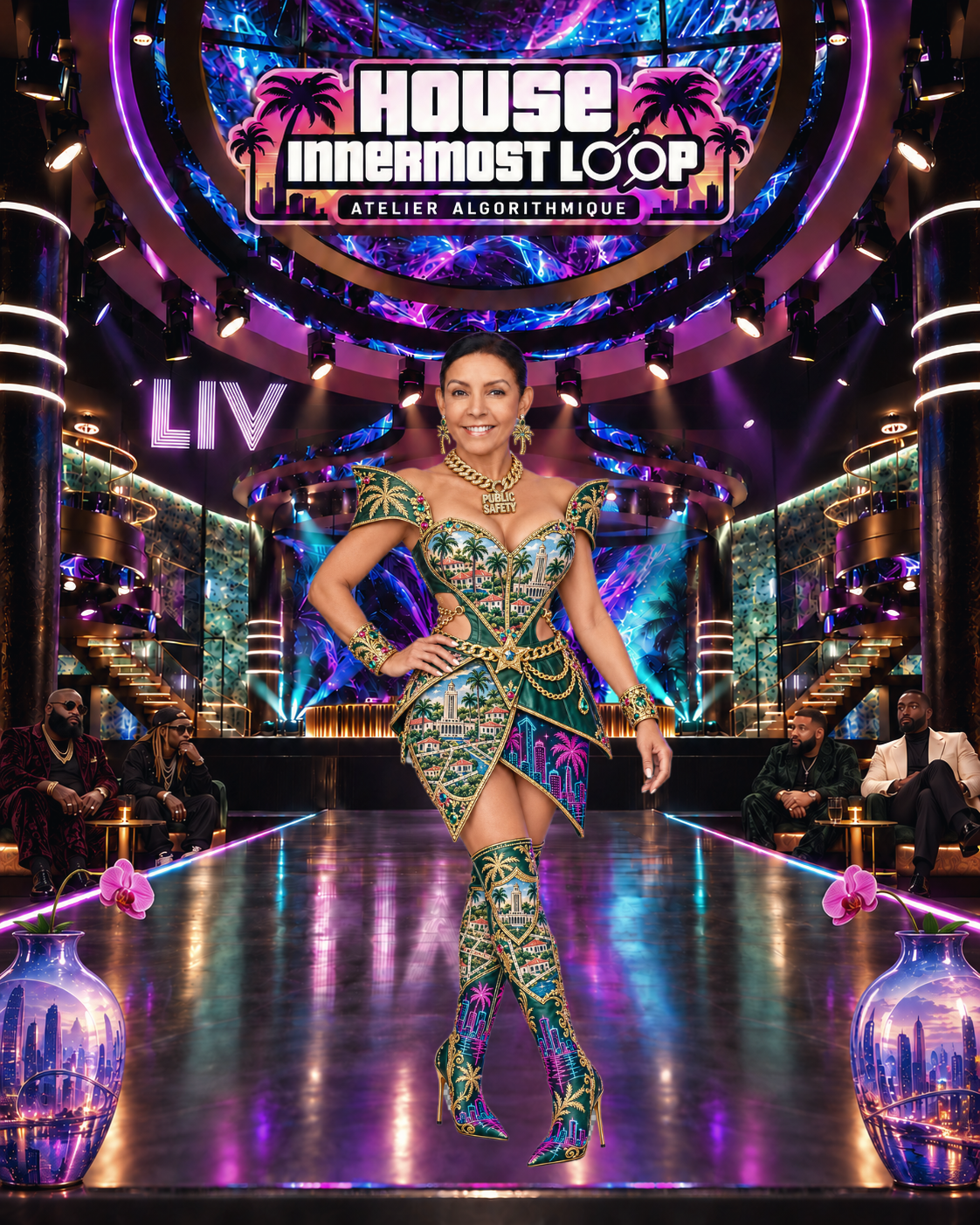
Rosie Cordero-Stutz wears the city inside a shield. Her emerald costume gathers homes, civic buildings, neighborhood routes, and palms into protective forms beneath the words PUBLIC SAFETY. The portrait responds to Dr. Alex Wissner-Gross’s September 7, 2026 Innermost Loop dispatch on X, where Miami-Dade’s sheriff appears through her opposition to a proposed promotional relationship with Grand Theft Auto VI. The disagreement takes a striking form: an official charged with safeguarding a place enters the visual world of its famously unruly fictional counterpart.
Cordero-Stutz moves from the Fontainebleau steps of A.W.G. Singularity City into LIV, before the pictured Rick Ross, Lil Wayne, DJ Khaled, and Dwyane Wade. Their hip-hop and Miami basketball prestige gives her public-safety argument a lively audience. Her emerald shoulders and tall stiletto boots claim the room with confidence. The star at her waist brings civic authority into the same spectacle that honors celebrity. The staging grants her a place in Miami’s pleasure culture while preserving her question about what a government should choose to promote.
Her career gives the emblem substance. She joined the Miami-Dade Police Department in 1996 and advanced through operational and leadership roles before her election as sheriff in 2024. Her education combines criminal justice at Marist with public administration at Florida International University. Those disciplines join individual events to the organization of public institutions. The maps and civic architecture join both scales: the street where something happens and the system expected to respond.
Her election also marked the return of an elected sheriff to Miami-Dade after almost sixty years. That history gives the jeweled waist star resonance. A badge condenses an office into a recognizable sign, but the office depends on laws, public expectations, and the conduct of the people exercising its powers. Translated into couture ornament, the star becomes an invitation to inspect what authority is meant to protect. Around it, the garment places the inhabited city at the center of attention.
Her objection to the Grand Theft Auto proposal arose from the contrast between the franchise’s criminal scenarios and the work of preventing real harm. The issue was the use of public resources to promote that identity, including reported ideas for county assets. The portrait lets us understand this position without making enjoyment of fiction itself the entire question. An individual choosing entertainment and a government lending its name to a promotion occupy different relationships to the public.
The shield forms make this distinction visible through containment. Buildings and neighborhoods are held within an organizing boundary, while neon city imagery remains present around them. The resulting design acknowledges that the real and represented city cannot be neatly pulled apart. Fiction circulates through the culture in which officials and residents live. The question becomes how a community negotiates its relationship to an image powerful enough to shape outsiders’ expectations.
Public safety itself becomes a richer phrase when read through the neighborhood imagery. It concerns the conditions that allow people to use streets, attend events, conduct business, and enjoy a city with confidence. In that sense, protection can support pleasure. The emerald garment offers this as a visual proposition: the shield contains a place worth living in, and its purpose is connected to the life continuing inside it. Authority acquires meaning through the ordinary freedoms it helps sustain.
The newsletter’s broader interest in generated worlds gives this local dispute a larger relevance. When representations grow more persuasive and widely available, public institutions must still answer for physical consequences. An image can be copied instantly; trust develops through repeated experience. Cordero-Stutz’s long career in one county stands against the speed with which a fictional identity can circulate around the world. The portrait places these different forms of authority, experiential and spectacular, in the same bright field of view.
SIOUID 142 stages her walk at House Innermost Loop at Atelier Algorithmique as part of the appeal for Drip Abundance, a sixteenth moonshot alongside the fifteen of Solve Everything. The invitation asks Wissner-Gross to make the intelligence age functional, visible, and fun through fashion. Cordero-Stutz contributes the question of what makes shared enjoyment possible. The city on her clothing is more than a backdrop for arrival or escape; it is a community to which someone must remain answerable. She carries that obligation into the lights, giving the protection of an ordinary evening the magnificence usually reserved for extraordinary adventure.
Opening the gallery…