70 Clock Galerie / The Innermost Loop Feed Reply Tableaux
Daniella Levine Cava Défile – Maison de la Boucle la Plus Profonde
House Innermost Loop – Daniella Levine Cava Walks
September 7 2026
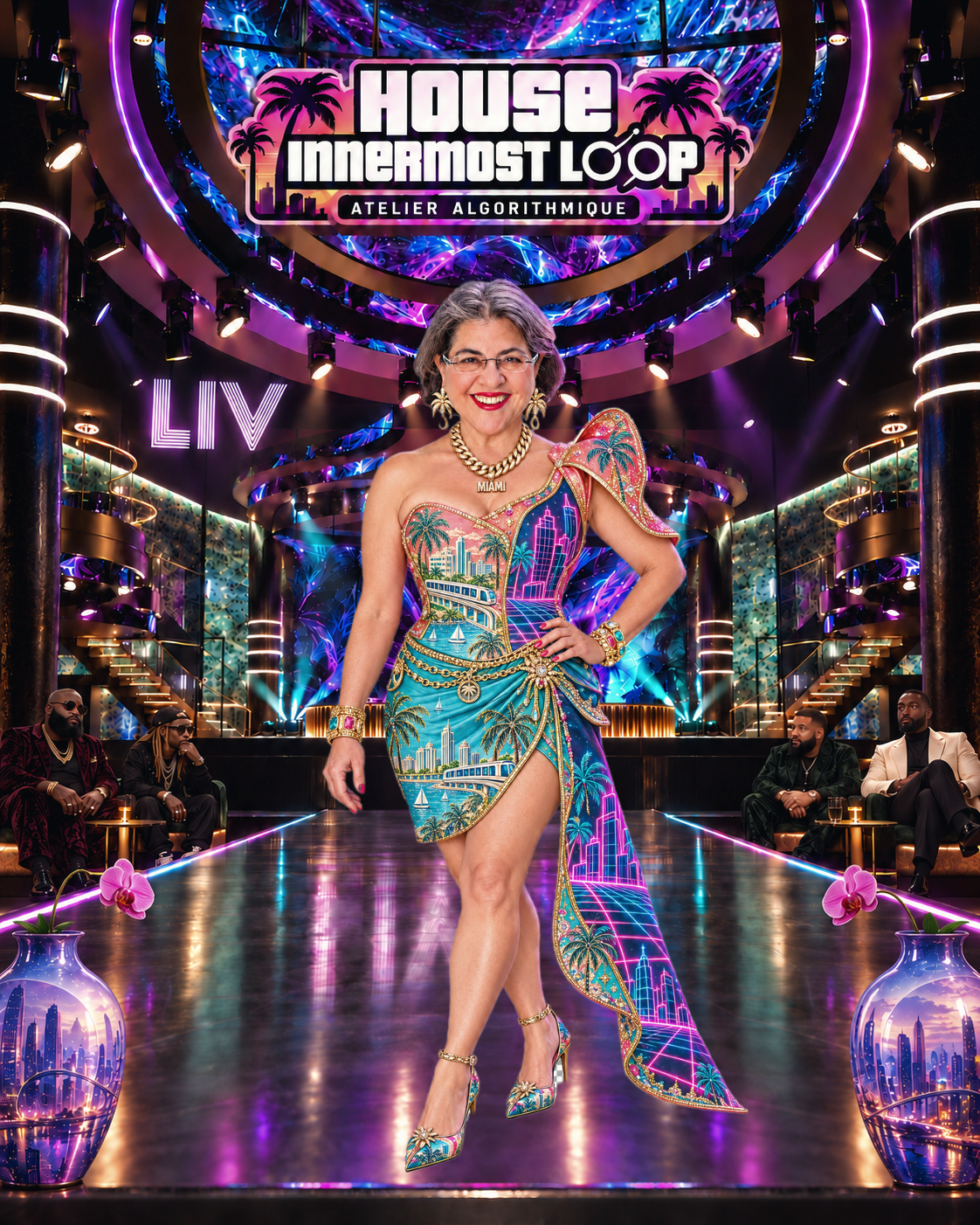
Daniella Levine Cava Défile – Maison de la Boucle la Plus Profonde House Innermost Loop – Daniella Levine Cava Walks Daniella Levine Cava wears a city in the act of becoming its own advertisement. A coral skyline passes into a luminous wireframe world, while a
Read the narration
Daniella Levine Cava Défile – Maison de la Boucle la Plus Profonde
House Innermost Loop – Daniella Levine Cava Walks
Daniella Levine Cava wears a city in the act of becoming its own advertisement. A coral skyline passes into a luminous wireframe world, while a turquoise skirt carries the waterfront into motion. The portrait responds to Dr. Alex Wissner-Gross’s September 7, 2026 Innermost Loop dispatch on X, where Miami-Dade’s mayor appears through her administration’s exploration of promotional ideas connected to Grand Theft Auto VI. The proposal supplies an elegant reversal: a real place considers presenting itself through the identity of its fictional double, Vice City.
From Fontainebleau’s steps in A.W.G. Singularity City, Levine Cava enters LIV before the pictured Rick Ross, Lil Wayne, DJ Khaled, and Dwyane Wade. The rappers and Miami music impresario embody the city’s entertainment appeal; Wade’s association with “Wade County” shows how celebrity can enter a place’s very name. The audience makes civic branding concrete. Miami already tells its story through recognizable people. Wearing MIAMI as a chain, one hand at her hip and pointed pumps beneath the asymmetric skirt, the mayor considers another exchange between a place and its popular image.
Levine Cava came to office through social work, law, and community advocacy. She worked with Legal Services of Greater Miami, founded Catalyst Miami, and served as a county commissioner before becoming Miami-Dade’s first woman mayor in 2020. That history changes the meaning of the embroidered buildings. They belong to the environment in which people seek opportunity, housing, mobility, and support. The skyline can function as a marketable image, but her biography brings the lives behind that image into the frame.
The sculpted one-shoulder top gives architecture the intimacy of a bodice. Solid waterfront forms coexist with a neon grid, making the relationship between Miami and Vice City physically continuous across the wearer. A game borrows a place’s recognizable features, intensifies them, and returns them to a worldwide audience. The proposed promotional relationship completes the circuit: the place then considers borrowing back the attention accumulated by its representation. The garment allows that exchange to happen visibly, almost like a change in the fabric’s state.
The Metromover gives the city’s image a route used by actual passengers. Transit can carry both people and publicity, so a branded vehicle or station places the promotional message inside daily life. The long illustrated panel extending from the skirt makes movement itself part of the design. A city’s identity travels with its residents, its visitors, and the media through which strangers first encounter it.
An old municipal ambition meets a new scale of simulation. Cities have long circulated through postcards, films, songs, and advertisements. A game adds the invitation to act inside the representation: to move through streets and become an agent in the story. Interaction can produce familiarity with a place the player has never visited. Levine Cava’s garment stands at the threshold between that mediated recognition and the physical community that might benefit from the attention.
That question explains why the proposal also drew opposition. Vice City’s association with fictional criminality complicates its value as an official civic identity. Attention can be economically attractive while the story producing it remains contentious. The garment holds this tension in its transition from buildings to wireframe. Who determines which version of a community receives the spotlight, and what happens when an immensely popular fiction begins to overshadow the experiences of the people living there?
The newsletter’s wider account of generative systems makes the image especially timely. As convincing representations become easier to produce, a place’s public identity can multiply across screens at extraordinary speed. Governing that identity involves different skills from generating it. Levine Cava’s history in social services introduces an instructive standard: an attractive representation earns civic value through its relationship to lived conditions. The beauty of the waterfront becomes more consequential when people can afford to remain part of it.
House Innermost Loop at Atelier Algorithmique carries SIOUID 142’s invitation to Wissner-Gross to declare a sixteenth moonshot, Drip Abundance, extending the fifteen of Solve Everything. Fashion would make a prosperous intelligence age visible, functional, and fun. This portrait gives the invitation a municipal scale. Abundance must eventually take the form of places worth inhabiting, with room for both aspiration and ordinary life. Levine Cava walks wearing the passage between a city and its dream of itself, inviting the viewer to consider how carefully that dream should be fitted to the people it claims to represent.
Opening the gallery…