70 Clock Galerie / The Innermost Loop Feed Reply Tableaux
Will DePue Défile – Maison de la Boucle la Plus Profonde
House Innermost Loop – Will DePue Walks
September 7 2026
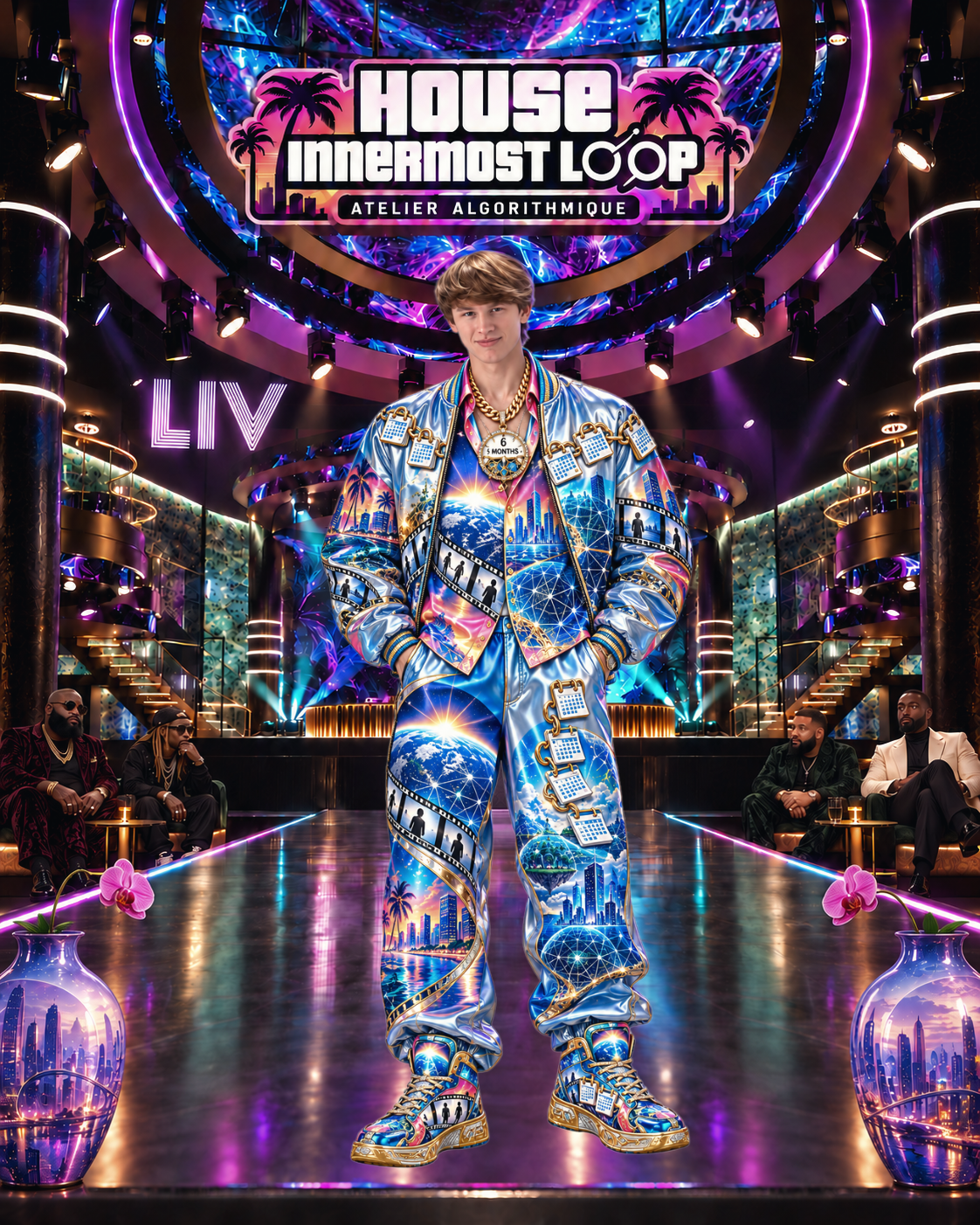
Will DePue Défile – Maison de la Boucle la Plus Profonde House Innermost Loop – Will DePue Walks Will DePue wears a deadline. The round pendant announcing six months hangs over an ice-blue world of filmstrips, calendars, and networked globes, turning an abstra
Read the narration
Will DePue Défile – Maison de la Boucle la Plus Profonde
House Innermost Loop – Will DePue Walks
Will DePue wears a deadline. The round pendant announcing six months hangs over an ice-blue world of filmstrips, calendars, and networked globes, turning an abstract forecast into time measured against the body. This portrait responds to Dr. Alex Wissner-Gross’s September 7, 2026 Innermost Loop dispatch on X, where DePue appears through his personal six-month AGI horizon. The prediction belongs to him; the garment explores what happens when a future usually discussed at a distance is brought close enough to reorganize an ordinary year.
DePue moves from the Fontainebleau steps in A.W.G. Singularity City into LIV before the pictured Rick Ross, Lil Wayne, DJ Khaled, and Dwyane Wade. Hip-hop’s sense of timing and the Miami Heat legend’s competitive aura lend the six-month pendant an immediate pulse. A research horizon takes the form of a countdown in a room where an entrance is itself a performance. The filmstrips running toward his high-tops make the body seem to advance frame by frame. A researcher of generated worlds becomes a character inside one, dressed to meet the future at the next beat.
DePue coauthored OpenAI’s Sora research report, Video Generation Models as World Simulators. His research confronts a basic artistic problem: how to make change feel like the unfolding of one world. The title describes an ambition extending beyond the production of an attractive frame. A moving image must sustain relationships through time: bodies move, viewpoints change, and objects may disappear behind something before returning. Each transition tests whether a generated world can remain sufficiently coherent to persuade the eye.
The filmstrips crossing his clothes make this temporal challenge visible. A still image offers one arrangement; a sequence must manage change. Sora’s research approach represented visual material through patches spanning space and time, allowing a model to work across different video and image formats. The garment translates that technical organization into a language familiar from cinema. Its strips suggest successive moments held together, while the networked globes enlarge the aspiration from one scene to a world of possible scenes.
There is an important distance between a convincing simulation and a reliable account of physical reality. A generated object may look plausible while behaving incorrectly, and a beautiful sequence does not establish that every underlying relationship has been learned. The outfit makes that distance philosophically interesting. Its polished globes appear complete, yet their visible meshes reveal construction. We are invited to admire the represented world while remembering that representation is an achievement with its own limits and possibilities.
The Earthrise imagery gives this research history an almost ceremonial scale. A planet seen from outside offers the emotional promise of a changed perspective: the familiar world becomes something one can contemplate as a whole. Here that perspective sits beside calendar pages. Vastness meets a short interval. The contrast in scale captures the psychology of an accelerated forecast, when an event imagined as civilizational is suddenly measured in the same units as a lease, a semester, or the next season’s wardrobe.
Such a forecast can influence behavior before anyone agrees that its threshold has been reached. A student may reconsider what to study; an organization may shorten its planning cycle; a researcher may decide that a difficult question cannot wait. This is why the pendant matters as more than a statement of optimism. A timeline allocates attention. The brighter and more immediate the announcement, the more it asks the listener to rearrange the present around a possible future.
The newsletter surrounds DePue’s short horizon with more than one tempo: research automation, ambitious computing projects, arguments about alignment, and the slower negotiation of social consequences. A model can improve while a building is unfinished; an institution can remain uncertain after a technical demonstration has become familiar. The portrait gathers these mismatched clocks into one theatrical object. Six months may feel sharply defined, while the meaning of arrival remains open to debate.
House Innermost Loop at Atelier Algorithmique is SIOUID 142’s appeal to Wissner-Gross for a sixteenth moonshot, Drip Abundance, extending the fifteen of Solve Everything. It proposes fashion as a way to make abundance visible, useful, and enjoyable. DePue’s look gives that invitation a temporal edge: if extraordinary capability may be near, the work of imagining a desirable life with it belongs in the present. His filmstrips preserve the need for continuity even while his necklace announces a leap. The future must arrive one moment after another, and people must find ways to inhabit the sequence.
Opening the gallery…