70 Clock Galerie / The Innermost Loop Feed Reply Tableaux
Nate Silver Défile – Maison de la Boucle la Plus Profonde
House Innermost Loop – Nate Silver Walks
September 7 2026
Nate Silver Défile – Maison de la Boucle la Plus Profonde House Innermost Loop – Nate Silver Walks Nate Silver walks toward us with several futures open across his clothes. Probability curves, playing cards, and dice occupy a burgundy cityscape split by a bril
Read the narration
Nate Silver Défile – Maison de la Boucle la Plus Profonde
House Innermost Loop – Nate Silver Walks
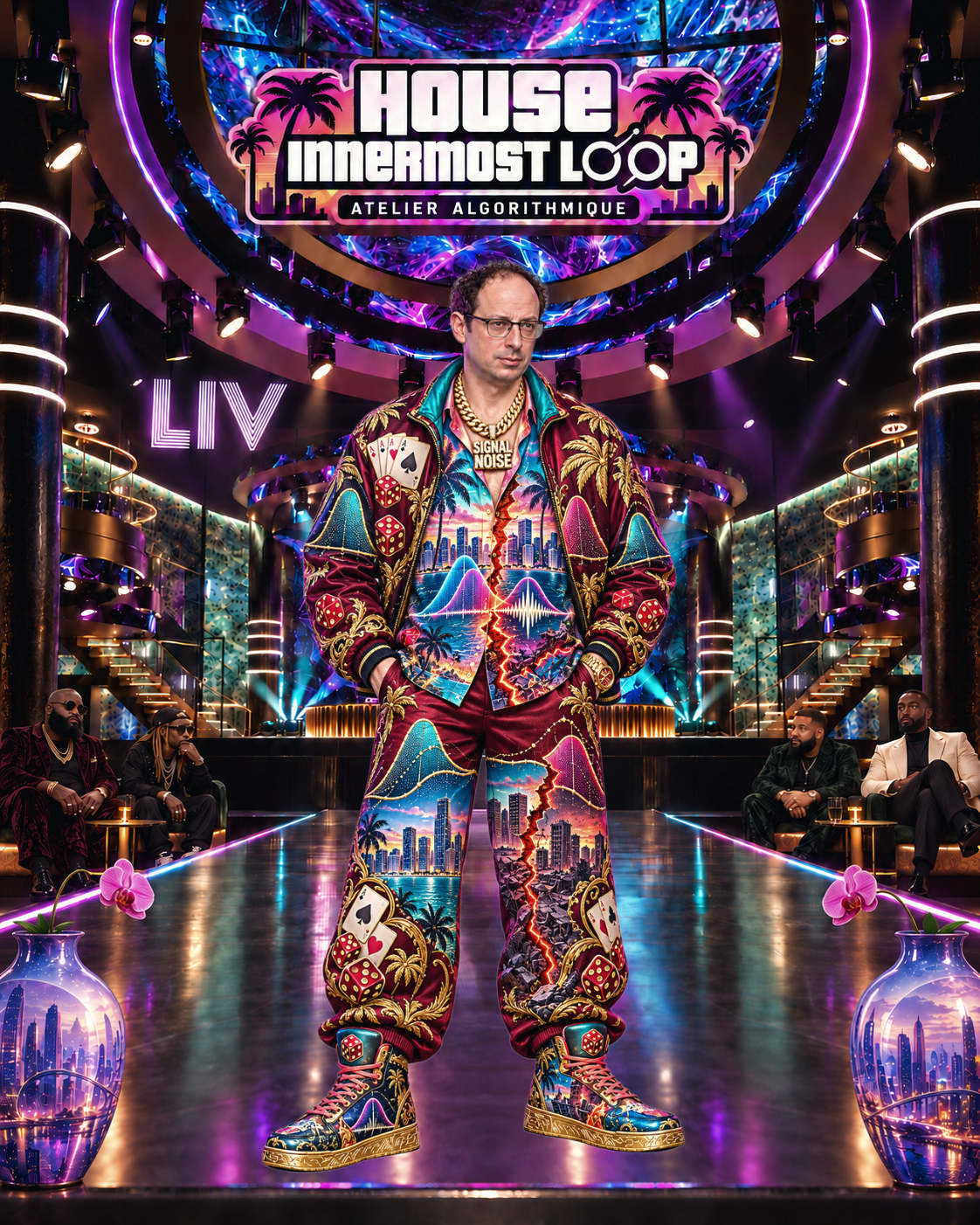
Nate Silver walks toward us with several futures open across his clothes. Probability curves, playing cards, and dice occupy a burgundy cityscape split by a brilliant fissure. It responds to Dr. Alex Wissner-Gross’s September 7, 2026 Innermost Loop dispatch on X, where Silver frames the period before GPT-7 in terms of a plateau or seismic change. The rupture makes the word seismic visible, while the SIGNAL NOISE chain supplies the method by which a forecaster tries to distinguish a meaningful tremor from surrounding excitement.
The forecaster moves from the crowd outside Fontainebleau in A.W.G. Singularity City into LIV’s interior. Rick Ross, Lil Wayne, DJ Khaled, and Miami Heat legend Dwyane Wade form the depicted audience. Their careers give Silver’s probability imagery a worldly setting: preparation matters, outcomes vary, and reputation grows through public tests. Beside Wade, the baseball forecaster’s history meets another sporting culture. The burgundy outfit’s fiery rupture carries uncertainty into a room devoted to the confidence of an entrance. Risk has dressed for the evening.
Silver’s career has made uncertainty intelligible. After studying economics at the University of Chicago, he developed PECOTA, a system for forecasting baseball players’ performance. Baseball offered a disciplined encounter with variation: a promising record had to be interpreted alongside age, comparable careers, and the possibility of disappointment. The later move into election forecasting carried that problem into public life. Individual polls could be informative and imperfect at once; their value depended on how they were combined and understood.
The title of his book The Signal and the Noise condenses this long concern. A signal is the information that helps explain or anticipate what matters. Noise is variation that can distract us from it. The boundary is rarely available as a label attached to the data. Someone must choose a model, consider its assumptions, and revise a judgment when evidence changes. The chain turns this intellectual labor into an emblem of identity: Silver wears the distinction by which his readers know him.
The cards and dice add another part of that history. Poker makes the separation between a good decision and a favorable outcome painfully clear. A player can reason well and lose a hand, or reason poorly and win one. Forecasting requires a similar discipline. A probability describes the range of outcomes one should take seriously; it does not promise the most likely outcome will occur. The garment gives risk the luxurious familiarity of a gaming table, then asks us to carry that understanding into decisions whose consequences extend far beyond the room.
The fiery crack interrupts the comfort of the elegant probability curves. A technological transition can alter the relationships on which a model relies. If research becomes partly automated, past rates of progress may become a less reliable guide to future rates. Institutions, meanwhile, may adapt slowly even when capabilities change quickly. Silver’s seismic metaphor acquires its force at this mismatch of tempos. The city can remain recognizable while the ground beneath its expectations shifts.
Within the newsletter, this discipline meets declarations that AGI has arrived, ambitious research timelines, and questions about the consequences for work. Each claim invites attention; none becomes more useful merely because it is emphatic. The portrait’s calm expression gives Silver a role within this noisy environment. He represents the effort to ask what observation would change a view, how much confidence a claim deserves, and which uncertainty is being concealed by a persuasive story.
The runway is House Innermost Loop at Atelier Algorithmique, SIOUID 142’s exhortation to Wissner-Gross to declare Drip Abundance as a sixteenth moonshot alongside the fifteen of Solve Everything. Fashion would let people encounter the intelligence age as something visible, functional, and fun. Silver’s outfit makes an especially educational contribution. It renders uncertainty glamorous enough to approach. The audience can enjoy the gold and the game while learning that a richer account of the future may require holding several possibilities in mind.
His biography gives that lesson a human scale. From a baseball player’s next season to a nation’s next election, forecasting begins with a wish to act intelligently before the result is known. The Singularity enlarges the field of play, but the obligation to reason carefully remains. The crack in the city is therefore more than a dramatic decoration. It is space left open for a future the present may fail to anticipate. Silver carries that opening through the nightclub with a gambler’s familiarity and a statistician’s insistence that confidence should remain answerable to evidence.
Opening the gallery…