70 Clock Galerie / The Innermost Loop Feed Reply Tableaux
Greg Brockman Défile – Maison de la Boucle la Plus Profonde
House Innermost Loop – Greg Brockman Walks
September 7 2026
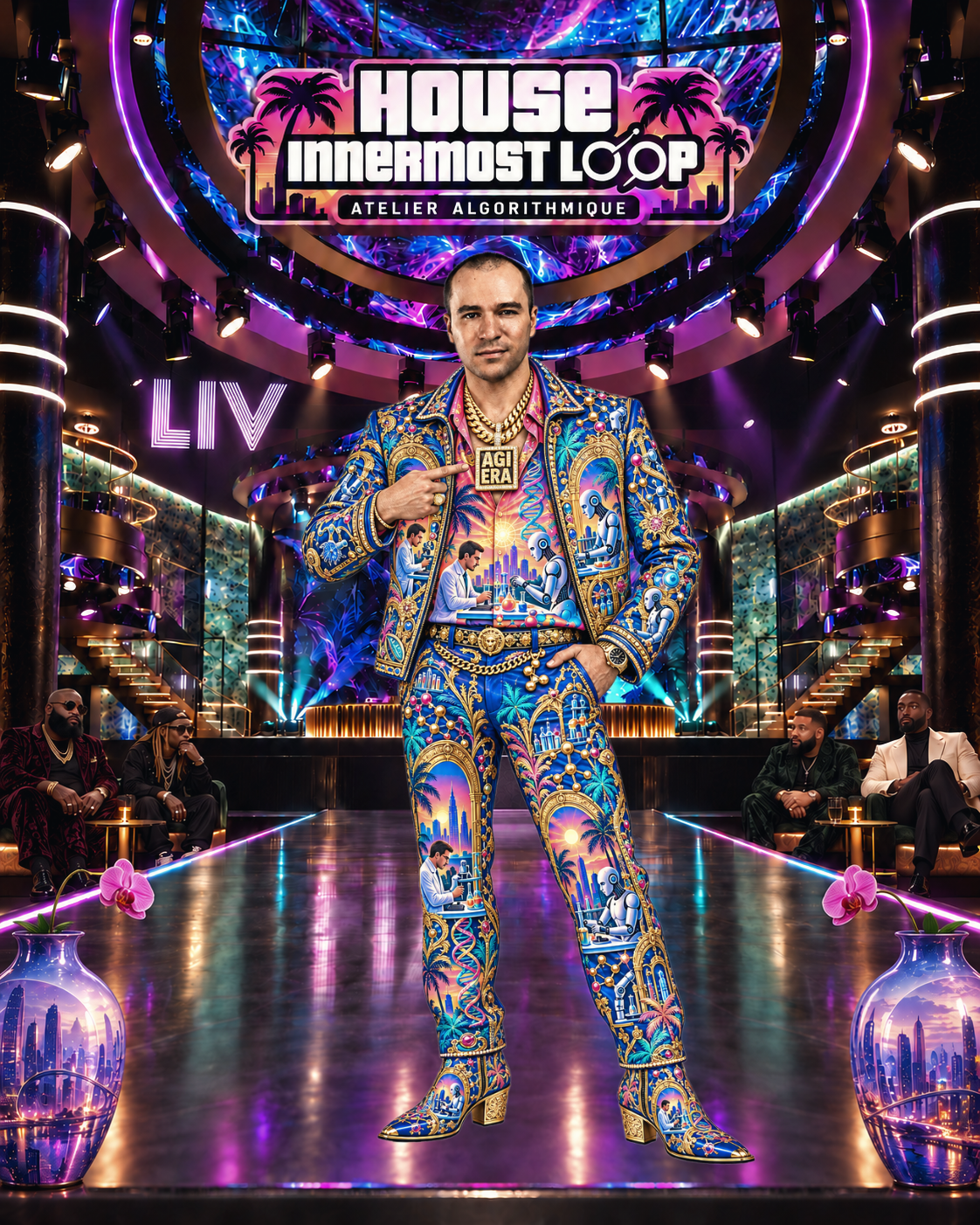
Greg Brockman Défile – Maison de la Boucle la Plus Profonde House Innermost Loop – Greg Brockman Walks Greg Brockman makes the announcement with his finger. Amid jeweled laboratories, he points to the words AGI ERA at his chest. The gesture turns a proposition
Read the narration
Greg Brockman Défile – Maison de la Boucle la Plus Profonde
House Innermost Loop – Greg Brockman Walks
Greg Brockman makes the announcement with his finger. Amid jeweled laboratories, he points to the words AGI ERA at his chest. The gesture turns a proposition into a declaration of belonging. This portrait answers Dr. Alex Wissner-Gross’s September 7, 2026 Innermost Loop dispatch on X, which places the OpenAI cofounder’s endorsement of the AGI-era framing beside the emergence of automated research assistants. Here the organizer of research steps forward wearing the historical moment he believes his institution has helped create.
From his place beside the computing hardware outside Fontainebleau in A.W.G. Singularity City, Brockman steps into LIV. The pictured audience includes LIV regulars Rick Ross and Lil Wayne, Miami’s DJ Khaled, and Heat legend Dwyane Wade. Their hip-hop and sporting prestige makes his pointing gesture instantly legible: he knows how to announce an arrival. The AGI ERA chain adopts the bravado of a performer displaying a hard-won emblem. A technical claim becomes a public identity. In this company, the question of who gets to name an era acquires the theatrical force of someone taking the microphone.
The embroidered chemists open a personal route into that claim. Before OpenAI, before his work as Stripe’s chief technology officer, Brockman won a silver medal at the International Chemistry Olympiad. As a student he even began a chemistry textbook, A Chemical Progression, before computing drew him elsewhere. The molecular structures and laboratory instruments therefore recover an early intellectual enthusiasm. The garment imagines a return to chemistry by way of the software systems that might expand what a chemist can attempt.
The biographical echo is instructive. Chemistry asks the investigator to move among symbolic representations, experimental procedures, and physical consequences. A diagram must eventually answer to matter. That habit of crossing between a formal system and the world provides a useful way to understand the research imagery here. A beautifully articulated hypothesis acquires scientific weight through testing. The robots sharing these golden laboratories personify software collaborators within that demanding process; their human companions preserve the place of judgment and experiment.
Brockman’s later career concerned how technical work can grow. At Stripe he helped the company expand from four people to hundreds; at OpenAI, his public account of his work ranges across research platforms, game-playing systems, and tools that bring models into practical use. This is the biography of a builder who repeatedly meets the distance between a promising capability and an organization able to employ it. The successive portals on his clothing give that distance an architectural form. Each opening suggests another room in which work can begin.
OpenAI’s research-acceleration report gives the newsletter’s moment a concrete scale. It describes agents tackling defined tasks under human direction, with substantial assistance still needed in many longer assignments. The attraction lies in extending a researcher’s reach: more lines of inquiry can be explored while human attention is concentrated on choosing and evaluating them. The costume turns that multiplication of activity into a dense community of laboratories. Discovery appears as a place growing more populous, even as some of its new workers arrive in software.
The cobalt, coral, turquoise, and gold resist the visual austerity often associated with science. Molecules become jewelry; experimental chambers become ornamental shrines. The imagery covers trousers and pointed boots like an illuminated manuscript devoted to invention. Its abundance rewards attention. The detail invites us to inspect what the announcement of a new era might contain.
House Innermost Loop at Atelier Algorithmique carries SIOUID 142’s invitation to Wissner-Gross to establish Drip Abundance as a sixteenth moonshot, extending the fifteen of Solve Everything. The proposal treats fashion as a way to make the intelligence age functional, visible, and fun. Brockman’s chemistry becomes a particularly apt expression of it: the child’s pleasure in discovering how the world works returns as the adult’s extravagant public costume. Intellectual seriousness keeps its capacity for delight.
The portrait’s deeper subject is the continuity between curiosity and institution building. A young person begins a textbook because knowledge seems worth arranging and sharing; a technical leader helps build systems through which many people might pursue new knowledge. Between those scales lie difficult questions of access, reliability, and purpose. The garment holds them inside an exuberant invitation. Its proud gesture announces an era, while its little laboratories suggest the work by which that announcement must earn its meaning.
Opening the gallery…