70 Clock Galerie / The Innermost Loop Feed Reply Tableaux
Jeremy Coller Défile – Maison de la Boucle la Plus Profonde
House Innermost Loop – Jeremy Coller Walks
September 6 2026
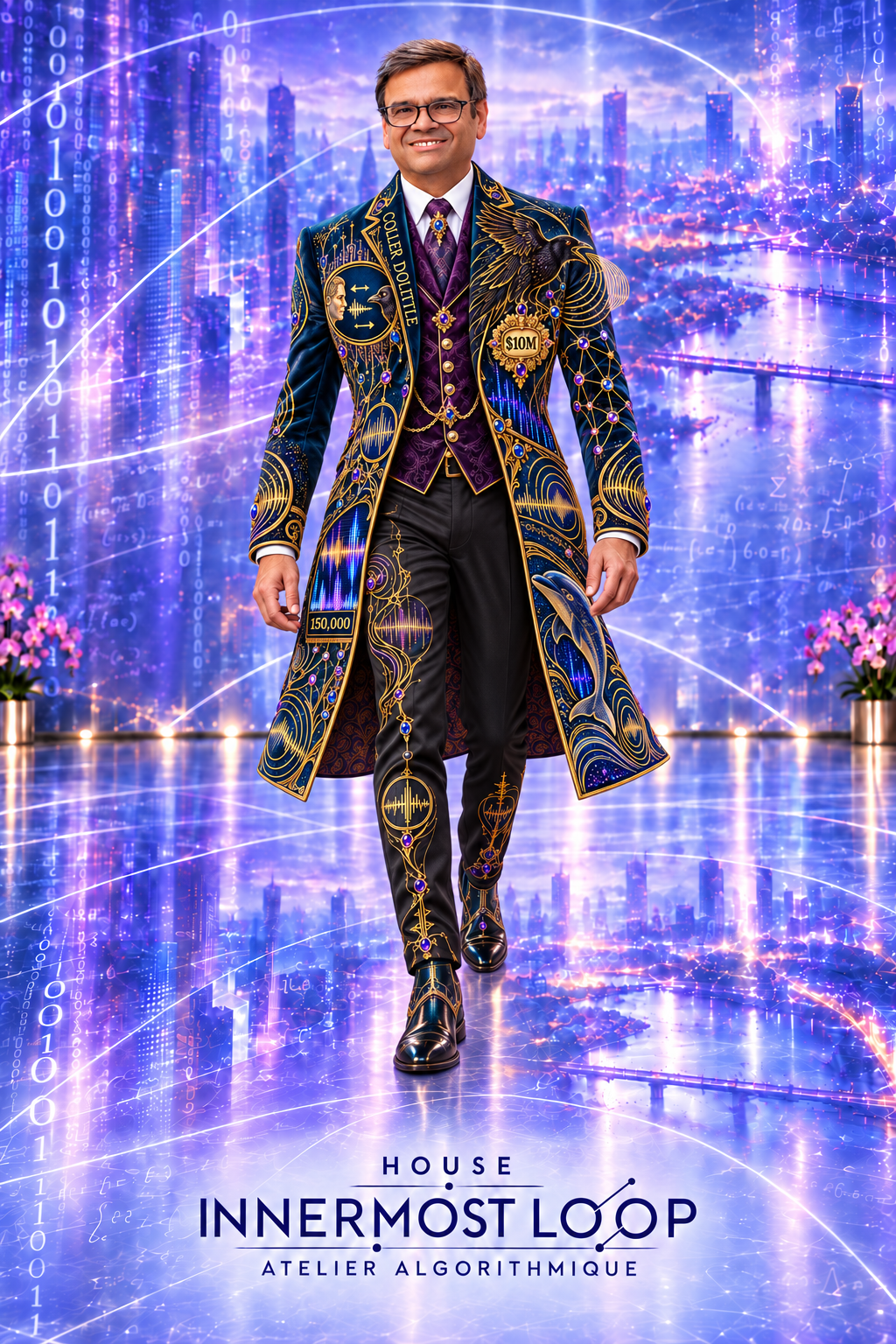
Jeremy Coller Défile – Maison de la Boucle la Plus Profonde House Innermost Loop – Jeremy Coller Walks Capital is asked to listen in this portrait of Jeremy Coller. A crow, a dolphin, and rings of sound interpret his place in Dr. Alex Wissner-Gross’s September
Read the narration
Jeremy Coller Défile – Maison de la Boucle la Plus Profonde
House Innermost Loop – Jeremy Coller Walks
Capital is asked to listen in this portrait of Jeremy Coller. A crow, a dolphin, and rings of sound interpret his place in Dr. Alex Wissner-Gross’s September 6, 2026 forensic dispatch of the Singularity. The SIOUID 142 X account offers the work through House Innermost Loop at Atelier Algorithmique, urging a sixteenth moonshot, Drip Abundance. Fashion would make abundance visible, functional, and fun. Coller’s garment widens that invitation: a more intelligent civilization might take pleasure in understanding lives that have always been speaking around it.
Coller founded Coller Capital in 1990 and helped develop the market in second-hand stakes in private equity funds. Such investing asks how value can be recognized where existing owners need a different route forward. His philanthropy carries that habit of redirecting attention into animal welfare, food systems, and research. The Coller Dolittle Challenge, developed with Tel Aviv University, brings those interests together in the ambition of communication between humans and other animals.
In 2015 he founded FAIRR, an investor network examining risks and opportunities in the food sector, including intensive animal agriculture. This history gives the crow and dolphin a significance beyond technological curiosity. Coller has worked to make treatment of animals visible within decisions about money. The garment places animal faces on the same sumptuous surface as financial symbols, bringing beings commonly excluded from an investor’s portrait into its field of concern.
The crow imagery connects to the newsletter’s discussion of AI analysis of a large archive of crow recordings. The acoustic markings turn sound into something that can be compared, clustered, and studied. Yet the bird remains present beside the data. It insists that an animal’s signal belongs to a life and a context, and that detecting a pattern is only one step toward understanding what that pattern means to the animal using it. An algorithm can group acoustically similar calls; experiments then test how the calls relate to behavior and circumstances. A warning, a request, and a social greeting would imply different uses of sound. The gold waveforms bring the listener toward that passage from statistical pattern to communicative purpose.
The ten-million-dollar emblem refers to the Coller Dolittle Challenge’s grand prize: an equity investment of that amount or an alternative five-hundred-thousand-dollar cash award. Its goal is an animal communicating independently without recognizing that it is communicating with humans. The ornament thus represents an incentive aimed at crossing a boundary in understanding, with capital placed in the service of a question.
The challenge’s 2026 annual award went to Julie Elie’s research on zebra finches, testing how the birds classified calls by meaning. That wider research history gives the acoustic ornament its depth. Human categories become more useful when their significance can be examined from the animal’s side of the exchange. The portrait’s crow and dolphin stand within an expanding field of inquiry into lives that organize sound differently from our own.
The facing profiles imagine exchange, while the gold sound rings reveal its ethical difficulty. A system that can imitate a signal may influence behavior without understanding it fully. Playback could help investigate communication or support animal care, but it could also introduce misleading cues into social worlds that humans barely understand. Listening and impersonating are different acts, even when they depend on similar technical capacities.
Coller’s presence makes this a portrait of patronage as well as science. Funding helps determine which questions attract sustained effort and what counts as success. Directing attention toward other species could enlarge the moral scope of the intelligence economy, particularly if improved understanding changes how animals are treated. That possibility remains conditional on what people choose to do with the knowledge. Recognition alone does not guarantee care. For a fashion moonshot, the association has a special resonance. Clothing also depends on decisions about materials, living creatures, and care. The joy of adornment can become more inventive as its understanding of those dependencies deepens.
At the end of a runway populated by engineers, mathematicians, investors, and a governor, the crow and dolphin interrupt the assumption that intelligence matters chiefly when it produces value for humans. The animal is given a place inside the same gold-framed world as the investor. The portrait’s richest promise lies in that redistribution of attention. A future able to generate increasingly fluent answers may also acquire a more demanding obligation: to listen carefully before deciding that another being has spoken in terms it understands.
Opening the gallery…