70 Clock Galerie / The Innermost Loop Feed Reply Tableaux
Warren Buffett Défile – Maison de la Boucle la Plus Profonde
House Innermost Loop - Warren Buffett Walks
September 6 2026
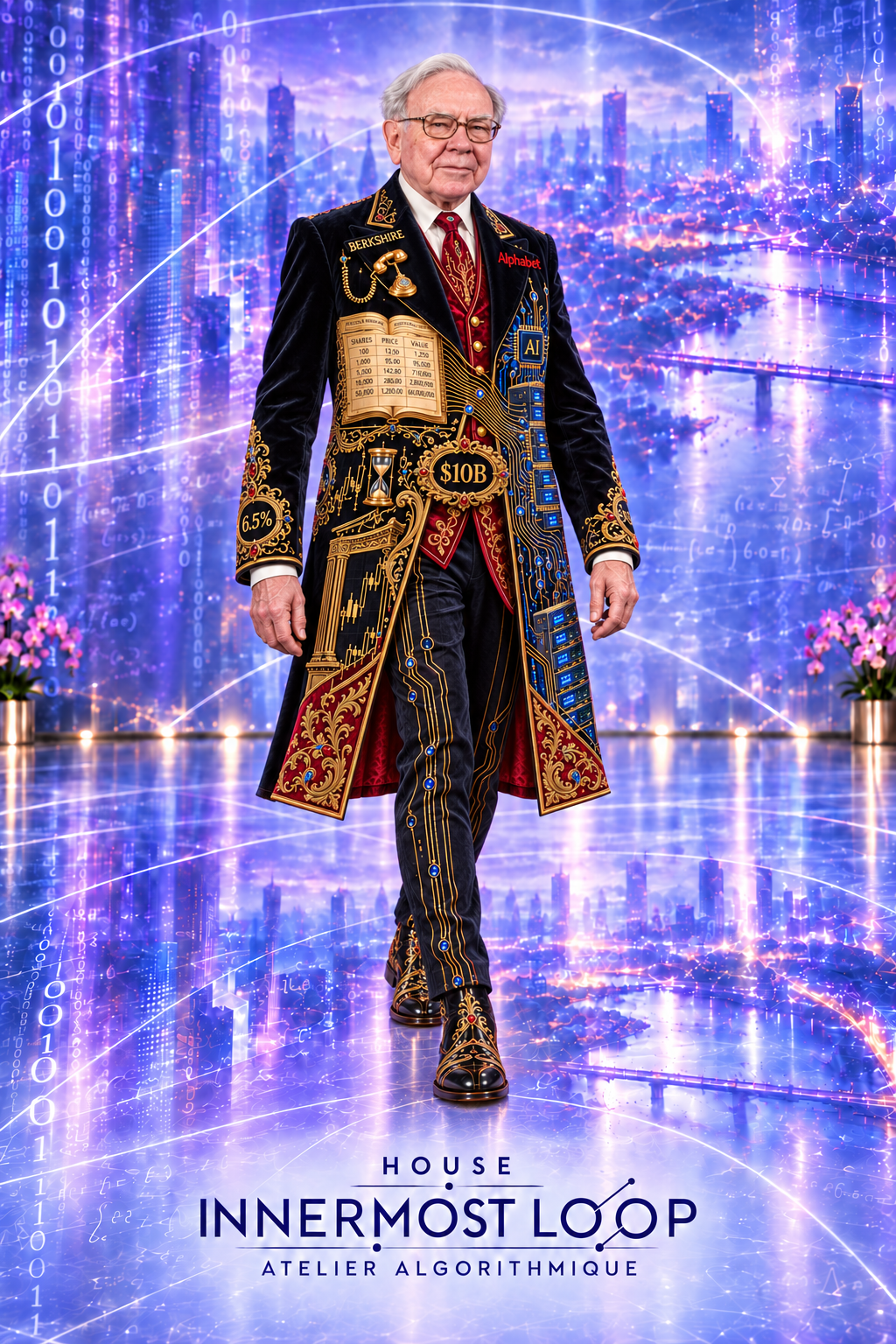
Warren Buffett Défile – Maison de la Boucle la Plus Profonde House Innermost Loop - Warren Buffett Walks An old ledger opens onto a new industrial order. Warren Buffett’s portrait places the instruments of patient investment among the servers of artificial int
Read the narration
Warren Buffett Défile – Maison de la Boucle la Plus Profonde
House Innermost Loop - Warren Buffett Walks
An old ledger opens onto a new industrial order. Warren Buffett’s portrait places the instruments of patient investment among the servers of artificial intelligence. It is the SIOUID 142 X account’s reply to Dr. Alex Wissner-Gross’s September 6, 2026 forensic dispatch of the Singularity. House Innermost Loop at Atelier Algorithmique advances the account’s call for a sixteenth moonshot, Drip Abundance: fashion as visible, functional, enjoyable abundance. Buffett arrives with a lifetime’s education in the difference between an attractive prospect and an enduring source of value.
Buffett’s education in value investing took shape under Benjamin Graham at Columbia. He learned to examine a business through its economics and the price paid for ownership. Charlie Munger later helped redirect that discipline toward exceptional businesses capable of compounding value. Berkshire, the textile company Buffett took control of in 1965, became the vehicle for this larger practice. The ledger on his garment contains a changing method, refined through experience, rather than a rule preserved untouched.
Insurance supplied Berkshire with a distinctive financial engine. Premiums arrive before many claims are paid; the money held in that interval is called float. Invested with care, it can support long-term ownership elsewhere. The hourglass acquires a second meaning through this history: time itself can become a resource, provided the obligations at its end are honored. Buffett’s decades of allocation explain why an AI-era transaction belongs within an older story about duration, discipline, and trust.
The newsletter brings Buffett into the day’s AI story through Abel’s account of their discussion before Berkshire’s ten-billion-dollar Alphabet purchase at a 6.5 percent discount. The investment figure and percentage are placed directly on the portrait. They record a specific negotiated transaction rather than a prediction of future returns. The gold telephone supplies the human bridge between the two men and makes a consequential financial decision appear as an act of conversation.
The ledger is the image’s governing object. Its orderly columns propose that enthusiasm must eventually become an account of price, ownership, and value. Across the body, circuitry and server racks introduce a business whose physical machinery can be seen even when the economics of its future remain uncertain. The two visual languages are joined without losing their differences. A balance sheet and a model benchmark answer different questions about the same technological enterprise.
The hourglass complicates the apparent opposition between patience and speed. Long-term ownership may benefit from rapid technical change, but it must also endure mistaken expectations, replacement cycles, and the cost of maintaining an advantage. The object measures the interval across which a promising story has to become a durable business. Set among rising financial motifs, it gives the portrait a quiet test of persistence.
This is Buffett’s role in the intelligence economy as the artwork interprets it. A technological transition can be extraordinary while the allocation of its rewards remains uneven. The ability to build a powerful system is one question; the ability to retain value from it is another. Owners of infrastructure, distribution, energy, and customer relationships may occupy different positions from the creators of a model. The ledger invites the viewer to examine those relationships instead of treating every participant in the boom as economically equivalent.
The sumptuous gold has an irony appropriate to that inquiry. The portrait dresses a figure associated with financial restraint in the language of baroque abundance. Yet the abundance is organized around accounts, a telephone, and a clock. Spectacle is made to carry the instruments that might discipline it. The consultation with Abel adds succession to that tension. Buffett’s authority now passes through another executive’s decision, giving the gold telephone the intimacy of counsel and the consequence of institutional continuity. There is pleasure in the theatrical excess. The practical investor becomes a walking illuminated account book, allowing financial literacy to enter through a joke. Drip Abundance makes an austere habit of thought unexpectedly enjoyable to look at.
Placed beside Abel, Buffett gives the runway a visible memory. The intelligence buildout draws on institutions, savings, and decisions accumulated before its newest models existed. In the mirrored violet city, the old ledger remains open to unfamiliar assets. The portrait’s most consequential gesture is that openness: a tradition continuing through a changed opportunity, with the obligation to distinguish the cost of entering the future from the value that future may eventually produce.
Opening the gallery…