70 Clock Galerie / The Innermost Loop Feed Reply Tableaux
Greg Abel Défile – Maison de la Boucle la Plus Profonde
House Innermost Loop - Greg Abel Walks
September 6 2026
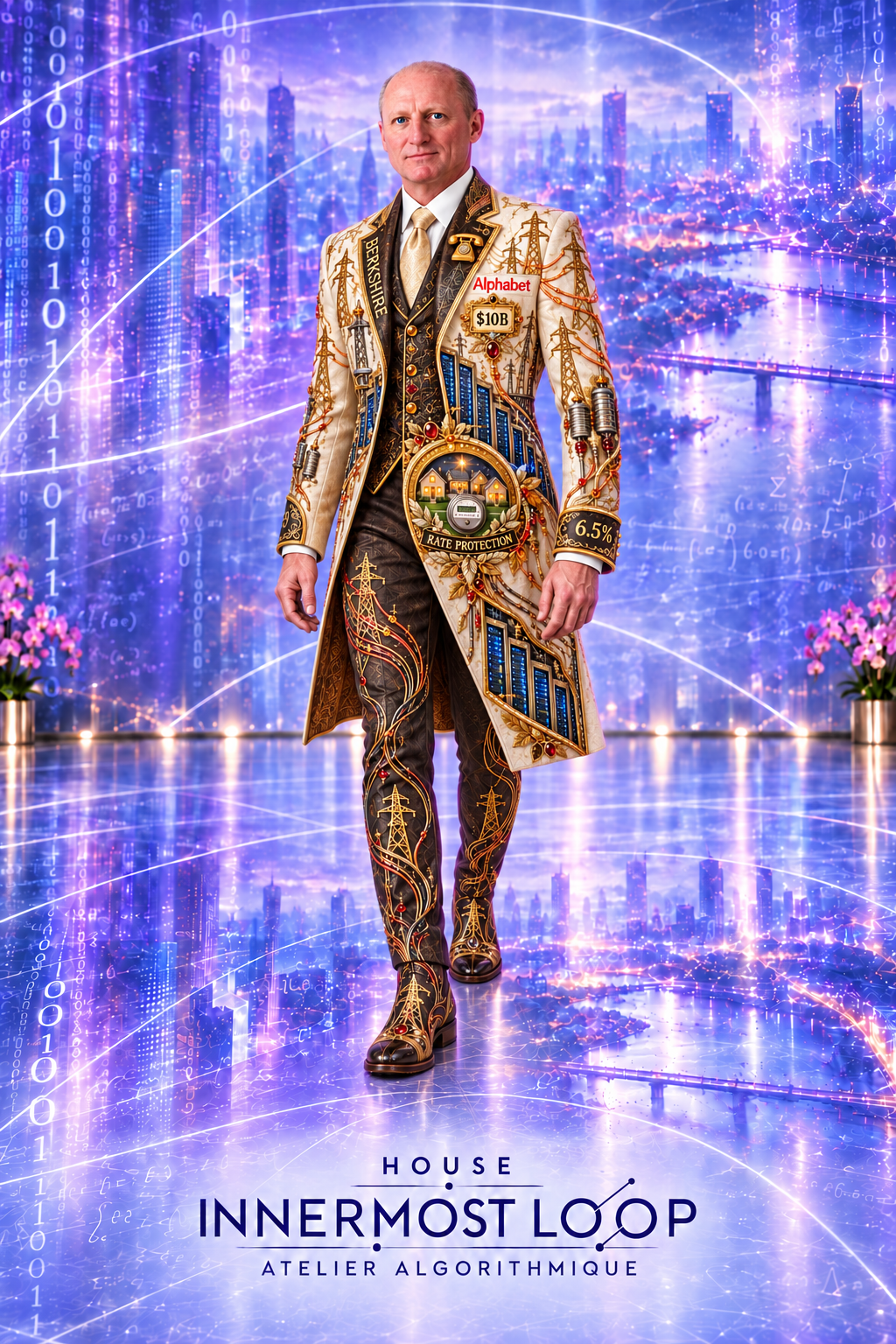
Greg Abel Défile – Maison de la Boucle la Plus Profonde House Innermost Loop - Greg Abel Walks The future of intelligence passes through a household electricity meter. Greg Abel’s portrait connects AI investment to the obligations of supplying its power in Dr.
Read the narration
Greg Abel Défile – Maison de la Boucle la Plus Profonde
House Innermost Loop - Greg Abel Walks
The future of intelligence passes through a household electricity meter. Greg Abel’s portrait connects AI investment to the obligations of supplying its power in Dr. Alex Wissner-Gross’s September 6, 2026 forensic dispatch of the Singularity. The SIOUID 142 X account’s reply advances its call for a sixteenth moonshot, Drip Abundance: House Innermost Loop at Atelier Algorithmique. Fashion would make abundance tangible, useful, and enjoyable. Abel’s towers and small homes ask how the power behind that promise reaches the people it is meant to serve.
Abel grew up in Edmonton and graduated from the University of Alberta in 1984. Accounting work took him from PricewaterhouseCoopers to CalEnergy, initially a geothermal business. He became president of MidAmerican Energy in 1999, chief executive in 2008, and later oversaw Berkshire’s non-insurance operations before becoming its chief executive in 2026. The transmission towers carry that history. They represent decades spent turning capital into physical systems that have to keep operating after the announcement has faded.
His route from accounting to energy also explains the meter’s prominence. An accountant follows costs and obligations; a utility operator must distribute them across equipment, customers, and time. A data center’s demand can require generation, transmission, and commitments lasting far beyond a model’s release cycle. The houses interrupt the grandeur with the smallest relevant unit of experience: someone opening a bill. Abel’s biography makes that domestic scale integral to the industrial portrait.
The newsletter places him at the junction of two opportunities: Berkshire’s investment in Alphabet and the power needed by hyperscale computing. The ten-billion-dollar emblem records the size of the reported share purchase discussed with Warren Buffett. The 6.5 percent motif refers to the discount on that investment’s share price. These numbers describe the capital transaction; the meter and the rate-protection imagery introduce the separate issue of electricity customers. A grid must continuously balance electricity supply and demand. Growth in computing therefore becomes a physical commitment, with costs distributed through infrastructure and tariffs.
That distinction organizes the portrait. One side presents the capacity to benefit from the intelligence buildout, while the domestic medallion keeps other users of the grid in view. Abel’s stated condition for serving hyperscalers was that existing customers should not bear higher rates because of them. The imagery turns that condition into a visible obligation. Small houses occupy the same privileged surface as towers and servers, refusing to disappear behind the scale of the proposed industrial customer.
The gold telephone brings human judgment into a landscape of large systems. It recalls consultation and a negotiated decision, the ordinary conversation through which exceptional sums can be committed. Its scale is modest beside the infrastructure, but its consequence is large. Capital does not enter the picture as an atmospheric force. People decide to allocate it, agree on terms, and accept responsibilities attached to those terms.
The intelligence economy’s physical dependence is the work’s central insight. More capable software may increase the appetite for computation, yet the electricity system must still accommodate demand through equipment, planning, and investment. Those arrangements connect the speed of digital development to the slower durations of construction and public approval. The coat’s continuous pathways make the connection appear effortless, while the meter interrupts that visual ease with the question of distribution.
The portrait also asks how an established conglomerate enters a transformative industry. Berkshire brings accumulated capital and operating experience to a field often narrated through new laboratories and new founders. Abel’s figure places continuity inside acceleration. The older institutions of power supply and long-term ownership become participants in the same future as the frontier model, carrying both resources and inherited obligations into it. For Drip Abundance, this is a foundational condition of enjoyment. More elaborate possibilities in design and daily life require power that people can obtain without forfeiting the security of the home around them.
The houses at the center prevent the piece from becoming a simple monument to investment. A promise of net benefit to customers must acquire meaning in contracts, costs, and actual outcomes. The small homes also give the investment a political constituency: people whose lives surround the proposed infrastructure. Abel’s luminous network reaches across the body, but its legitimacy rests on those small domestic forms. The current can flow only through a world already inhabited.
Opening the gallery…