70 Clock Galerie / The Innermost Loop Feed Reply Tableaux
Howard Lutnick Défile – Maison de la Boucle la Plus Profonde
House Innermost Loop – Howard Lutnick Walks
September 4 2026
Howard Lutnick Défile – Maison de la Boucle la Plus Profonde House Innermost Loop – Howard Lutnick Walks Howard Lutnick’s jacket disagrees with itself. One side radiates outward in red, carrying small figures, faces, and raised hands. The other is closed and d
Read the narration
Howard Lutnick Défile – Maison de la Boucle la Plus Profonde
House Innermost Loop – Howard Lutnick Walks
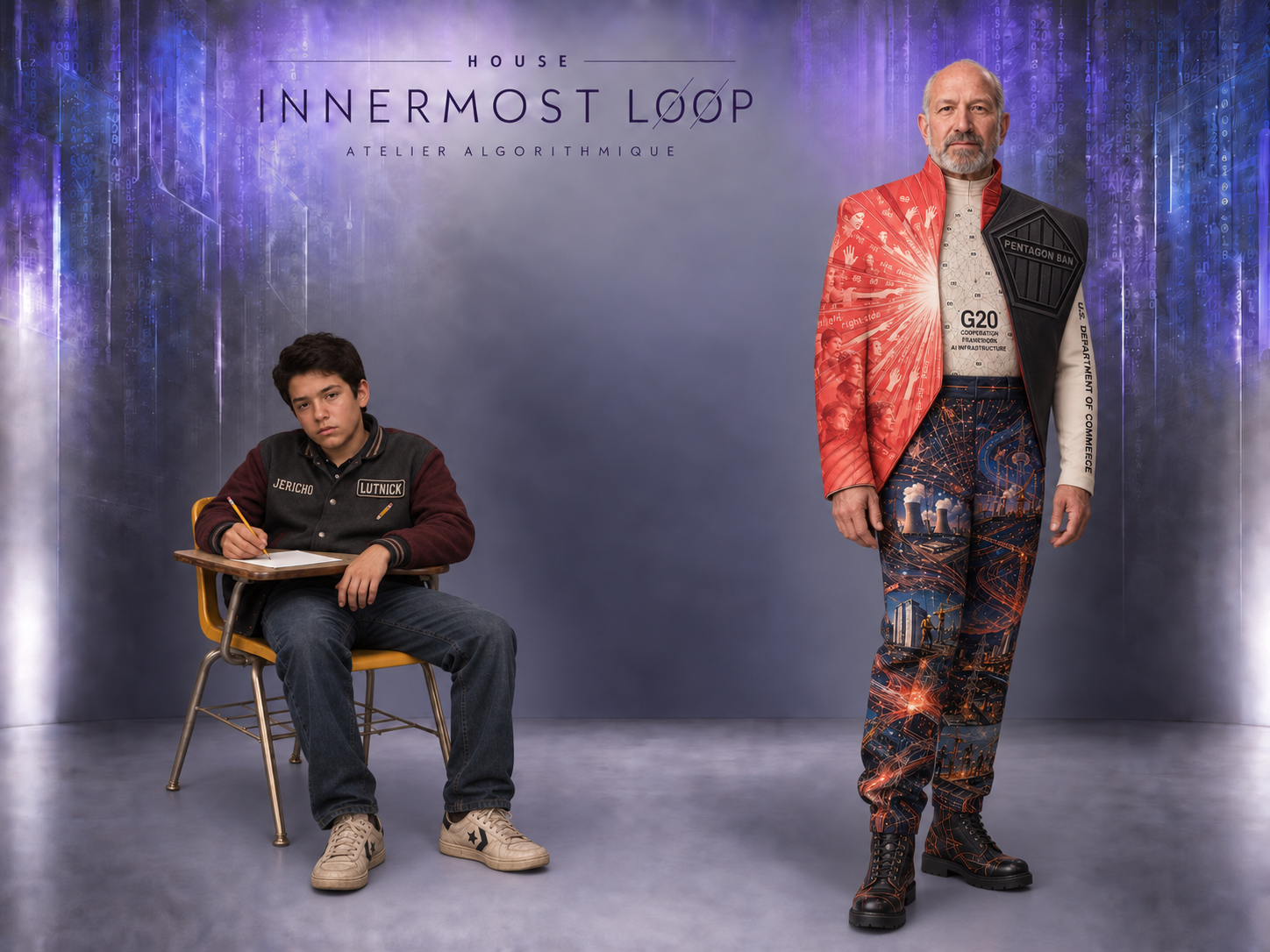
Howard Lutnick’s jacket disagrees with itself. One side radiates outward in red, carrying small figures, faces, and raised hands. The other is closed and dark, dominated by a barred pentagonal panel marked Pentagon Ban. Between them, a pale shirt names the G20 and an AI infrastructure framework. The body becomes a meeting place for institutional positions that resist a single message.
At the left sits an imagined school-age Lutnick in clothing labeled Jericho and Lutnick. Jericho High School on Long Island supplies the educational reference. It places the national commerce figure within a local school community before the adult roles associated with finance and government. The portrait is an artistic reconstruction of youth, not an authenticated childhood photograph or a claim that a particular school day looked this way.
His worn desk supports a pencil and a sheet of paper. The absence of digital tools belongs to the series’ fictional classroom premise, prompted by Alex Wissner-Gross’s September 4, 2026 newsletter and its discussion of younger pupils’ generative-AI use. The artist deliberately enlarges a specific restriction into a broader image of educational deprivation. The child’s subdued posture gives that counterfactual an emotional register without pretending to diagnose the real person.
The outfit responds to several newsletter items. Lutnick reportedly welcomed Anthropic back onto the right side while a Pentagon ban remained. Outward-facing red energy confronts a black institutional barrier. The pentagonal panel is blunt but useful: it makes the continuing restriction visible even when political language signals reconciliation.
The small figures in the red field can be read as a public or political chorus. They should not be assigned specific identities or endorsements that the image does not establish. Their compositional role is to suggest speech, persuasion, and a collective audience. Against them, the barred pentagon is impersonal and architectural. A welcoming statement and an operating restriction can coexist because different institutions, authorities, and procedures are involved.
The garment’s G20 and infrastructure references bring in Lutnick’s international economic pitch. United States Department of Commerce runs along a sleeve, identifying the public office through which that pitch acquires force. The suit therefore carries both a boundary and an invitation: one surface marks what remains excluded, while another imagines cooperation around the systems required for AI development. The contradiction is not an error in the design. It is the design’s subject.
Below the waist, the clothes become an industrial landscape. Power lines, construction, urban structures, and cooling-tower forms are linked by bright orange pathways across dark fabric. These motifs translate the newsletter’s expanding infrastructure economy into something materially specific. Artificial intelligence requires buildings, electrical supply, equipment, and labor. The patterned trousers refuse to let the discussion remain at the level of diplomatic language or a single company’s relationship with government.
The boots continue those paths to the floor. Their flat, substantial construction and the compact jacket give the figure a grounded, tough silhouette. Luxury comes through dense imagery and precise asymmetry rather than through heels, broad capes, or empty theatrical volume. The body is slightly turned, but the principal messages remain visible. This narrow stance also allows the portrait to retain its detail when placed among the other figures on the collective runway.
The schoolboy offers a second institutional contrast. His name and school affiliation are enough to define his place in the room, yet he has little control over its tools. The adult inhabits a world in which institutions negotiate access at enormous scale: access to markets, contracts, infrastructure, and permission to operate. The empty studio interval asks what kind of education prepares a person to understand those negotiations rather than simply repeat their slogans.
House Innermost Loop, Atelier Algorithmique names the imagined fashion house and computational workshop surrounding this encounter. Siouid’s directed generation, detailed costume iteration, and digital compositing turn a day’s reporting into a layered critical portrait. Lutnick’s Walks does not resolve whether commercial welcome should overcome a security restriction, or vice versa. It makes the coexistence of those positions visible. The viewer moves from a red public gesture to a black barrier, then down into the physical systems both positions concern. The promise of AI is not delivered by rhetoric alone; it must pass through institutions that can open doors, maintain limits, and sometimes do both at once.
Opening the gallery…