70 Clock Galerie / The Innermost Loop Feed Reply Tableaux
Matt Shumer Défile – Maison de la Boucle la Plus Profonde
House Innermost Loop – Matt Shumer Walks
September 4 2026
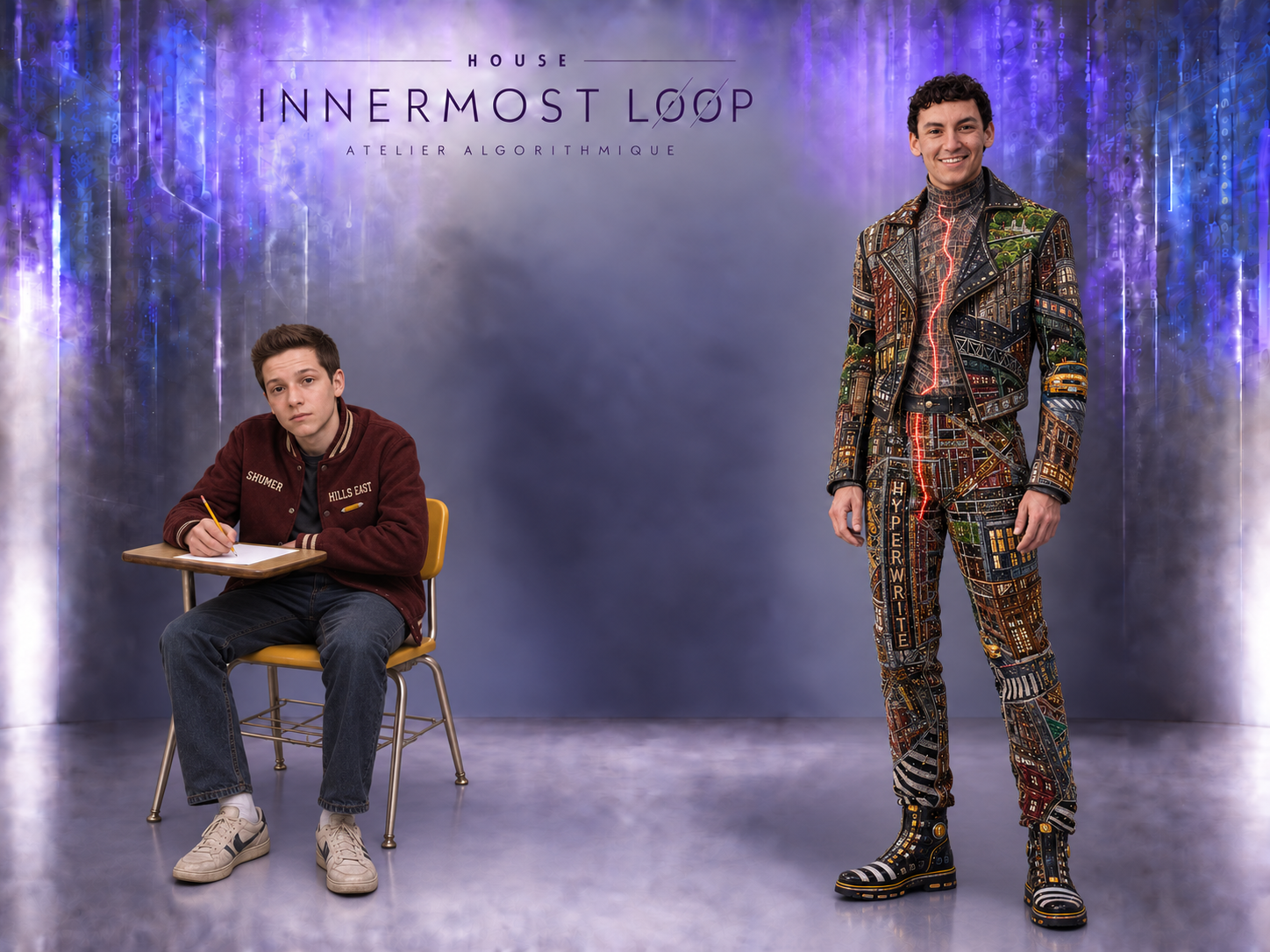
Matt Shumer Défile – Maison de la Boucle la Plus Profonde House Innermost Loop – Matt Shumer Walks Matt Shumer wears a city that can be followed from collar to pavement. Warm windows glow across the jacket. Bridge spans and architectural fronts occupy the slee
Read the narration
Matt Shumer Défile – Maison de la Boucle la Plus Profonde
House Innermost Loop – Matt Shumer Walks
Matt Shumer wears a city that can be followed from collar to pavement. Warm windows glow across the jacket. Bridge spans and architectural fronts occupy the sleeves. A red-orange line moves through the torso and down the trousers like a route selected on a map. Near the feet, crosswalk patterns turn the boots into a continuation of the streets. The outfit is not simply urban in mood; it is organized as a miniature built environment.
At the left, an imagined school-age Shumer sits in a burgundy jacket labeled Hills East and Shumer. Hills East refers to Half Hollow Hills High School East in Dix Hills on Long Island, which he attended. The school name gives the youthful figure a specific suburban beginning beside the adult’s metropolitan imagery. This is an artistic reconstruction, not a historical photograph, and the visual continuity between the figures serves the portrait’s argument rather than claiming documentary exactness.
The boy’s desk is worn and small. He has a pencil and a sheet of paper, but no visible digital tool. His subdued frustration belongs to the series’ counterfactual classroom: future technological figures are imagined being denied the instruments that will later expand their work. The premise responds to the education-policy discussion in Alex Wissner-Gross’s September 4, 2026 newsletter, while exaggerating a restriction on younger pupils’ generative-AI use into a much broader analog limitation.
The adult’s clothing supplies the opposite condition. Its city extends across virtually every available surface. A fitted, biker-like jacket provides the basic structure, but studded lapels, intricate panels, gold-lit facades, and sharply patterned trousers transform that familiar form into speculative couture. The silhouette remains compact. Instead of making the figure physically enormous, the design makes his clothes informationally dense.
HyperWrite runs vertically down a trouser leg, identifying the AI writing company Shumer co-founded. The name is embedded in the street environment rather than isolated as a sponsor label. In the newsletter, his immediate story was not simply corporate identity. It was his use of Astra to reconstruct Manhattan street by street, an experience described as restoring his enthusiasm for the model. The garment translates that specific creative encounter into a body-sized city.
The reconstruction must be understood as a digital representation. The outfit does not claim that the actual borough was built by a language model, nor that a generated environment automatically reproduces every street correctly. Its subject is the striking expansion of what one person can attempt with a computational tool: not merely describing a place, but asking a model to help assemble a spatially extensive version of it.
That distinction gives the red-orange route a useful role. It guides the viewer through the abundance rather than allowing the urban motifs to dissolve into decorative noise. A city is not just a mass of buildings; it is an arrangement through which people and information move. Bridges, streets, crossings, and lit interiors suggest circulation and occupancy. The clothing makes those relationships visible without requiring a literal map legend.
The dark palette is warmed by gold windows and copper paths. Technology is represented through a human-scale city rather than an empty field of neon machinery. Even where the pattern becomes highly abstract, it retains the suggestion of places where people live, travel, and work. This is why the garment’s density feels narrative rather than arbitrary: its smallest marks contribute to the same recognizable world.
The desk and the city establish the artist’s intended educational contrast. Pencil work occupies one small surface; the adult’s garment distributes a generated Manhattan across an entire body. Street grids and pathways repeat the idea of a route at different scales. The image’s argument about access is carried by that difference in pictorial reach.
House Innermost Loop and Atelier Algorithmique identify the violet-gray studio as an imagined fashion house and computational workshop. Siouid uses directed generation, symbolic garment design, and digital assembly to turn Shumer’s reported experience into a standalone portrait. The method mirrors the subject: a tool helps construct an environment, and human direction determines which details carry meaning. Shumer’s Walks ends at that meeting point. The adult wears an expansive city; the child waits at a narrow desk. Between them lies neither automatic progress nor mere nostalgia, but a choice about the scale of the worlds a learner is allowed to try making.
Opening the gallery…