70 Clock Galerie / The Innermost Loop Feed Reply Tableaux
Greg Kamradt Défile – Maison de la Boucle la Plus Profonde
House Innermost Loop – Greg Kamradt Walks
September 4 2026
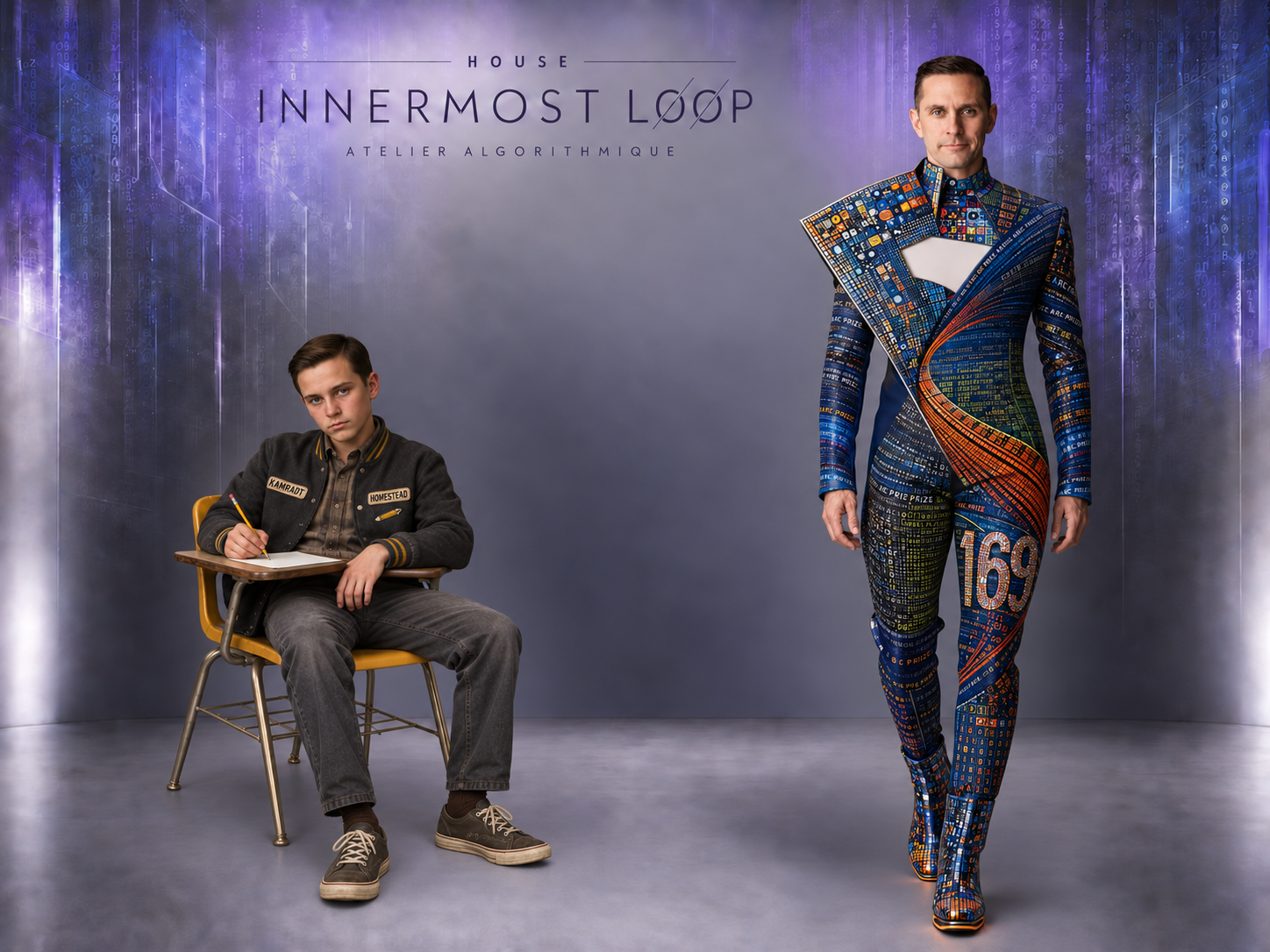
Greg Kamradt Défile – Maison de la Boucle la Plus Profonde House Innermost Loop – Greg Kamradt Walks The orange path across Greg Kamradt’s clothing seems to search for its own route. It begins among densely packed colored cells, cuts through a sharply construc
Read the narration
Greg Kamradt Défile – Maison de la Boucle la Plus Profonde
House Innermost Loop – Greg Kamradt Walks
The orange path across Greg Kamradt’s clothing seems to search for its own route. It begins among densely packed colored cells, cuts through a sharply constructed torso, and sweeps toward the leg carrying the enormous number one hundred sixty-nine. The garment looks at once like a puzzle, a scoreboard, and a path through a field of possible answers. It is a portrait about evaluation rather than merely the excitement of a high score.
At the left, an imagined school-age counterpart sits with a pencil at a battered desk. Homestead and Kamradt appear on the dark jacket. The school wording functions as identification within the artist’s reconstruction; it does not authenticate a particular childhood photograph. The portrait places its question about evaluation at the beginning of a learning life.
The boy’s restricted tools belong to the series’ fictional classroom, prompted by Alex Wissner-Gross’s September 4, 2026 newsletter and its discussion of younger students’ generative-AI use. The artist exaggerates a policy restriction into a pencil-only setting. His quiet frustration is therefore part of the constructed premise, not a psychological claim about the real person. The contrast asks what future evaluators of intelligence are allowed to explore while they are still being educated.
The adult outfit refuses large areas of blank cloth. Small orange, blue, white, and dark cells cover the jacket; fine columns and pathways continue over the trousers and boots. The raised, angular shoulder introduces a dramatic silhouette without spreading into a cape. A pale geometric opening at the chest interrupts the density, giving the eye a resting point before it resumes tracing the pattern. This is couture conceived as an organized problem space.
ARC Prize markings identify Kamradt’s institutional context. The newsletter reported Astra’s 99.9 percent ARC-AGI-3 result and Kamradt’s caution about declaring that general intelligence had therefore been achieved. It also described a shift in which some work previously handled by an external harness had moved into the model’s own behavior. The clothing translates that conversation into cells, routes, and recurring structures: not simply the answer to a puzzle, but the changing location of the machinery that solves it.
The large one hundred sixty-nine requires a separate explanation. It is the newsletter’s Epoch Capabilities Index figure for Astra. It is not Kamradt’s score, and it is not the ARC-AGI-3 percentage. Two different forms of measurement occupy the same garment because the newsletter placed them within the same capability debate. Keeping them distinct is part of reading the artwork carefully. A spectacular numeral can unify an image while still referring to a very specific metric.
That distinction is the portrait’s intellectual center. A benchmark measures performance under particular conditions. A declaration of artificial general intelligence reaches beyond any single number into definitions, transfer, robustness, and the kinds of tasks a system can handle. Kamradt’s reported restraint becomes visually interesting against the exuberance of the clothes. The outfit looks celebratory, but the position it represents refuses to let celebration substitute for judgment.
The orange path helps sustain that tension. It leads the eye through the cells rather than allowing the viewer to remain at the giant number. One has to inspect the route, the surrounding pattern, and the way the parts have been assembled. In that sense, the garment teaches a mode of attention appropriate to evaluation: look beyond the headline result and ask what processes, conditions, and definitions made it possible.
The schoolboy and adult are separated by open gray studio space, framed by violet digital curtains. House Innermost Loop names an imagined fashion house; Atelier Algorithmique names its computational workshop. Siouid’s directed image generation and compositing use machine assistance to construct a portrait of someone concerned with measuring machine capability. The work makes its own medium part of the question without claiming that image-making performance alone settles it.
Kamradt’s Walks finally places two kinds of assessment side by side. The child may be waiting for an answer to be marked on a sheet. The adult participates in a debate about how an entire class of intelligence should be judged. The picture’s abundance of pattern gives both situations dignity: learning is not empty because it is elementary, and a frontier result is not self-explanatory because it is impressive. Between the pencil and the number lies the difficult art of knowing what a test has—and has not—shown.
Opening the gallery…