70 Clock Galerie / The Innermost Loop Feed Reply Tableaux
Bernie Sanders Défile – Maison de la Boucle la Plus Profonde
House Innermost Loop – Bernie Sanders Walks
September 4 2026
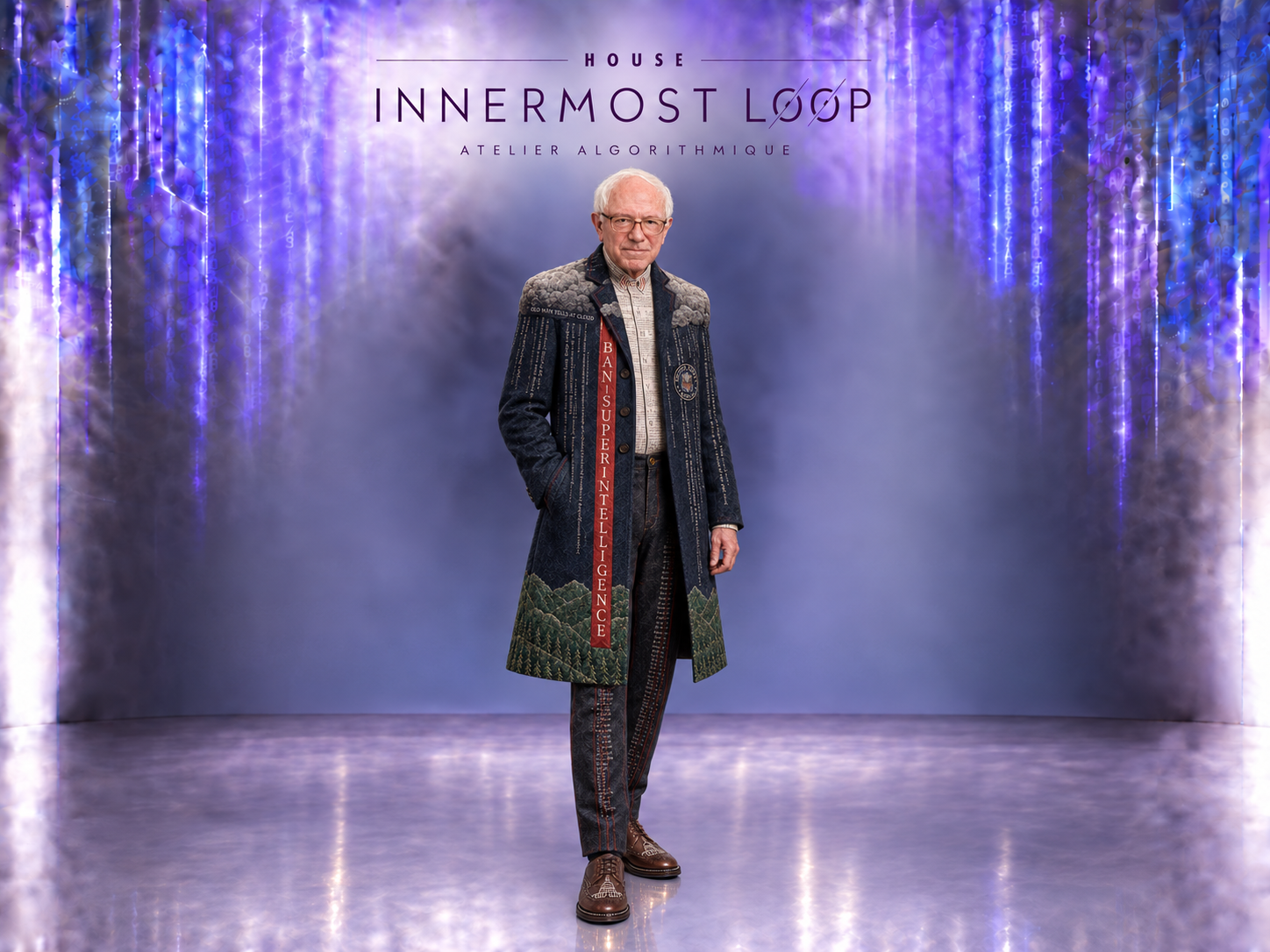
Bernie Sanders Défile – Maison de la Boucle la Plus Profonde House Innermost Loop – Bernie Sanders Walks Bernie Sanders does not shout in this portrait. He stands alone, one hand in a pocket, with a reserved expression and one foot slightly advanced. The gray-
Read the narration
Bernie Sanders Défile – Maison de la Boucle la Plus Profonde
House Innermost Loop – Bernie Sanders Walks
Bernie Sanders does not shout in this portrait. He stands alone, one hand in a pocket, with a reserved expression and one foot slightly advanced. The gray-violet studio gives him room. Unlike the paired portraits elsewhere in the series, there is no school-age double and no desk. The absence is meaningful: Sanders is not being imagined as one of the future founders awaiting permission to learn, but as an established public figure whose response to advanced AI is itself part of the technological present.
The coat initially appears familiar. Its dark color, long line, and modest tailoring recall a public servant’s practical outerwear. Looking more closely, however, every surface becomes an argument. Clouds gather across the shoulders. Fine pale marks fall vertically like rain or lines of text. A narrow red strip carries Ban Superintelligence down the front, while a Senate emblem locates the wearer within a legislative institution.
The immediate source is Alex Wissner-Gross’s September 4, 2026 newsletter, which reported Sanders’s proposed federal restrictions on artificial superintelligence. The proposal was not an enacted ban. It combined a prohibition on developing or deploying artificial superintelligence with a temporary pause on advanced AI development pending a regulatory framework. The clothing condenses that legislative direction into a forceful vertical phrase, making the wish to stop or delimit a technology bodily visible.
The red strip is especially effective because it does not transform the coat into an extravagant costume. It resembles a narrow banner stitched into otherwise sober dress. Resistance becomes something worn continuously rather than a placard briefly carried. Around it, the falling marks suggest the legal and informational density required to translate a political position into rules. The document-like shirt continues that sense of an institution speaking through text.
The clouds introduce the image’s satirical edge. A small phrase invokes the old-man-yelling-at-a-cloud meme, and the shoulders turn the joke into textile. In the related classroom tableau, Sanders gestures at a chalk cloud while the computational world flourishes outside. Here the agitation has subsided. The cloud remains, but the viewer is asked to inspect rather than simply laugh. It is both an atmospheric form and a reference to the infrastructure through which contemporary AI operates.
The cloud motif expresses the artist’s disagreement with prohibition as a response to advanced AI. Sanders’s stated proposal concerns safety and public accountability; the image’s satirical treatment does not establish the merits of that proposal. His restrained stance and familiar coat preserve the format of a recognizable public portrait beneath the meme reference.
At the hem, mountainous green forests bring Vermont into the garment. The landscape offers a geographic counterweight to the abstract scale of superintelligence. It recalls the constituency and place through which Sanders’s national political role is grounded, rather than describing his birthplace or an invented school affiliation. Brown shoes embroidered with a Capitol-like building carry the institutional theme to the floor. Law is not confined to a chest emblem; it underwrites the figure’s footing.
The trousers remain narrow and patterned, and the shoes have practical, grounded proportions. These choices give the outfit a different fashion language from the more reflective, sharply faceted technology portraits. Its luxury comes through density of surface and continuity of meaning rather than theatrical volume. Clouds, law, geography, and office coexist in a garment whose overall restraint makes its written demand harder to ignore.
House Innermost Loop, Atelier Algorithmique appears above the figure as the identity of an imagined fashion house and computational workshop. Siouid uses directed image generation, symbolic tailoring, and digital assembly to turn a newsletter item into a standalone portrait. The medium adds a productive irony: AI-assisted image-making is used to picture a politician arguing for strong limits on advanced AI. That irony invites reflection rather than settling the debate by itself.
Sanders’s Walks slows the meme into a standing portrait. The viewer encounters a person, then a coat, then the red wording of a legislative position. Clouds spread across the shoulders while institutional emblems hold the figure within a recognizable public role. In the artist’s visual vocabulary, the cloud connects a cartoon target to computational infrastructure. The garment gives both meanings room without turning either into a literal scene.
Opening the gallery…