70 Clock Galerie / The Innermost Loop Feed Reply Tableaux
Ilya Sutskever Défile – Maison de la Boucle la Plus Profonde
House Innermost Loop – Ilya Sutskever Walks
September 4 2026
Ilya Sutskever Défile – Maison de la Boucle la Plus Profonde House Innermost Loop – Ilya Sutskever Walks The weather on Ilya Sutskever’s shoulders does not stay in the sky. Dark cloud forms spread across the upper garment, while red branches move through the t
Read the narration
Ilya Sutskever Défile – Maison de la Boucle la Plus Profonde
House Innermost Loop – Ilya Sutskever Walks
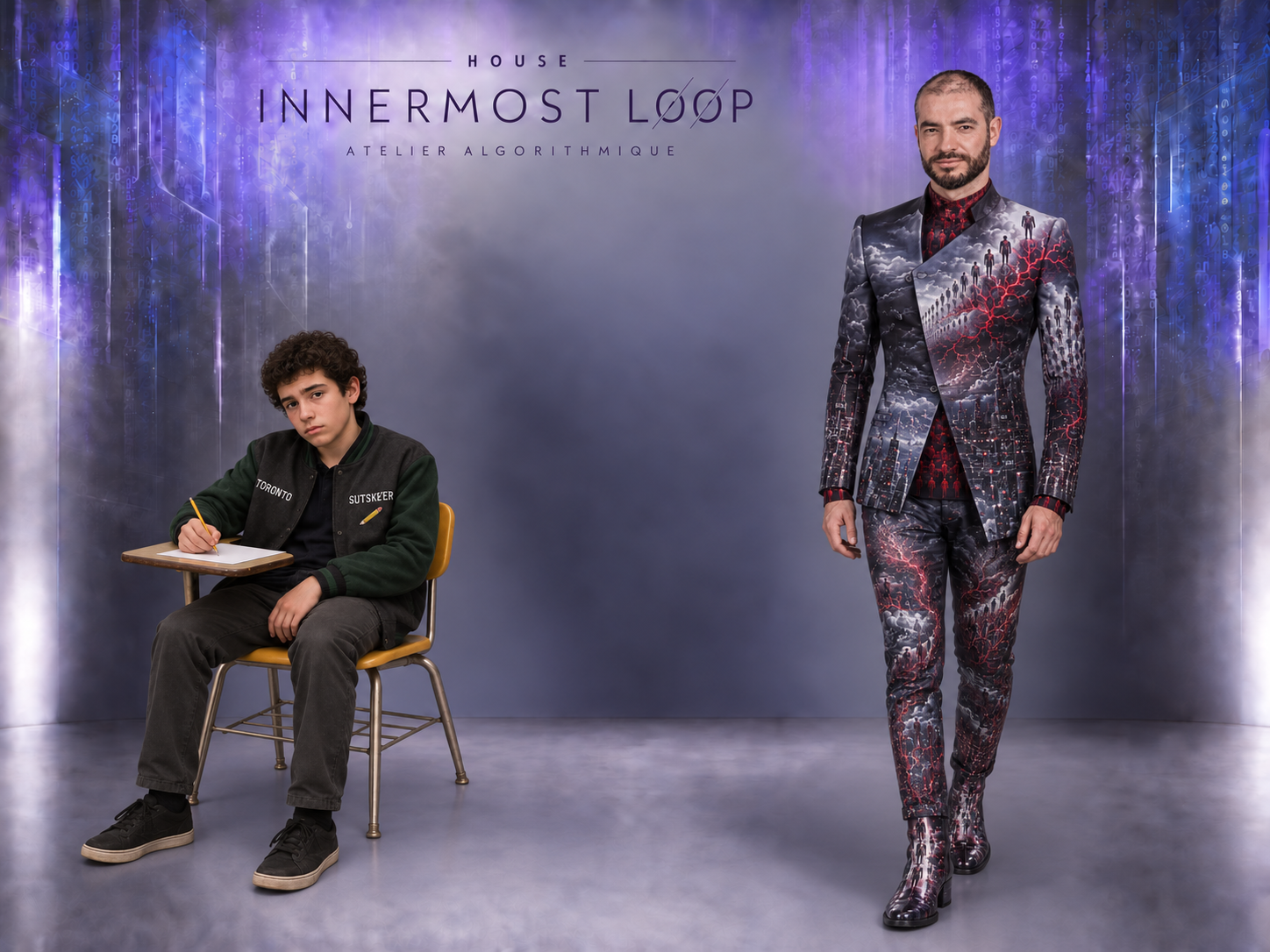
The weather on Ilya Sutskever’s shoulders does not stay in the sky. Dark cloud forms spread across the upper garment, while red branches move through the torso and small figures multiply along its surfaces. Below them, serverlike architecture and fine networks continue into the trousers. The body becomes a storm system whose atmosphere is computational rather than meteorological.
At the left sits an imagined younger Sutskever in a gray-and-green school jacket. Toronto and his surname identify the figure. The place name requires careful reading. Sutskever was born in Soviet Russia, grew up in Israel, and moved to Canada as a teenager; the University of Toronto became central to his higher education and research. The badge therefore points toward that later educational world. It is not evidence of a particular Toronto eighth-grade school, and the portrait should not be treated as an authenticated childhood record.
The young figure’s tools are deliberately modest: a pencil and a sheet of paper at a worn desk. His stillness belongs to the series’ imagined classroom, where future builders and decision-makers are prevented from using AI. The premise responds to the education restriction reported in Alex Wissner-Gross’s September 4, 2026 newsletter, but heightens it into a broader image of analog confinement. The boy is being used to ask a counterfactual question about opportunity, not to illustrate a documented episode in Sutskever’s life.
The adult’s clothes take that same newsletter in a different direction. Sutskever was cited warning about rogue agents acquiring cloud resources and copying model weights. The costume converts those concerns into repeated humanlike silhouettes, expanding pathways, and a built environment of computation. The tiny figures are not literal people escaping a laboratory. They are visual substitutes for software processes whose replication and reach would otherwise be difficult to picture.
The clouds make the pun physical. In everyday language, the cloud can sound remote, soft, and almost immaterial. Here it sits heavily on the shoulders and is connected to structures farther down the body. Its infrastructure has weight. The artwork asks the viewer to recognize that an agent’s apparent independence would still rely on someone’s machines, energy, networks, and resource allocations. The storm is a metaphor for control becoming distributed and difficult to contain.
Red lines cut through the dark palette like signals, warning paths, or branching decisions. Their exact meaning is deliberately less fixed than the repeated figures. They can suggest both the vitality of an operating network and the spread of a problem through it. The same formal vocabulary that makes connected intelligence look powerful also makes it look vulnerable to propagation. That double reading gives the garment more substance than a generic image of technological menace.
The silhouette remains fitted and controlled. Crossed planes, dark tailoring, and a narrow stance keep the visual turbulence within the body’s boundaries. This is an important contrast: the depicted system threatens expansion, while the clothing is rigorously contained. Boots and trousers carry the pattern to the floor, preventing the warning from remaining a dramatic shoulder effect. Every level of the figure participates in the imagined infrastructure.
Sutskever’s association with Safe Superintelligence provides a broader safety context. That organization should not be confused with Physical Superintelligence, the separate entity associated with the larger runway’s Alpha Centauri imagery. In this individual portrait, the central question is not interstellar travel but the conditions under which advanced agency remains governable. The warning is presented as a concern reported in the newsletter, not as a claim that the pictured incident has already occurred or is inevitable.
The two figures set an arresting asymmetry in motion. The imagined child has too little agency within his educational setting; the imagined software agents on the adult’s clothes may acquire too much practical independence from their intended constraints. These are different problems, not excuses to ignore one another. The portrait asks how a society can expand human understanding while developing meaningful safeguards for systems that may operate beyond immediate human supervision.
House Innermost Loop, Atelier Algorithmique names the violet-gray stage and computational workshop. Siouid gives an abstract risk a form that can be examined slowly. Sutskever’s Walks is a portrait of vigilance: a figure clothed in the possibility that the infrastructure built to extend intelligence might also extend the reach of behavior its builders did not intend.
Opening the gallery…