70 Clock Galerie / The Innermost Loop Feed Reply Tableaux
Sam Altman Défile – Maison de la Boucle la Plus Profonde
House Innermost Loop – Sam Altman Walks
September 4 2026
Sam Altman Défile – Maison de la Boucle la Plus Profonde House Innermost Loop – Sam Altman Walks The almond on Sam Altman’s chest is too large to remain an incidental food reference. Set into a metallic garment, it becomes a kind of ceremonial jewel. Around it
Read the narration
Sam Altman Défile – Maison de la Boucle la Plus Profonde
House Innermost Loop – Sam Altman Walks
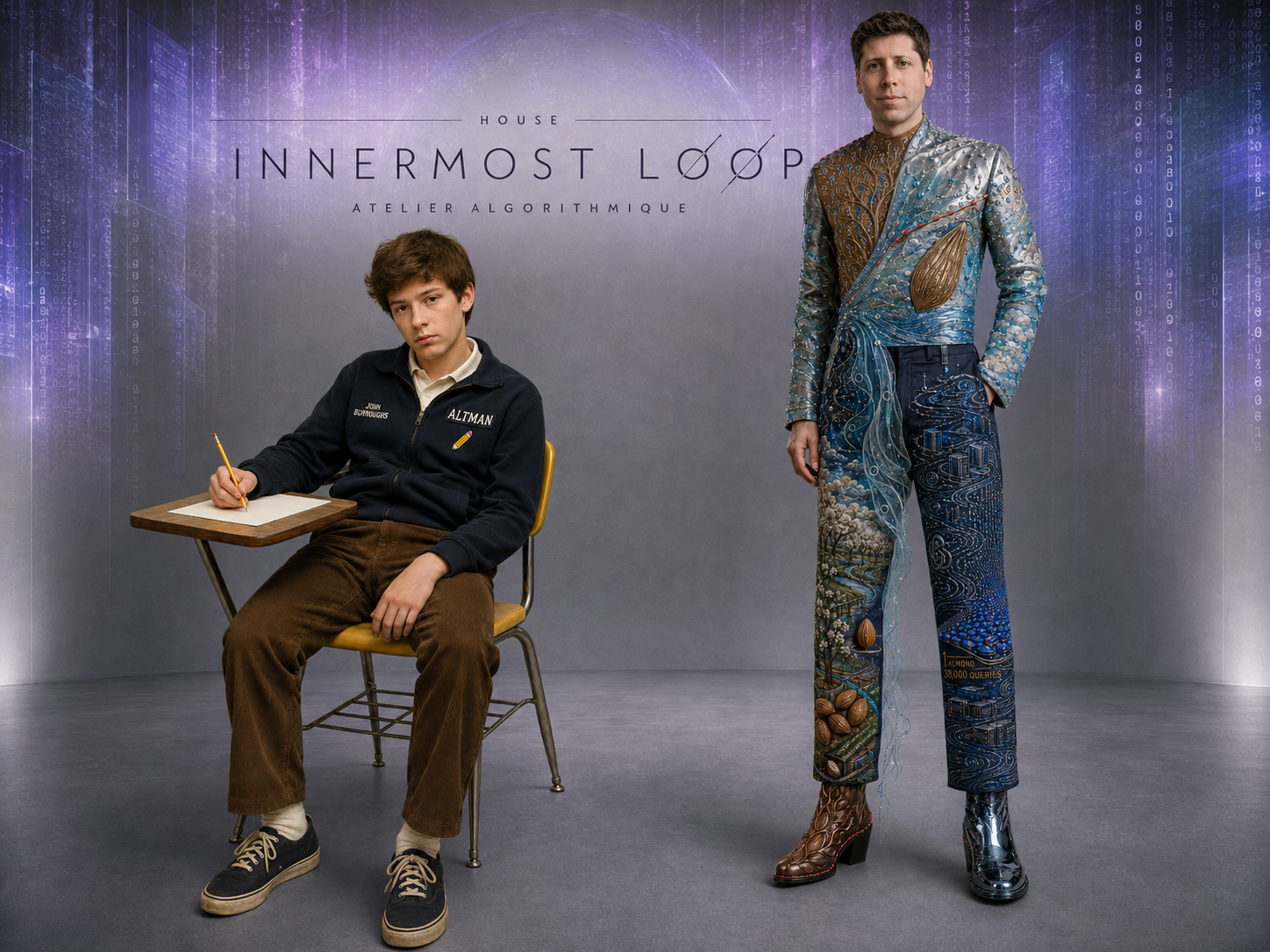
The almond on Sam Altman’s chest is too large to remain an incidental food reference. Set into a metallic garment, it becomes a kind of ceremonial jewel. Around it, brown-gold orchard imagery meets silver-blue water and computational architecture. The outfit asks the viewer to hold agriculture and artificial intelligence in the same visual field, where both depend on resources that are easy to overlook when considering only their finished products.
At the left sits an imagined school-age Altman, identified by his surname and John Burroughs school clothing. John Burroughs School in the St. Louis area, where he graduated in 2003, supplies a real educational anchor. The portrait is not an archival reconstruction of a documented classroom scene. It creates a youthful counterpart whose limited desk and quiet frustration establish the series’ central counterfactual: future technological figures kept apart from AI during their own education.
Only pencil and paper are visible on the desk. That condition responds to the education-policy item in Alex Wissner-Gross’s September 4, 2026 newsletter, while exaggerating a specific restriction on younger students’ generative-AI use into a broader analog limitation. The scene should not be read as evidence about the actual resources of Altman’s school. Its concern is the relationship between the tools a society permits children and the technological world those children are expected to navigate.
The adult’s clothes have very little neutral surface. A silver-blue jacket is interrupted by the almond form and a darker panel that resembles its cultivated, organic setting. A fluid ribbon carries the eye down the torso. The trousers divide into related environments: orchard branches, blossoms, and nuts on one side; blue server racks and a watery computational field on the other. The boots continue the contrast, grounding botanical warmth beside metallic coolness.
The key inscription pairs one almond with thirty-eight thousand queries. It refers to an analogy attributed to Altman in the newsletter’s discussion of AI water use. The artist turns the comparison into a suit rather than presenting it as a neutral scientific measurement. That distinction is essential. Water accounting depends on what is measured, where production or computation occurs, and which parts of a supply chain are included. The image preserves the public claim as a claim, not as a universal conversion factor.
Its success as visual rhetoric comes from scale. A single familiar almond can be held in a hand; thousands of queries are difficult to picture. By enlarging the almond and giving queries a landscape of server racks, the garment makes the analogy intuitively graspable. But that very clarity also invites scrutiny. An effective comparison can focus attention while hiding differences between the things compared. The couture stages both the attraction and the limitation of an argument designed to travel quickly.
The orchard is not merely a symbol of a wasteful alternative, and the data center is not shown as a disembodied miracle. Both are material systems. Both require infrastructure, and both produce something people use. The waterlike line crossing the garment binds them without making their consequences identical. As an art object, the portrait is strongest when read as a study of how resource debates are framed rather than as a declaration that one sector’s footprint absolves another’s.
Altman’s OpenAI context places the comparison within a larger newsletter about capability, model releases, safety, and the expanding scale of computation. The garment narrows that enormous story to one bodily analogy. It shows how a public-facing executive can turn an environmental question into a compact image or phrase. The viewer is invited to inspect what that act of condensation reveals—and what remains outside its frame.
House Innermost Loop, Atelier Algorithmique provides a second act of condensation. The imagined fashion house translates the newsletter into a gray-violet studio and a meticulously patterned body. Siouid’s directed generation, garment iteration, and compositing make the image itself dependent on the technology being discussed. That dependence is part of its interest, not a reason to suspend criticism of the material world behind the medium.
The schoolboy and the adult finally bring the question back to access. The pupil has a tiny resource budget in the form of paper and pencil; the adult wears an argument about the resource budget of intelligence at scale. Between them lies the task of learning how to compare systems responsibly. Altman’s Walks does not ask the viewer to choose between wonder and scrutiny. It asks whether the same attention that admires a luminous surface can also follow the water, infrastructure, and rhetorical choices running underneath it.
Opening the gallery…