70 Clock Galerie / The Innermost Loop Feed Reply Tableaux
Ron DeSantis Défile – Maison de la Boucle la Plus Profonde
House Innermost Loop – Ron Desantis Walks
September 4 2026
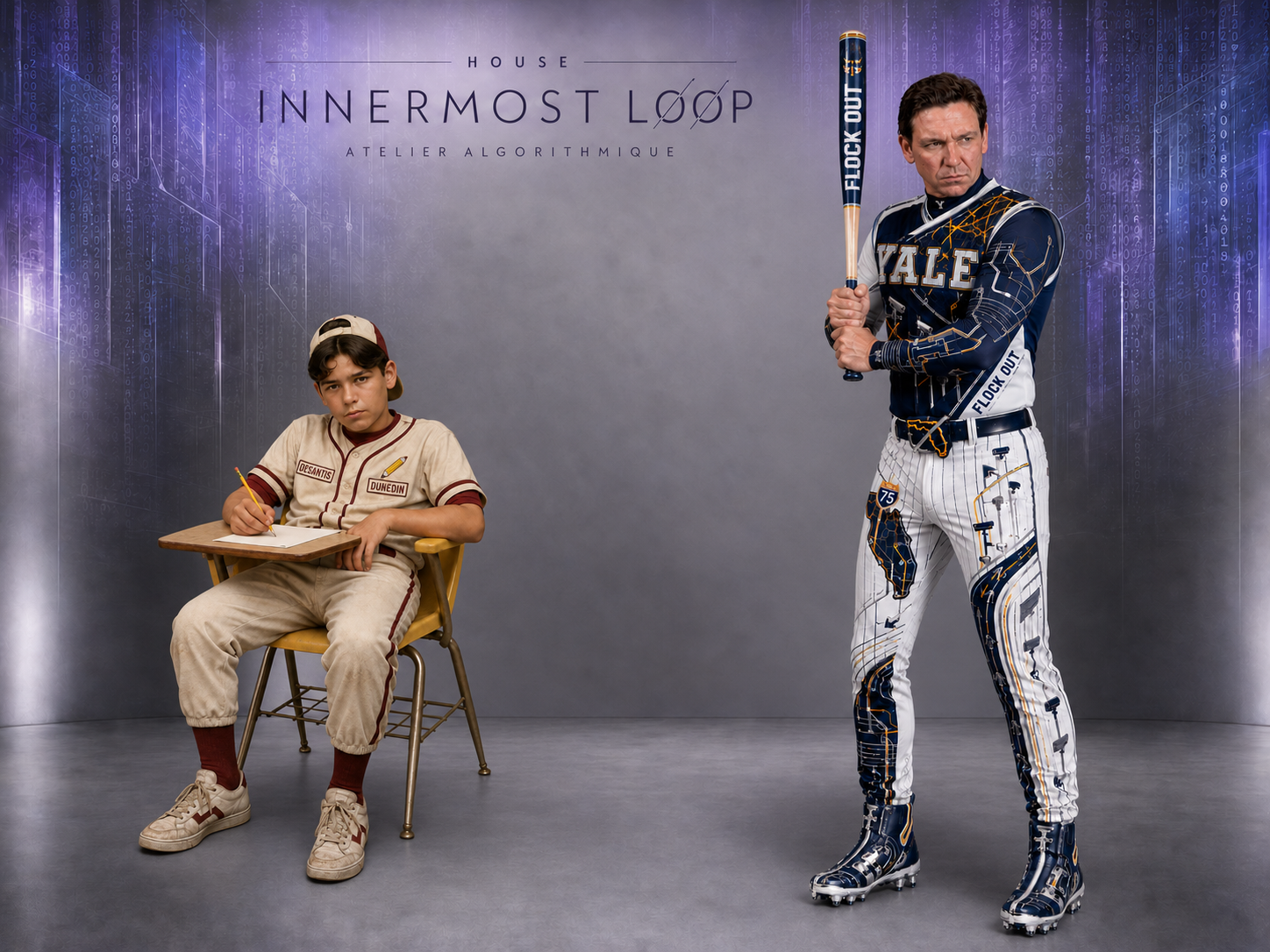
Ron DeSantis Défile – Maison de la Boucle la Plus Profonde House Innermost Loop – Ron DeSantis Walks The bat is held upright, not swung across the picture. That choice makes Ron DeSantis’s stance unusually concentrated. His face has the intensity of a hitter w
Read the narration
Ron DeSantis Défile – Maison de la Boucle la Plus Profonde
House Innermost Loop – Ron DeSantis Walks
The bat is held upright, not swung across the picture. That choice makes Ron DeSantis’s stance unusually concentrated. His face has the intensity of a hitter waiting for a pitch, but the action is contained within a narrow silhouette. Flock Out runs along the bat, converting a piece of sporting equipment into an inscription about a contemporary surveillance dispute.
At the left, a younger version sits at a battered school desk in cream and burgundy Dunedin Falcons baseball clothes. Dunedin and DeSantis identify the school-age figure. The reference connects to his Florida upbringing and Dunedin High School baseball background. The adult’s Yale uniform introduces a later chapter: he played college baseball at Yale and became a team captain. The two uniforms therefore carry distinct biographical meanings rather than functioning as interchangeable athletic decoration.
The boy is an imagined adolescent counterpart, not an authentic photograph of a classroom episode. His pencil and single sheet of paper belong to the series’ fictional restriction on its future leaders. Alex Wissner-Gross’s September 4, 2026 newsletter discussed New York City’s temporary limitation on younger pupils’ student-facing generative AI. The artist amplifies that debate into a nearly tool-less educational environment. Nothing in the image establishes that DeSantis’s actual school imposed such conditions.
The adult uniform takes familiar baseball forms and pushes them into speculative luxury. Navy and white are sharpened by fitted construction, metallic accents, gold routes, and carefully placed patterns. The clothes retain the physical readiness of sportswear while acquiring the visual density of a couture surface. There is no broad cape and no apparatus projecting far from the body. Every important reference is carried by the shirt, trousers, footwear, or tightly held bat.
Florida’s outline, an interstate marker, roadlike lines, and embedded camera forms explain why this is not simply a portrait of an alumnus in team colors. The newsletter reported an order affecting Flock cameras installed in Florida state-road rights-of-way. That scope matters. The image’s forceful slogan should not be mistaken for evidence of a blanket prohibition on all surveillance cameras everywhere. The artwork condenses a particular jurisdictional action into a memorable sporting gesture.
The camera motifs are integrated into the fabric rather than floating beside it. Their placement makes observation part of the environment the body inhabits. Road markings and network lines suggest that surveillance operates through ordinary infrastructure: routes people travel, permits institutions issue, and systems that collect information as daily life proceeds. The bat becomes a symbol of intervention in that network, not a depiction of an actual assault on a person.
The difference between the two hand-held tools is especially pointed. The younger figure has a small pencil, suited to the narrow demands of a school exercise. The adult has a bat with a public message, held with the confidence of someone able to challenge an arrangement. Both are instruments, but their scales of agency differ. One records an answer on paper; the other announces a boundary in the public world.
This contrast prevents the portrait from reducing to a simple position for or against technology. The wider series criticizes withholding AI from imagined students, while this garment addresses limits on a particular use of cameras. The work can therefore be read as a question about distinctions: access to a cognitive tool and exposure to surveillance are not the same experience. A society may need to decide differently about different systems, rather than treating technology as one indivisible category.
House Innermost Loop and Atelier Algorithmique place the pair inside an imagined fashion house and computational workshop. Violet symbols frame a gray studio that leaves the uniform’s details clear. Siouid’s directed generation, iterative costume design, and digital assembly turn biography and policy into a compact visual narrative. The baseball stance supplies energy without requiring the figure to occupy an entire stage.
Viewed independently, DeSantis’s Walks is a portrait of readiness: the readiness of an athlete, a public official, and an imagined pupil whose abilities are still being formed. The title’s motion is held in suspension. He has not yet hit the pitch. That pause gives the viewer time to read the images running over the fabric and to ask what kind of action the slogan promises. The force of the piece lies not in indiscriminate aggression, but in the tension between a trained body, an institutional boundary, and the choice of what should be allowed to pass.
Opening the gallery…