70 Clock Galerie / The Innermost Loop Feed Reply Tableaux
Michael Kratsios Défile – Maison de la Boucle la Plus Profonde
House Innermost Loop – Michael Kratsios Walks
September 4 2026
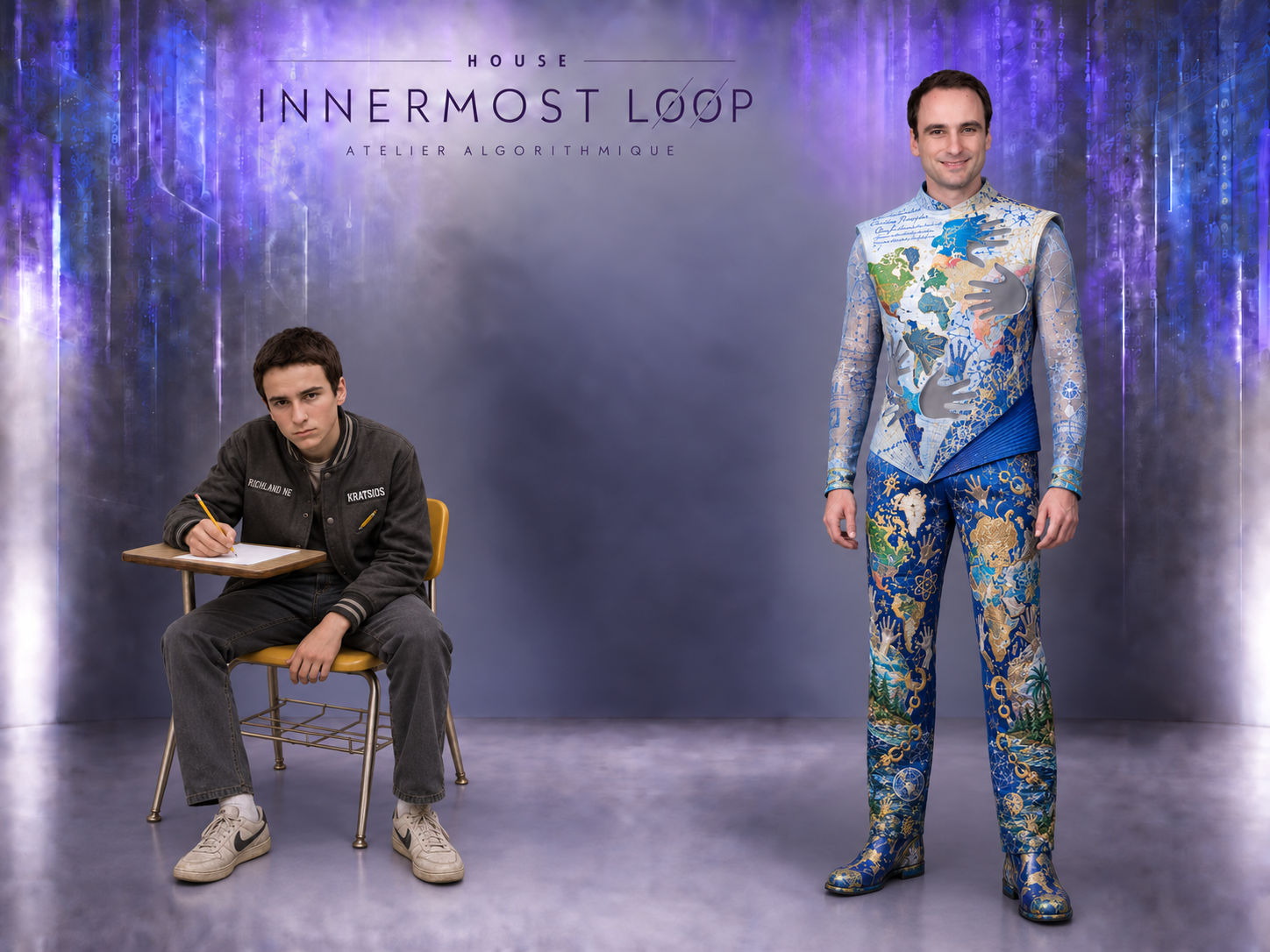
Michael Kratsios Défile – Maison de la Boucle la Plus Profonde House Innermost Loop – Michael Kratsios Walks The hands on Michael Kratsios’s clothing are nearly as important as the hands of the wearer. Large, open shapes cross a map of the world, while smaller
Read the narration
Michael Kratsios Défile – Maison de la Boucle la Plus Profonde
House Innermost Loop – Michael Kratsios Walks
The hands on Michael Kratsios’s clothing are nearly as important as the hands of the wearer. Large, open shapes cross a map of the world, while smaller networks and linking forms continue down his sleeves and trousers. They might suggest cooperation, protection, or a loosening of control. The image holds those readings together rather than assigning one gesture a single, unchanging political meaning.
Across the studio sits an imagined younger Kratsios. His dark school jacket carries the Richland Northeast identification and his surname. Richland Northeast High School, in Columbia, South Carolina, supplies a real biographical location for the youthful portrait. This school reference is not decorative prestige alone. It places the future science-policy official within the ordinary geography of classrooms, teachers, and local institutions before his work acquires international reach.
The boy’s desk is small and worn. A pencil and paper define the visible tools available to him. Like the other youthful counterparts in this series, he is a fictional reconstruction rather than a documentary childhood likeness. His restrained, frustrated stillness belongs to the artist’s premise: the people who will later direct technological development are imagined being kept at a distance from AI during their formative years.
The immediate source is Alex Wissner-Gross’s September 4, 2026 newsletter, which placed a restriction on younger students’ generative-AI use beside rapid developments in models, infrastructure, and governance. The portrait intensifies that education debate into an analog-only scene. Its argument is visual and counterfactual; it does not claim that Kratsios’s real school had this policy or that every limitation on classroom AI is identical.
The adult garment moves from the local to the planetary. Pearl-white fabric carries colored continental forms, while blue panels introduce the depth and movement of water. A pleated wedge at the waist gives the ensemble a sharp, contemporary silhouette. Gold lines, chainlike links, and molecular-looking figures spread into the trousers. The imagery remains embedded in the tailoring, avoiding the separation between a plain suit and a collection of attached technological props.
Kratsios’s role in the newsletter concerned the Carolina Principles and an international AI conversation around the G20. His Office of Science and Technology Policy position supplies the governmental context. The name Carolina creates a subtle echo with the schoolboy’s South Carolina affiliation, but the two references do different work: one locates a person’s education, the other names a policy framework. The garment lets personal geography and public language meet without making them the same thing.
The open hands provide an especially economical interpretation of an approach emphasizing room for technological development. A hand can help build, support another hand, or withdraw from an object it has been gripping. Across the map, that ambiguity becomes productive. What looks like a hands-off principle from one angle can resemble a cooperative arrangement from another. The artist turns a policy position into a gesture whose consequences depend on how it is used.
The smaller links and networks qualify any idea of pure detachment. International technology does not operate without standards, infrastructure, agreements, or institutions. Even an argument for allowing innovation more space must negotiate relationships between countries and systems. The suit’s connected surfaces keep those relationships present. Its decorative abundance is therefore not simply a fantasy of frictionless globalization; it can also be read as the demanding work of coordination.
In the shared gray-violet studio, the schoolboy’s contained posture and the adult’s world-covered clothing establish a striking difference in reach. One person can act within the boundaries of a desk; the other is represented through a planetary field. The empty interval asks how that expansion becomes possible. Educational opportunity, access to tools, and the ability to understand systems sit between the two figures, even though none can be pictured as a single object.
House Innermost Loop, Atelier Algorithmique names the imagined couture house and computational workshop. Siouid turns the newsletter’s policy discussion into a portrait organized around gestures, geographic forms, and differences of scale. The school patch names a local institution; the adult’s fabric opens onto the planet. Their shared studio allows those two kinds of belonging to remain visible at once.
Opening the gallery…