70 Clock Galerie / The Innermost Loop Feed Reply Tableaux
Elon Musk Défile – Maison de la Boucle la Plus Profonde
House Innermost Loop – Elon Musk Walks
September 4 2026
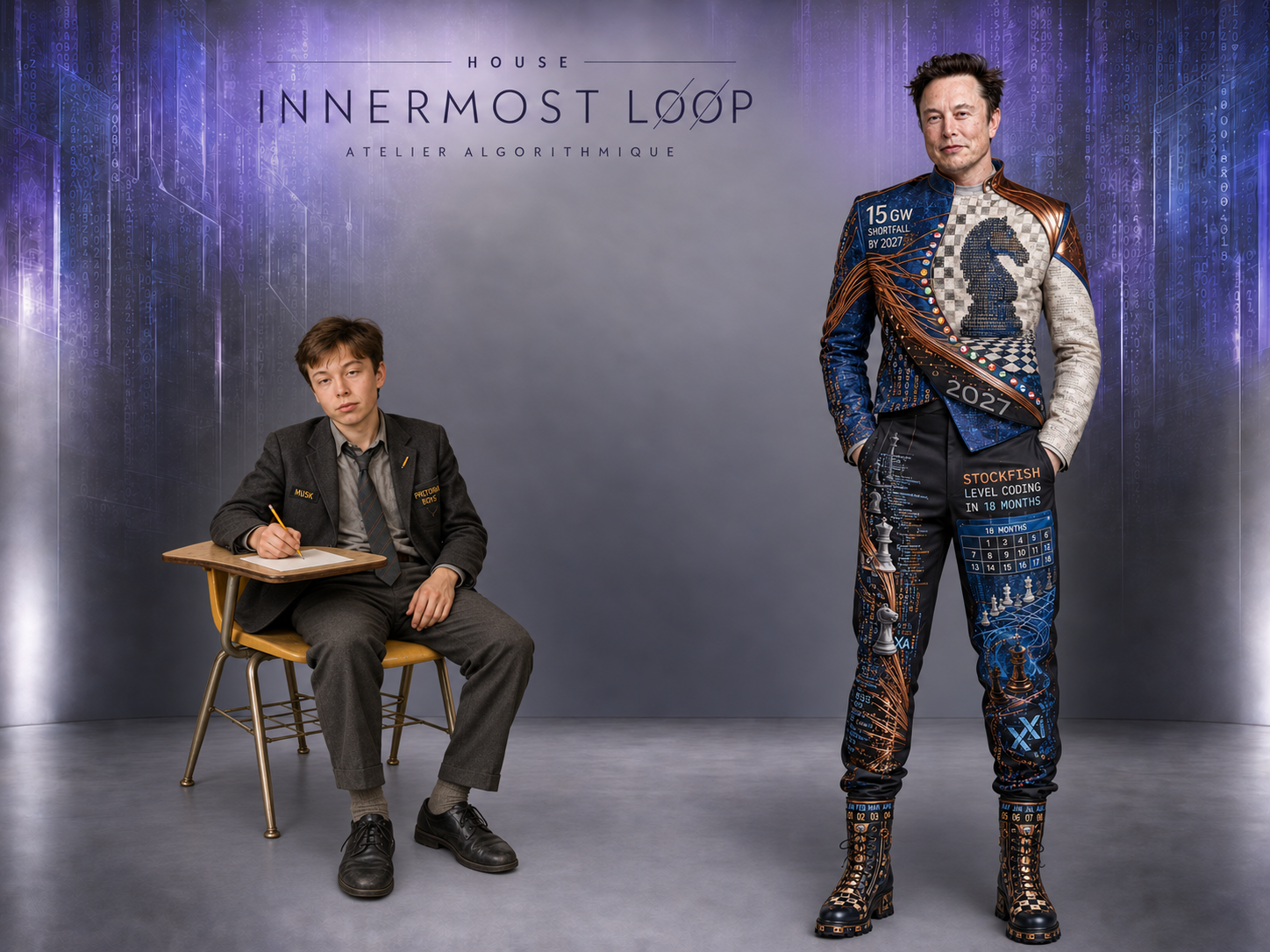
Elon Musk Défile – Maison de la Boucle la Plus Profonde House Innermost Loop – Elon Musk Walks A chess knight occupies Elon Musk’s chest, but the game being staged extends far beyond a board. Electrical paths curl around his torso. A calendar horizon crosses h
Read the narration
Elon Musk Défile – Maison de la Boucle la Plus Profonde
House Innermost Loop – Elon Musk Walks
A chess knight occupies Elon Musk’s chest, but the game being staged extends far beyond a board. Electrical paths curl around his torso. A calendar horizon crosses his waist. Predictions descend into the trousers, where coding prowess and a looming power shortage become components of the same outfit. The portrait’s central tension is between what intelligence might do and what the physical world can supply.
At the left, an imagined school-age Musk sits in a gray blazer, a loose striped tie, and school clothes bearing the Pretoria Boys identification. The reference is to Pretoria Boys High School in South Africa, which he attended. It anchors the global technological figure in a particular educational setting. The portrait is not presented as an authentic childhood photograph; it is a deliberately reconstructed younger counterpart whose posture belongs to the artwork’s fictional classroom premise.
The worn desk offers only pencil and paper. The boy’s subdued expression contrasts with the adult’s electrically animated clothing. Across this series, future builders and decision-makers are imagined as students denied AI while the world they will later inhabit is being transformed by it. The premise responds to the September 4, 2026 Innermost Loop newsletter’s account of restrictions on younger pupils’ generative-AI use. It is an artistic exaggeration of a policy debate, not a claim that Musk’s own school imposed the pictured conditions.
The adult costume avoids a generic space-age silhouette. It uses fitted trousers, a sharply cut asymmetric jacket, exposed-looking layers, and substantial lace-up boots. Ivory and cobalt surfaces are interrupted by orange and copper channels. The seam across the body functions like a conduit. Instead of treating technical imagery as a logo placed on otherwise empty clothes, the design lets that imagery determine the garment’s movement and construction.
One inscription names a fifteen-gigawatt shortfall by 2027. Another anticipates Stockfish-level coding in eighteen months. Both refer to forecasts attributed to Musk in Alex Wissner-Gross’s newsletter. Neither should be read as an independently established outcome. Their placement is nevertheless revealing: the coding promise and the energy warning inhabit the same body, refusing to let an extraordinary software prediction float free of the infrastructure required to support it.
Stockfish supplies the chess metaphor. A chess engine’s formidable performance offers a model for imagining coding systems that outstrip human skill in a similarly competitive domain. The knight and board translate that analogy into recognizable objects. They do not prove that programming and chess are identical problems. Rather, the artist gives a technological forecast the visual language through which its confidence can be felt—and questioned.
The electrical networks complicate that confidence. Data centers, transmission, generation, and operating capacity are physical conditions, not mere background to a model release. Copper-colored paths run toward the floor as if the suit itself needs a connection to an external supply. The flat, heavy boots help ground the figure. For all the garment’s luminous detail, it cannot escape the material world on which the imagined intelligence depends.
The xAI markings identify the institutional context of part of Musk’s AI activity. In the larger newsletter, frontier-model competition and autonomous systems accelerate together. Here those dispersed reports have been condensed into a wearable argument about speed. A deadline at the waist and a forecast down the leg make time almost architectural. The body becomes a measuring instrument for the interval between an announcement, an engineering effort, and a public result.
The studio surrounding the pair is equally deliberate. Gray space keeps the silhouette readable, while violet columns of symbols establish the computational atmosphere of House Innermost Loop, Atelier Algorithmique. The name describes an imagined fashion house and an algorithmic workshop. Siouid’s process combines reference-based characterization, directed image generation, detailed costume iteration, and digital assembly. Technical rhetoric is converted into surfaces the viewer can inspect.
The empty distance between the two Musks holds the artist’s educational premise beside the adult’s forecasts. Electrically animated tailoring answers a still body at a small desk. Across the garment, chess, coding, and power share one surface, making ambition and dependency visually inseparable. The title’s movement remains suspended in a portrait: a future imagined in months is represented through objects and systems that must operate in the physical world.
Opening the gallery…