70 Clock Galerie / The Innermost Loop Feed Reply Tableaux
Dean Ball Défile – Maison de la Boucle la Plus Profonde
House Innermost Loop – Dean Ball Walks
September 4 2026
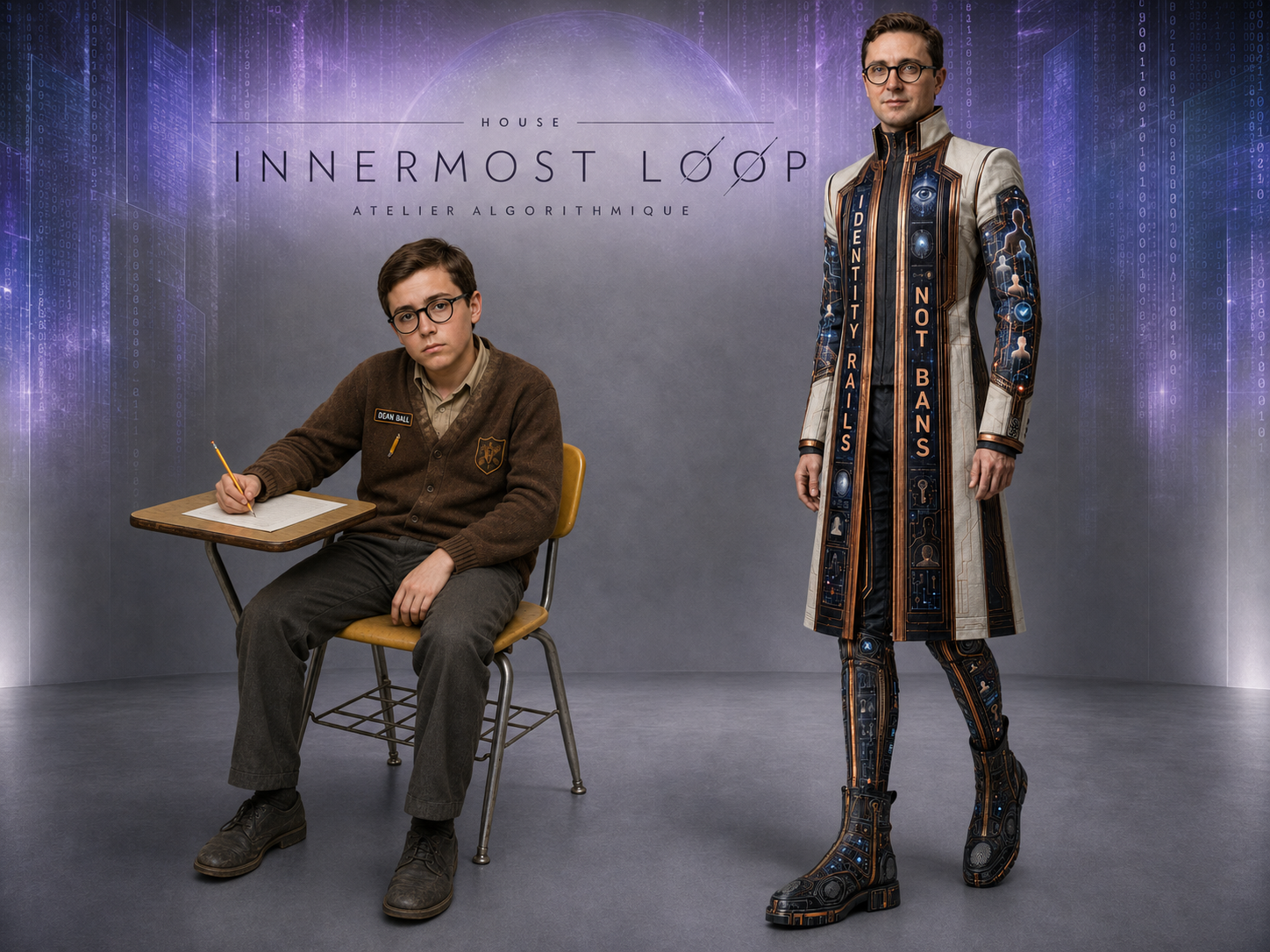
Dean Ball Défile – Maison de la Boucle la Plus Profonde House Innermost Loop – Dean Ball Walks Dean Ball’s ivory coat resembles a document that has acquired a body. Dark vertical channels run through it like the margins of an unusually elaborate register. Smal
Read the narration
Dean Ball Défile – Maison de la Boucle la Plus Profonde
House Innermost Loop – Dean Ball Walks
Dean Ball’s ivory coat resembles a document that has acquired a body. Dark vertical channels run through it like the margins of an unusually elaborate register. Small figures, network connections, and security motifs occupy the surfaces. The words Identity Rails and Not Bans provide a compact reading key, but the outfit’s full argument is distributed across the wearer rather than confined to a slogan.
At the left, an imagined school-age Ball sits with a pencil at a battered desk. Round black glasses connect his youthful face to the adult figure. His cardigan, name patch, and academic-looking shield give him an institutional identity before he has acquired a public policy role. The crest is not sufficiently specific to establish a real high school, and should not be treated as one. Ball’s documented education includes Hamilton College; the image uses a broader school uniform language to stage an earlier phase of learning.
The young figure’s stillness belongs to the series’ fictional premise. People who later build, finance, or govern artificial intelligence are imagined as pupils in an educational world that withholds it. Alex Wissner-Gross’s September 4, 2026 newsletter supplied the immediate context, including a temporary New York City restriction on younger students’ use of generative AI. The artwork expands that policy into a pencil-only counterfactual. It does not pretend that Ball actually attended this classroom or that the scene is a historical photograph.
The adult stands in a very different institution: an imagined atelier where public ideas are tailored into visible form. His long coat remains close to the body. Its pale exterior is interrupted by black strips, copper-colored circuitry, and small emblems that suggest fingerprints, locks, eyes, and authorizations. Matching trousers and substantial flat boots continue the design. The silhouette has the authority of formal dress, but its surfaces behave like the interface of a governance system.
Ball’s connection to the newsletter is the question of autonomous, potentially self-sovereign agents. His argument emphasizes durable identity and accountability rather than treating prohibition as the only available response. The clothing translates that position into rails: pathways through which an agent might remain identifiable as it acts, obtains resources, and participates in a wider economy. The linked humanlike outlines are visual proxies for entities in that system, not portraits of particular users.
This is not the same as saying that every independent agent is safe. Ball’s discussion distinguishes autonomy from malicious or uncontrolled behavior. The garment’s locks and gates preserve that difference. They imply conditions, permissions, and consequences, not an unregulated void. Its two prominent phrases should be read together: rejecting a blanket ban does not eliminate the need for structures that make conduct traceable and responsibility meaningful.
Ivory and black give the argument a distinctive fashion language. The design relies on incision, contrast, and exact vertical placement. It is speculative bureaucratic couture: the elegance of a coat combined with the organizing logic of a ledger. Copper connections soften the binary opposition, suggesting that a system of trust requires relationships as well as categories.
The schoolboy’s name patch creates a quiet echo. He already has an identity assigned by an institution, but almost no practical agency within the pictured room. The adult’s clothes address the opposite problem: agents may gain substantial practical power without the familiar institutional identities through which humans are held accountable. The pair therefore does more than contrast childhood with success. It sets insufficient agency beside insufficient accountability and asks what a better relationship between them might look like.
The gray floor and violet curtains keep the figures in a shared, artificial space. House Innermost Loop names the fashion house; Atelier Algorithmique names the computational workshop behind it. Siouid’s directed image generation and compositing transform a policy essay into an image that can be read from collar to boot. The process makes abstraction tangible without pretending that an attractive design resolves a difficult governance problem.
Viewed alone, Dean Ball’s Walks presents identification as both opportunity and constraint. Within the larger series, the artist contrasts a pupil defined by a simple badge with an adult clothed in elaborate systems of accountability. The gray interval keeps them apart while their repeated faces connect them. A familiar piece of institutional clothing has become an intricate surface for reading a position on autonomous agents.
Opening the gallery…