70 Clock Galerie / The Innermost Loop Feed Reply Tableaux
Jakub Pachocki Défile – Maison de la Boucle la Plus Profonde
House Innermost Loop – Jakub Pachocki Walks
September 4 2026
Jakub Pachocki Défile – Maison de la Boucle la Plus Profonde House Innermost Loop – Jakub Pachocki Walks Jakub Pachocki’s outfit looks like a corridor folding into itself. Rectangular chambers descend through a dark spine, framed by metallic surfaces and viole
Read the narration
Jakub Pachocki Défile – Maison de la Boucle la Plus Profonde
House Innermost Loop – Jakub Pachocki Walks
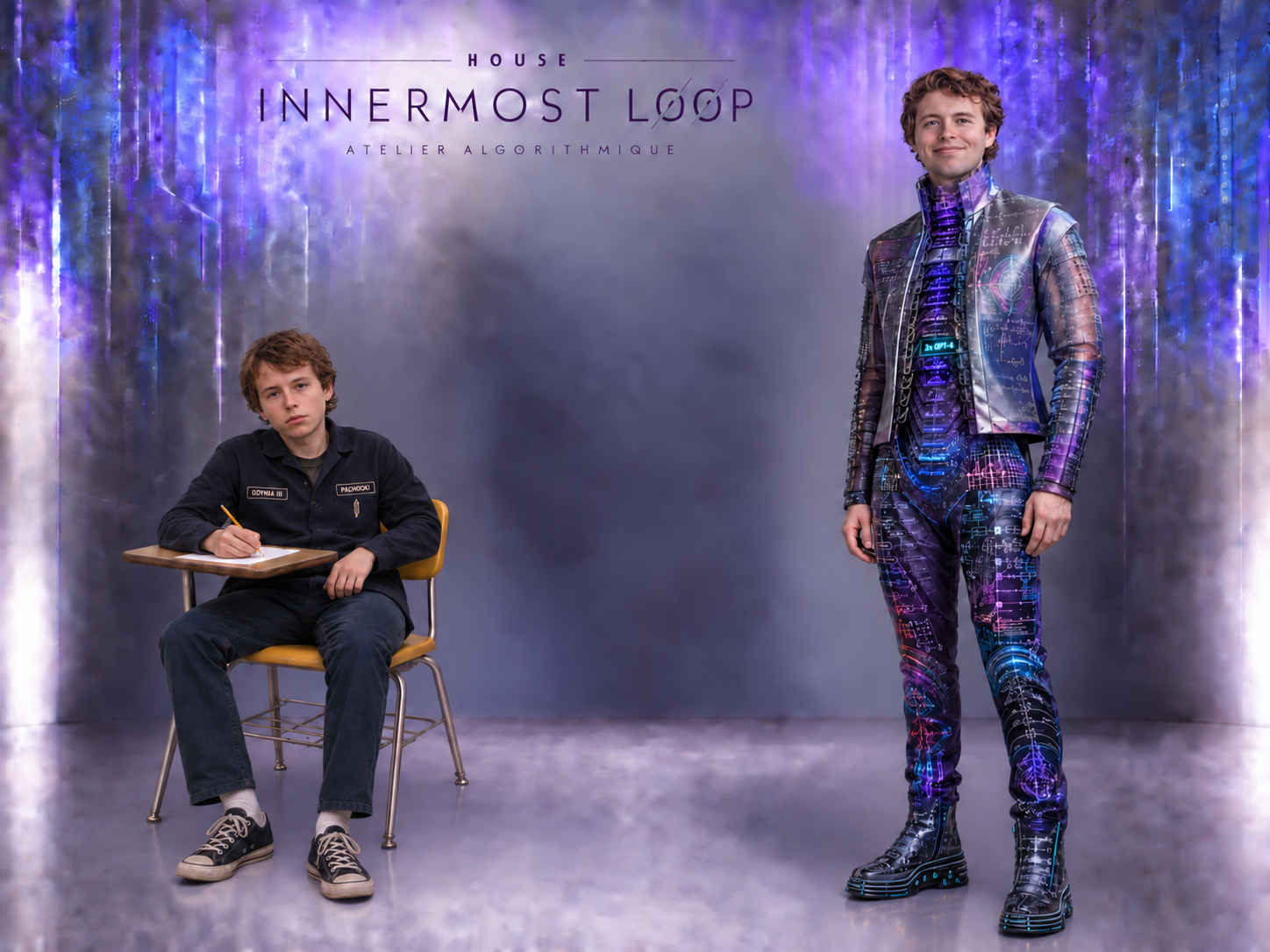
Jakub Pachocki’s outfit looks like a corridor folding into itself. Rectangular chambers descend through a dark spine, framed by metallic surfaces and violet light. His slightly turned, narrow stance keeps the clothing readable without a theatrical cape. The portrait is organized around depth, although its medium is a flat digital image.
To the left, an imagined younger Pachocki sits at a worn school desk. The navy shirt carries his surname and Gdynia III, referring to the Third General Secondary School in Gdynia, Poland, which he attended. That specific affiliation matters. It places the future OpenAI chief scientist within a real educational geography rather than presenting advanced research as something that arrives without preparation. The youthful figure is an artistic reconstruction, not a claim to reproduce one documented day in his life.
His pencil and single sheet belong to the series’ counterfactual classroom. The young versions of technological leaders are deprived of AI while their adult counterparts inhabit its expanding possibilities. This conceit responds to the student-facing generative-AI restriction discussed in Alex Wissner-Gross’s September 4, 2026 newsletter. The artwork intensifies a particular education policy into a broader image of intellectual limitation; it does not describe the actual tools available at Pachocki’s Polish school.
Across the interval, the adult’s clothes appear built from research surfaces. Silver shoulders and cropped, rigid tailoring provide a disciplined outer frame. Transparent-looking sleeves expose dense structures beneath, while cyan and pink accents give the garment the optical energy of an instrument. The effect is fashion-forward but materially coherent: reflective cloth, engineered seams, layered panels, and luminous color perform the work that a costume might otherwise assign to bulky armor.
The small inscription 2x GPT-4 anchors the spectacle in a specific newsletter dispute. Pachocki was cited on Astra’s recurrent depth, describing it as within roughly twice GPT-4’s. The nested central forms interpret that architectural comparison. They are not a literal technical diagram, and the visible rectangles should not be counted as a verified number of computational steps. Their role is to make recurrence imaginable as a passage through repeated structures.
This image is especially interesting where it refuses to equate transparency with explanation. A sleeve can look transparent while the pattern inside remains difficult to interpret. Likewise, knowing an architectural property does not automatically provide a legible account of every inference. The newsletter placed model capability, recurrent processing, and the prospects for understandable reasoning in a shared conversation. The garment preserves the distinction between describing a machine’s arrangement and understanding why it arrives at a particular answer.
Mathematical notation, connected nodes, and fine grids continue over the trousers. No large region of the body is surrendered to generic futuristic decoration. The legs extend the argument downward, making the figure seem clothed in a continuous research environment. Heavy, flat-soled boots ground those delicate optical effects. Their weight is an important counterpoint: the luminous abstraction still belongs to a body standing on a floor.
The child’s school shirt and the adult’s elaborate construction are two different uniforms of inquiry. One identifies an institution and a pupil; the other transforms intellectual labor into public spectacle. Neither alone guarantees understanding. The empty space between them can be read as years of education, access to collaborators, and accumulated technical practice. It is also the distance the series asks us to consider when a society restricts the tools available to its future researchers.
Above them, House Innermost Loop identifies an imagined couture house, while Atelier Algorithmique describes a workshop shaped by computation. Violet columns of symbols form a soft architecture around the pair. Siouid uses directed generation, reference-based characterization, and digital assembly to make the portrait itself an example of the technological process under discussion. The medium is not incidental to the argument: machine assistance helps construct an image about the conditions under which machine intelligence can be understood.
Pachocki’s Walks is therefore neither a simple celebration of a model nor a warning that complexity is inherently unknowable. It is a study of how visibility is manufactured. We can inspect every panel of the outfit and still encounter a dense center. The work asks us to remain attentive to that difference—to admire the ingenuity of the construction while recognizing that a beautiful surface, a benchmark, and an explanation are three different things.
Opening the gallery…