70 Clock Galerie / The Innermost Loop Feed Reply Tableaux
Vieil Homme Criant Après les Nuages
Old Man Yelling at The Clouds
September 4 2026
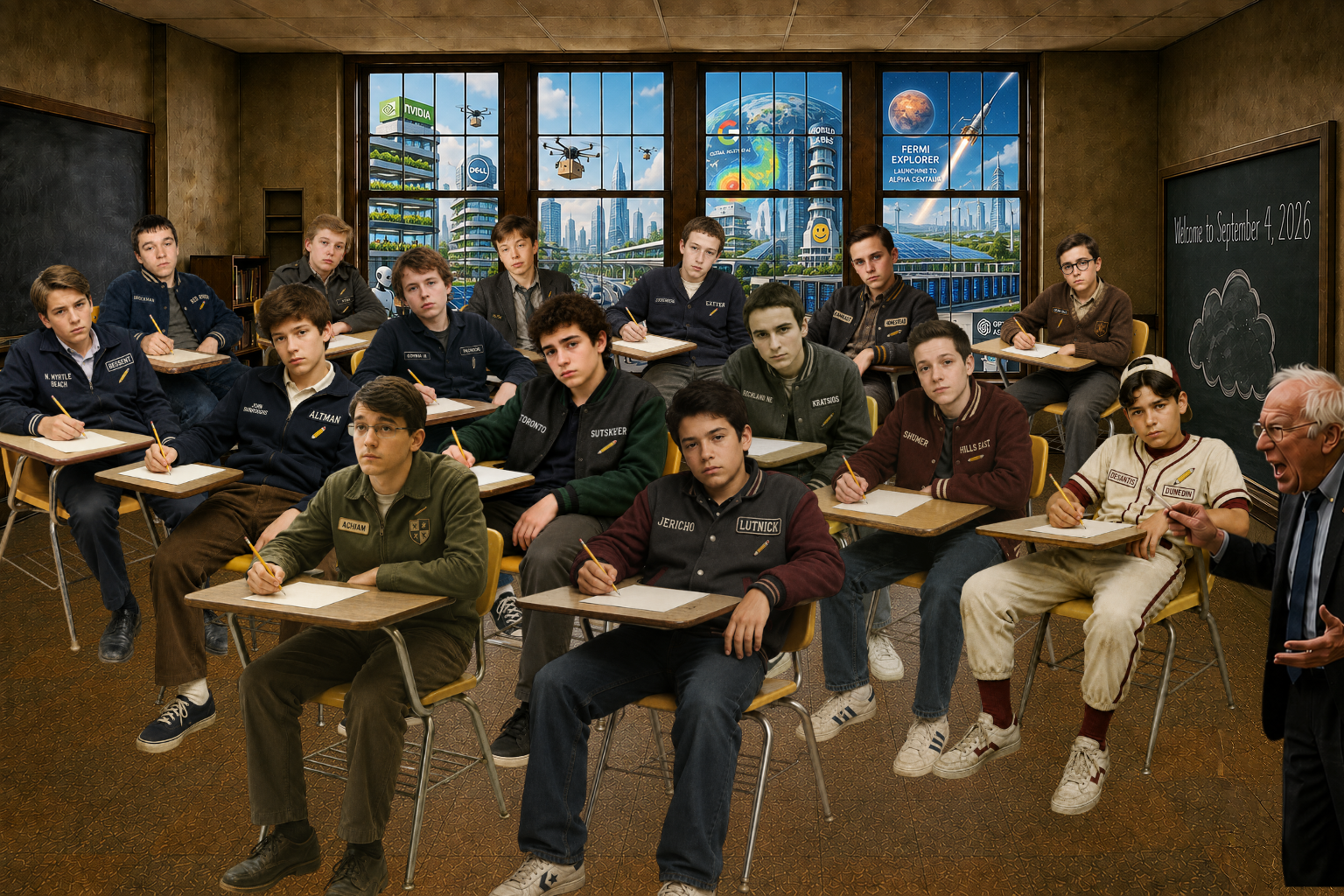
Vieil Homme Criant Après les Nuages Old Man Yelling at The Clouds The brightest part of this classroom is somewhere the students cannot reach. Beyond a row of windows, an impossible city grows upward through greenery, computation, and flight. Inside, the walls
Read the narration
Vieil Homme Criant Après les Nuages
Old Man Yelling at The Clouds
The brightest part of this classroom is somewhere the students cannot reach. Beyond a row of windows, an impossible city grows upward through greenery, computation, and flight. Inside, the walls have aged to tobacco brown. The desks are yellowed, their metal frames tired, their writing surfaces barely large enough for a sheet of paper. A pencil is the principal instrument of intellectual work. The contrast gives this digitally constructed tableau its argument before any name is read.
Old Man Yelling at the Clouds, by Siouid, responds to Alex Wissner-Gross’s September 4, 2026 newsletter. Its fifteen students are imagined thirteen- or fourteen-year-old eighth-grade versions of people discussed in that technological and political world: Donald Trump, Greg Brockman, Ron DeSantis, Greg Kamradt, Dean Ball, Jakub Pachocki, Joshua Achiam, Matt Shumer, Howard Lutnick, Michael Kratsios, Scott Bessent, Mark Zuckerberg, Elon Musk, Sam Altman, and Ilya Sutskever. This is a fictional reunion, not a reconstruction of a school they attended together. Their adult differences have been temporarily subordinated to the same institutional furniture.
Names, school insignia, varsity jackets, and baseball clothes make the figures legible without giving them power. DeSantis’s Dunedin Falcons baseball uniform and Trump’s New York Military Academy clothing preserve recognizable educational histories. Other affiliations similarly locate the imagined pupils in particular places and formative institutions. Their slumped shoulders and depleted expressions are not diagnoses of the real people. They are the emotional grammar of the artist’s premise: substantial potential being made to wait.
The newsletter states: “New York City paused student-facing AI through eighth grade.” The city’s one-year generative-AI policy includes exceptions and does not prohibit every classroom technology. The artist magnifies it into a room without phones, laptops, tablets, or calculators. Battered nineteen-seventies tablet-arm desks and institutional browns evoke Welcome Back, Kotter. A contemporary debate is staged within the visual machinery of an earlier educational age.
Bernie Sanders is the exception to the age transformation. At the far right, still elderly, he gestures beside a board reading exactly, “Welcome to September 4, 2026”. A crudely drawn cloud receives his indignation. The familiar old-man-yelling-at-a-cloud joke becomes a double image: a harmless chalk outline and the computational cloud through which artificial intelligence is delivered. His appearance also refers to the newsletter’s separate report of proposed federal legislation against artificial superintelligence. The artwork places the two restrictions in conversation; it does not establish that Sanders authored the city’s school policy.
The exterior supplies the artist’s opposing vision. NVIDIA and Dell identify AI’s hardware foundation; server racks make the cloud physical. Hugging Face recalls NVIDIA’s reported acquisition agreement, and GPT-6 Astra names the frontier-model story. Google’s planetary imagery suggests global information and forecasting; World Labs points toward generated three-dimensional environments. Planted towers, robots, drones, and elevated transport compress applications into a blue-green panorama. This is a montage of reported developments and imagined possibilities, not a documentary view of one functioning city.
Farther right, the Fermi Explorer reference extends that montage toward Alpha Centauri. In the newsletter, Physical Superintelligence’s work on mission planning connects artificial intelligence to interstellar ambition. In the artwork, a launch makes ambition immediately visible. The image does not certify that the spacecraft has reached another star. Its function is to give the room’s confinement a cosmic scale: outside, intelligence is imagined crossing astronomical distances; inside, a student cannot cross the distance between paper and a digital tool.
The windows resemble enormous luminous screens, yet the pupils have no screens of their own. Their dark frames divide the promised abundance into compartments, turning access itself into the composition’s subject. Sepia and blue-green, manual repetition and machine assistance, fatigue and expansion are held in a single low, frontal view. The viewer is placed near the students’ level, not safely above their predicament.
The low, straight-on perspective keeps the viewer inside the classroom’s institutional world. In the artist’s interpretation, the room is a cognitive quarantine: the imagined younger builders can see the systems they might one day create but cannot use them. The windows function as both view and barrier. Their brightness, held behind dark frames, gives that intended contrast an architectural form.
Opening the gallery…