70 Clock Galerie / The Innermost Loop Feed Reply Tableaux
Navire Brique par Brique
Ship By Brick
September 3 2026
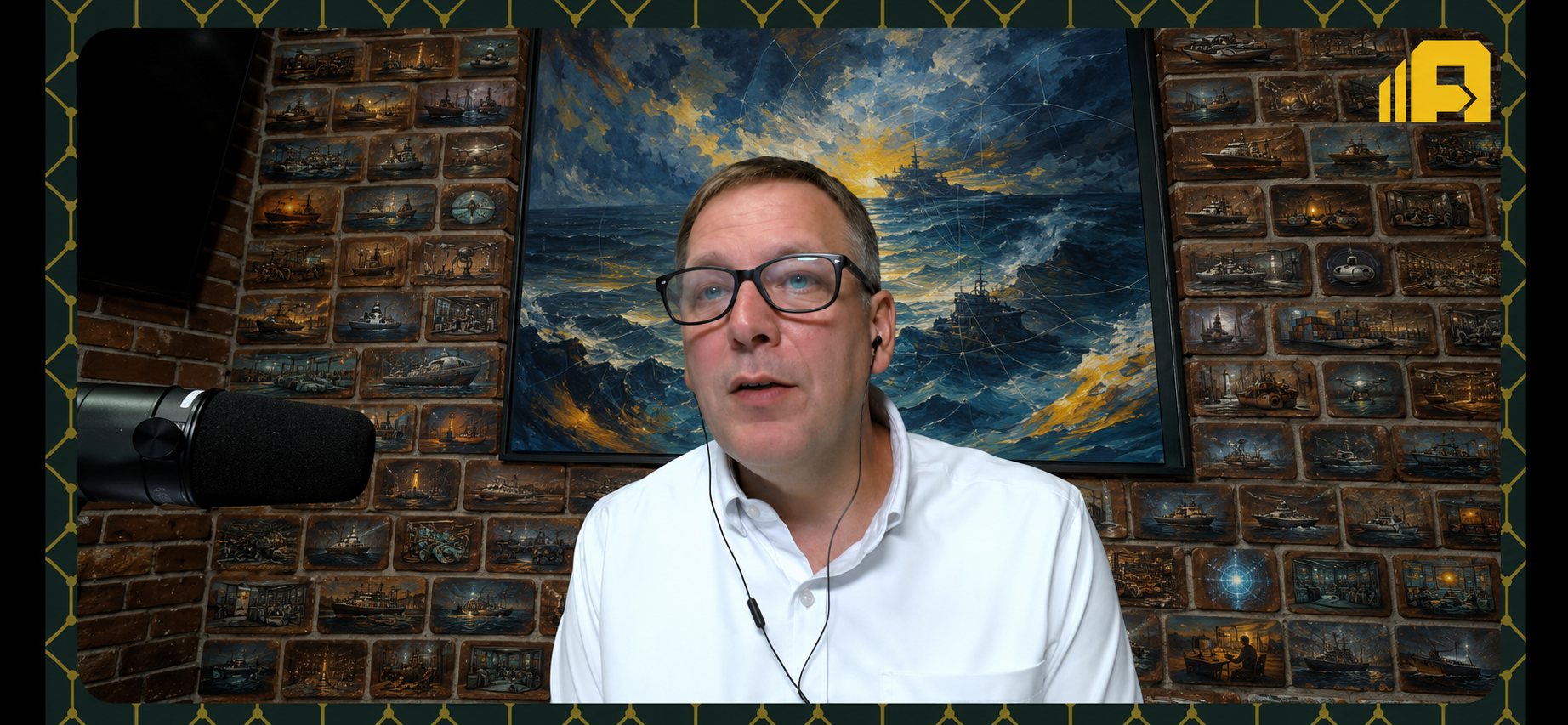
Navire Brique par Brique Ship By Brick The wall behind John Werner has become a fleet in miniature. Its bricks retain their earthy, rectangular rhythm, but individual units now contain vessels, cranes, mechanical equipment, industrial interiors, and scenes of
Read the narration
Navire Brique par Brique
Ship By Brick
The wall behind John Werner has become a fleet in miniature. Its bricks retain their earthy, rectangular rhythm, but individual units now contain vessels, cranes, mechanical equipment, industrial interiors, and scenes of maritime work. A framed seascape occupies the upper center. Beneath it, Werner remains in his white shirt and black glasses, wearing wired earbuds beside a large microphone entering from the left. The ordinary components of his podcast setting have become surfaces for remembering the conversation.
Ship By Brick belongs to the Seaweed 142 account’s response to Conversations in Action, episode ten, What Happens When AI Goes to Sea?, announced on September 3, 2026. Werner and Dr. Alex Wissner-Gross spoke with Rylan Hamilton, co-founder and chief executive of Blue Water Autonomy. The account watched the episode and produced a three-person composite and three individual portraits. This work gives Werner’s room its own visual method: instead of replacing the wall, the artist makes the wall carry the subject.
The title supplies a compact material pun. A ship suggests a single object launched into open water; a brick suggests a small unit whose usefulness depends on assembly. Here a large maritime discussion is constructed from many such units. Each miniature remains bounded by masonry joints, yet all participate in the same environment. The wall can be read as an archive, a collection of small panels, or an unusually dense picture gallery built directly into a room.
The brick format slows the eye. At a distance the surface is brown, gold, and blue texture. Closer attention distinguishes small working boats, larger ships, cranes, equipment, and technological diagrams. This shift in scale is part of the work’s structure. What initially appears to be the background becomes a succession of subjects, and the viewer moves from the speaker’s face to a vessel, from that vessel to its neighboring machinery, and back to the conversation that brought them together.
The central painting gives those fragments a shared horizon. Dark waves are broken by broad strokes of gold and pale light. Ships occupy different distances, while thin connecting lines and nodes cross the water and sky. The seascape combines the painterly drama of an ocean picture with the geometry of a network. Its rough-looking brushwork differs from the photographic treatment of the portrait, producing an image within an image whose material language remains distinct.
That contrast makes the room more than a collection of technical illustrations. Sea conditions appear turbulent and expansive; the network appears ordered and precise. Neither cancels the other. The episode’s maritime subject requires both: information about the world and a vessel capable of enduring it. Lines can connect distant positions on a painting, but the surrounding waves keep physical exposure in view.
The artist’s account of the conversation describes a similar movement between levels. Navigation, machinery maintenance, modular payloads, fuel, hull size, remote supervision, and manufacturing all contribute to an autonomous ship. Questions about compact nuclear power, smaller craft, undersea systems, and the continuing role of aircraft carriers extend the discussion into possible future fleets. The mural distributes these topics across its repeated units rather than suggesting that every vessel possesses every capability at once.
Werner’s retained setting also gives the three portraits different relationships to their backgrounds. Alex’s lamp turns ideas into illumination. Hamilton’s gray relief organizes them as an engineering environment. Werner’s bricks make them cumulative and architectural. The three treatments share a source while showing how an existing room can determine the form of a visual reply. The artist works with a lamp, a wall, and a framed picture as found compositional opportunities.
The white shirt provides a broad interval of rest amid the wall’s density. Its pale surface draws the eye toward the face, while the microphone’s dark horizontal mass establishes the act of recording. The subject is still a person participating in a conversation. The surrounding images are an elaboration of that participation, preserving the distinction between the speaker and the many systems being discussed.
The green-and-gold border completes the transformation of a podcast frame into a gallery object. Inside it, a building material becomes a sequence of pictures and a marine painting acquires computational connections. Ship By Brick treats the conversation as something assembled through attention to parts. A fleet can occupy a horizon, but the wall keeps returning the viewer to the smaller operations from which ships, engineering programs, and an informed discussion are made.
Opening the gallery…