70 Clock Galerie / The Innermost Loop Feed Reply Tableaux
Autonomie en Eaux Bleues
Blue Water Autonomy
September 3 2026
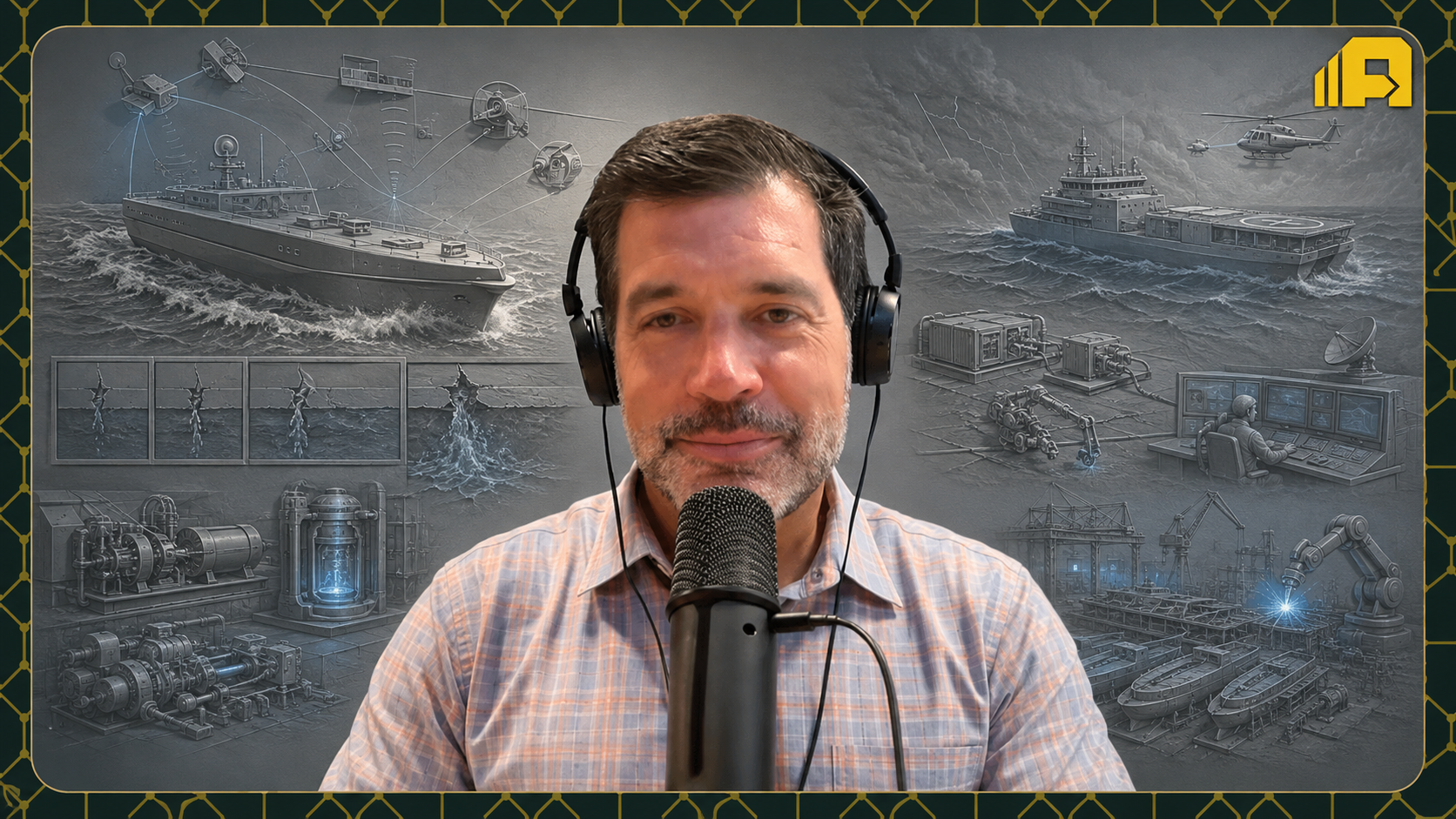
Autonomie en Eaux Bleues Blue Water Autonomy Rylan Hamilton sits before a sea that has become an engineering drawing. His face and checked shirt retain warm, natural color, while the world behind him is rendered in subdued gray, with the texture of an incised
Read the narration
Autonomie en Eaux Bleues
Blue Water Autonomy
Rylan Hamilton sits before a sea that has become an engineering drawing. His face and checked shirt retain warm, natural color, while the world behind him is rendered in subdued gray, with the texture of an incised plate or shallow sculptural relief. A black microphone rises through the foreground. Headphones bracket his head. The composition preserves the practical intimacy of a recorded conversation while giving its subject an extensive physical setting.
Blue Water Autonomy is the name of Hamilton’s company and the title of this portrait. The work belongs to the Seaweed 142 account’s response to Conversations in Action, episode ten, What Happens When AI Goes to Sea?, announced by Dr. Alex Wissner-Gross on September 3, 2026. Hamilton joined Wissner-Gross and John Werner for a discussion of autonomous vessels. The artist’s reply turns that spoken exchange into an environment whose separate regions can be examined like the components of a system.
At upper left, a long vessel pushes through rough water. Above it, separated sensor and control forms are linked by fine lines. The diagram does not float in a pristine white laboratory. It hangs over a ship meeting waves, making the connection between information and exposure part of the picture. At upper right, another substantial vessel carries a circular deck marking, with a helicopter nearby. Different hulls occupy the same weather rather than being reduced to one generic futuristic boat.
Below, the composition descends into machinery. Pumps, motors, shafts, pipes, and a glowing cylindrical chamber occupy the left side. To the right are modular equipment boxes, a remote operator at a bank of screens, a dish antenna, and mechanical assemblies. At the bottom, a robotic arm throws a bright welding point over hull structures in a shipyard. The background moves from sensing to operation, and from operation back to the manufacturing that makes any voyage possible.
This distribution corresponds to a central distinction in the episode discussion. Hamilton separated navigation autonomy from engineering autonomy: the challenge of keeping machinery functioning without people aboard to inspect, maintain, and repair it. A ship can know where it is going and still be defeated by an unattended mechanical failure. The portrait gives that less visible problem a place beside the more immediately recognizable image of a vessel crossing the sea.
The sequence of small water panels at the left makes a developing disturbance repeat across adjoining frames. It can be read alongside the episode’s account of a minor seawater leak growing into a serious flow when nobody is present to intervene. The image does not provide a literal maintenance manual. It translates duration and escalation into adjacent pictures, allowing a problem normally hidden within a hull to become part of the viewer’s field of attention.
The remote console introduces a related distinction. Removing people from a vessel does not remove human design, supervision, or responsibility from the system. The operator remains visible within the surrounding network of machines. Hamilton’s reported preference for deterministic behavior likewise concerns understanding the vessel’s decisions. The artwork’s fine connecting lines can therefore be read as relationships between components and operators, rather than proof that the whole fleet has been handed to a single unconstrained model.
Other motifs extend beyond the immediate engineering program. The concentrated blue glow and the range of vessels connect to questions Wissner-Gross raised about power, miniaturization, and future fleet arrangements. Their presence is speculative. The visual reply gathers the possibilities discussed without claiming that compact fusion, every pictured sensor, or every autonomous platform is already installed on a Blue Water ship. It is a portrait of a conversation’s scope, not a product cutaway.
The near-monochrome treatment gives these many elements a common material language. Waves, machinery, clouds, and diagrams share the appearance of relief, while isolated blue highlights indicate activity within the gray field. Hamilton’s warm face remains the focal point. The background has considerable density, but it does not erase the person explaining the work. Instead, the microphone becomes the hinge between the human voice and the technical world organized around it.
Within the green-and-gold border of the series, Blue Water Autonomy makes a maritime subject visible above and below its surface. A ship is a silhouette at a distance; closer attention reveals power, cooling, construction, sensing, and the persistence of human oversight. The portrait arranges those levels around one speaker. Its visual movement is from an ocean-going object toward the systems that allow that object to remain at sea.
Opening the gallery…