70 Clock Galerie / The Innermost Loop Feed Reply Tableaux
Docteur Peabody
Doctor Peabody
September 3 2026
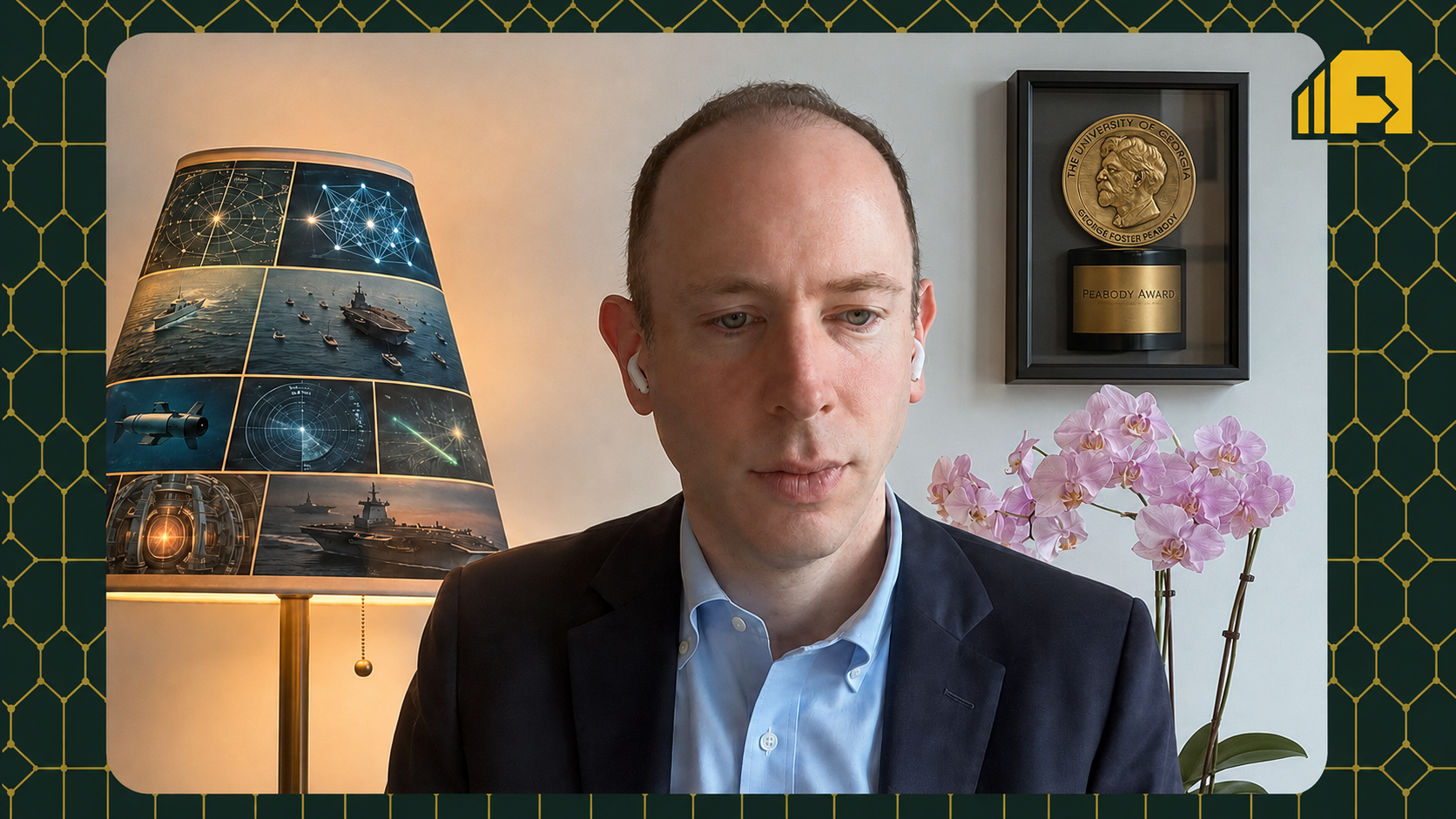
Docteur Peabody Doctor Peabody This portrait begins with the recognizable visual language of Dr. Alex Wissner-Gross’s remote podcast setup: the dark suit, pale-blue shirt, white earbuds, warm standing lamp and pink orchid. Rather than replacing that environmen
Read the narration
Docteur Peabody
Doctor Peabody
This portrait begins with the recognizable visual language of Dr. Alex Wissner-Gross’s remote podcast setup: the dark suit, pale-blue shirt, white earbuds, warm standing lamp and pink orchid. Rather than replacing that environment, the artwork allows the conversation to invade it. The domestic background becomes a speculative command center, and the lamp—which normally provides atmosphere—becomes an illuminated archive of the ideas Alex introduced during What Happens When AI Goes to Sea?
The source is Conversations in Action, episode ten, announced on September 3, 2026, with Blue Water Autonomy co-founder and chief executive Rylan Hamilton. The Seaweed 142 account watched the podcast and responded with these images. Across the lampshade appear autonomous surface vessels, an aircraft carrier surrounded by smaller craft, an undersea vehicle, radar and sensor diagrams, networked intelligence, directed-energy beams and a compact source of power. They visualize questions that moved beyond the company’s immediate engineering program toward possible naval futures.
Alex first challenged the meaning of autonomy itself. Was Blue Water preparing to place frontier AI models on the open ocean, or was this principally a classical robotics problem? In the discussion, Hamilton explained that the present system is deliberately deterministic. When the vessel and its payload may be worth tens or hundreds of millions of dollars, the company wants to understand why the ship makes every decision. The open ocean also permits a conservative rule unavailable on a busy highway: when uncertain, slow down.
Alex then searched for the deepest constraint. Navigation, Hamilton argued, is relatively mature. The harder problem is engineering autonomy: replacing the people who maintain the machinery. A tiny leak in a seawater-cooling system can become a garden hose and then a fire hose when nobody is aboard to patch it. An autonomous ship therefore cannot merely be a conventional vessel with software added afterward. Its hardware, redundancy and internal architecture must be conceived from the keel upward for prolonged survival in salt, storms, heat and cold.
From there, Alex tested the physical and economic assumptions determining the vessel’s size. Blue Water’s approximately one-hundred-fifty-to-two-hundred-foot ships must carry modular payloads, enough chemical fuel for thousands of nautical miles and a hull long enough to achieve useful speed efficiently. Alex imagined those constraints relaxing through compact fission or fusion, inexpensive energy and smaller payloads. Would fleets move toward miniaturization and swarms? Would more activity disappear beneath the surface, where autonomous submarines become harder to detect?
The lampshade also records questions about lasers, electronic warfare and layered defense. Hamilton envisioned autonomous vessels operating like forward pieces on a chessboard, testing defenses before a threat reached a destroyer or aircraft carrier. They would not be disposable like missiles, but could be sufficiently risk-worthy that losing one would have different human and financial consequences from losing a major crewed vessel. These are discussion themes, not a specification for every ship pictured on the shade.
The future of aircraft carriers was another question rather than a settled prediction. Their usefulness depends on theater, adversary, and air and undersea conditions. The discussion describes a possible barbell: numerous autonomous systems balanced by a smaller number of highly capable crewed platforms. On the lamp, large and small vessels share one illuminated surface, giving that difference of scale an immediately visible form.
The mounted Peabody Award is an explicitly imaginative honor, born from the account’s reply asking Peter Diamandis, Dave Blundin, Salim Ismail and Dr. Wissner-Gross to call Moonshots the best podcast “along with Conversations in Action.” The closing declaration—“The Doctor gets a Peabody!”—is rendered as an object, complete with the medallion’s University of Georgia and George Foster Peabody wording. It is the artist’s award within the picture, not a claim of an actual Peabody win.
That joke carries the artist’s appreciation for the questions themselves: their movement from today’s vessel to tomorrow’s fleet, deterministic control to frontier intelligence, chemical fuel to nuclear possibilities, and surface ships to an autonomous ocean. The lamp converts those questions into light. Gold dividers organize its separate scenes while the orchid retains a note of living delicacy beside the machinery. A familiar room remains recognizable even as an entire maritime conversation takes up residence in it.
Opening the gallery…