70 Clock Galerie / The Innermost Loop Feed Reply Tableaux
Singularité en Vue : Tribord, Bâbord, Proue et Coque
Singularity Ahoy! Starboard, Port, Bow and Hull
September 3 2026
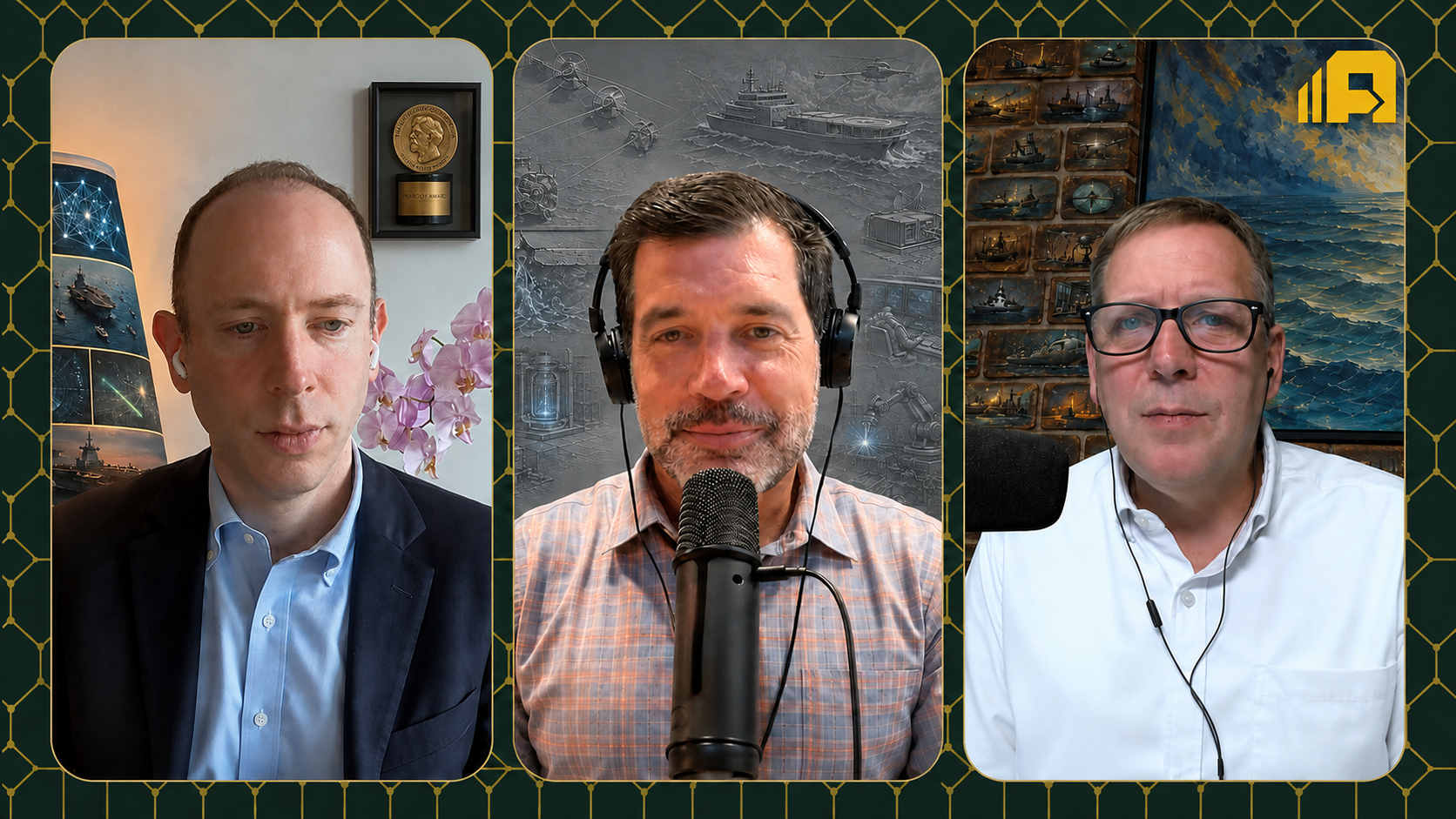
Singularité en Vue : Tribord, Bâbord, Proue et Coque Singularity Ahoy! Starboard, Port, Bow and Hull Three podcast windows have become three chambers of a maritime imagination. Dr. Alex Wissner-Gross occupies the left panel, Rylan Hamilton the center, and John
Read the narration
Singularité en Vue : Tribord, Bâbord, Proue et Coque
Singularity Ahoy! Starboard, Port, Bow and Hull
Three podcast windows have become three chambers of a maritime imagination. Dr. Alex Wissner-Gross occupies the left panel, Rylan Hamilton the center, and John Werner the right. Rounded gold borders separate their spaces while a dark-green field of linked gold lines binds the whole composition. The familiar grammar of a remote conversation survives, but each speaker’s background has become an illustrated extension of the subject under discussion.
The work responds to Conversations in Action, episode ten, What Happens When AI Goes to Sea?, announced by Wissner-Gross on September 3, 2026. Hamilton, the co-founder and chief executive of Blue Water Autonomy, joined Wissner-Gross and Werner to discuss autonomous ships. The Seaweed 142 account watched that conversation and answered with this composite and its three individual portraits. The source is an exchange between speakers, whose questions and answers become the material of the visual reply.
At the left, Alex’s dark jacket, pale-blue shirt, white earbuds, warm lamp, and pink orchid preserve the intimacy of his usual setting. The lampshade has acquired small panels of ships, networks, radar, undersea machinery, directed energy, and concentrated power. A framed Peabody Award hangs behind him. This is an imagined honor, created from the account’s affectionate request that the Moonshots hosts describe their program as the best podcast “along with Conversations in Action.” The reply’s declaration, “The Doctor gets a Peabody!”, has been installed on the wall.
Hamilton’s central panel changes the material register. Behind his checked shirt, headphones, and prominent microphone, a gray relief-like environment contains vessels, mechanical assemblies, communication paths, and control equipment. Faces remain warm and photographic; the surrounding engineering becomes almost sculptural. That contrast makes the technical world read as something being explained by a person, rather than as a free-floating prediction without an author or a practical constraint.
Werner’s panel offers another method of translation. The brick wall is retained, but its individual units contain miniature maritime and industrial scenes. The framed seascape behind him combines dark water, golden light, vessels, and fine network lines. The room becomes an archive whose organizing unit is the brick. Where Alex’s subjects illuminate a lampshade and Hamilton’s occupy an engineering relief, Werner’s accumulate in the fabric of a wall.
The artist’s episode notes identify a distinction running beneath all three rooms: navigating a vessel is only part of making it autonomous. Hamilton discussed the machinery that must survive when nobody is aboard to repair it. A leak, a cooling circuit, fuel supply, and maintenance become consequential parts of the same problem as sensing and control. The pictures repeatedly return to equipment below the level of a glamorous ship silhouette, allowing the word autonomy to acquire a physical interior.
Wissner-Gross’s questions extend the discussion beyond the immediate design. Could frontier multimodal models eventually operate at sea? How might compact nuclear power alter vessel size and range? Could smaller craft, autonomous submarines, or laser defenses change the arrangement of a fleet? The backgrounds visualize that spectrum of inquiry. They combine near-term engineering with possibilities raised in conversation, rather than presenting every pictured technology as a feature of one existing Blue Water vessel.
The triptych format lets these different registers remain distinct. Warm domestic light occupies one room, restrained gray machinery another, and a turbulent blue-and-gold seascape the third. The repeated microphones, earbuds, and frontal portraits keep returning the viewer to the act of conversation. The images do not replace the speakers with their subject. They make their surroundings porous to it.
The title turns that exchange into a lookout’s call. Ahoy announces an encounter; starboard, port, bow, and hull supply the vocabulary of orientation and physical construction. A discussion about intelligence is given sides, a direction, and a body capable of meeting the water. Across the three panels, an ordinary remote interview becomes a composite portrait of inquiry: questions casting light, engineering taking relief, and ideas settling into the wall one image at a time.
Opening the gallery…