70 Clock Galerie / The Innermost Loop Feed Reply Tableaux
L’Éclair Graissé d’Alpha du Centaure
Alpha Centauri Grease Lightning
September 2, 2026
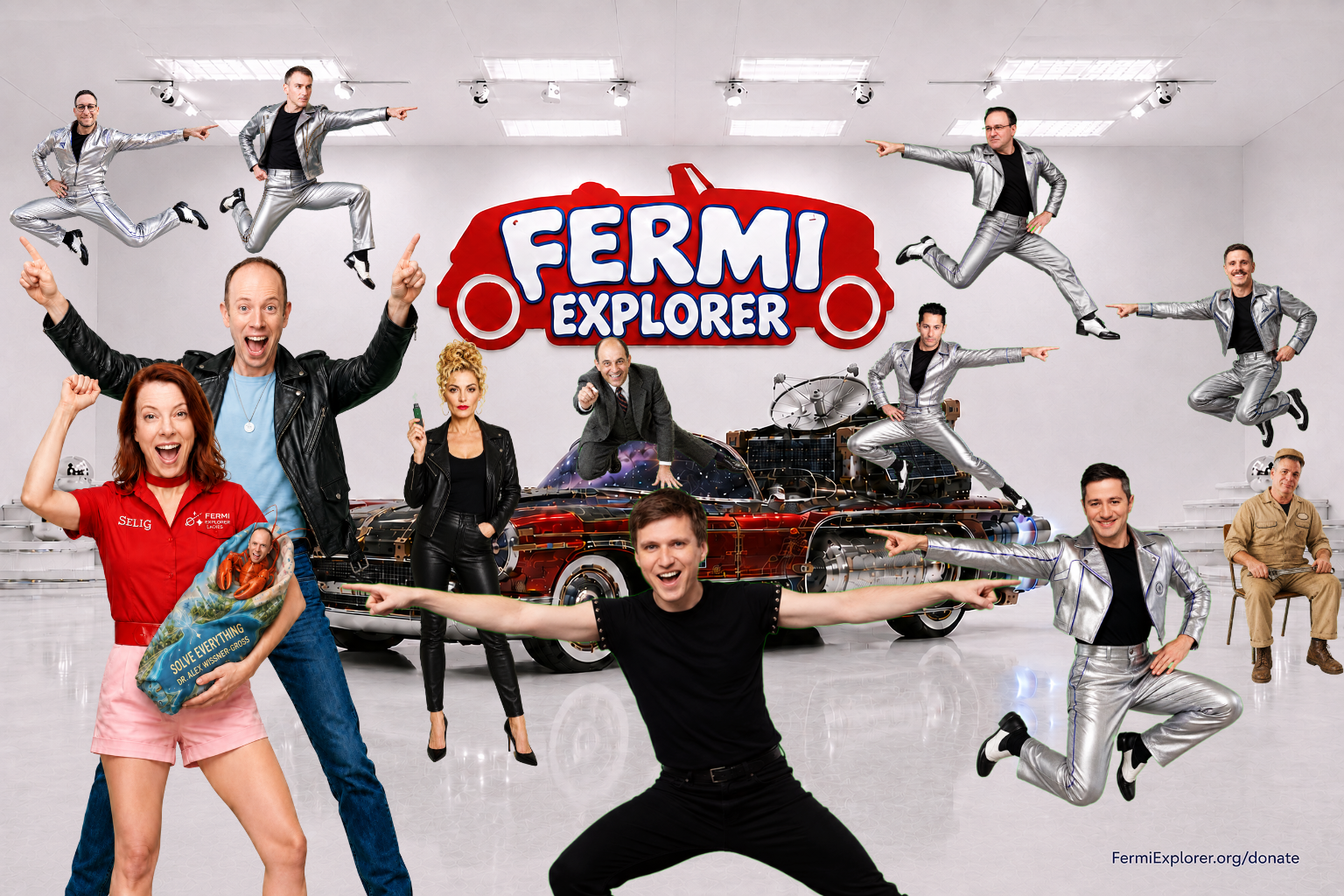
L’Éclair Graissé d’Alpha du Centaure. Alpha Centauri Grease Lightning. This reply tableau transforms the Fermi Explorer Mission into the finale of Grease. Against a white studio background, a red-and-black vehicle sits between hot rod and interstellar spacecra
Read the narration
L’Éclair Graissé d’Alpha du Centaure.
Alpha Centauri Grease Lightning.
This reply tableau transforms the Fermi Explorer Mission into the finale of Grease. Against a white studio background, a red-and-black vehicle sits between hot rod and interstellar spacecraft. Above it, the dripping red title treatment associated with the film has been rewritten as Fermi Explorer. The joke is immediate: an eighty-thousand-year ion-thruster journey is staged with the swagger of Greased Lightnin’, the musical number in which desire and collective bravado convert a battered car into a fantasy machine.
Philip Johnston, founder of Fermi Explorer and founder and chief executive of Starcloud, occupies the John Travolta position at center front. He does not present the mission as a remote abstraction. He sells it bodily, with the broad stance and theatrical confidence of Danny Zuko unveiling what the car might become. Lucy Walker supplies the Sandy or Olivia Newton-John register nearby, while the historical Enrico Fermi sits on the machine’s hood. Fermi’s presence joins the mission’s brand to the paradox that motivates it: if the galaxy should contain technological life, why has none become unmistakably visible?
The surrounding ensemble converts the project’s collaborators into a Rydell High cast. Alex Wissner-Gross appears in black leather behind Lauren Selig, taking the Kenickie position as mission adviser and co-founder of Physical Superintelligence, its founding technical partner. Ezra Feilden, Garrett Jameson, Adi Oltean, Matthew Pines, Alessandro Morari, and Ashkan Borna become a silver-clad chorus of futurists and builders. At far right, Avishai Abrahami sits in tan, grease-marked shop coveralls with cap and wrench, recast as Mrs. Murdock, the auto-shop teacher played by Alice Ghostley. The team is folded into a musical’s communal act of making a machine ready to go.
Lauren Selig carries the strangest emblem: a swaddled baby lobster with Wissner-Gross’s face. Its blanket incorporates his Solve Everything artwork, including the blue river and stenciled lettering. The lobster continues the account’s Accelerando lineage of agentic crustaceans witnessing technological acceleration. It is newborn because the mission begins a lineage. The first craft cannot replicate, but it gestures toward descendants that may. The baby is mascot, payload, and nascent von Neumann probe.
The car-spacecraft fusion sharpens the argument. Greased Lightnin’ is a vehicle of exaggerated speed and adolescent projection. Fermi Explorer is almost impossibly slow by human standards: roughly eighty thousand years to Alpha Centauri. The longest voyage becomes a drag-race reveal. Yet the parody is not dismissive. Like the musical number, the mission treats transformation as social technology. People gather around an object, imagine a more powerful version, and commit themselves to building.
The source dispatch contrasts Fermi Explorer with proposals such as Breakthrough Starshot. Starshot waits for propulsion infrastructure that does not yet exist. This mission chooses demonstrated ion-thruster technology, accepting extreme duration in exchange for the ability to begin. That practical inversion is why the hot-rod imagery works. The machine’s importance lies less in its top speed than in crossing the threshold from concept to trajectory. It is the first deliberate aim at another star.
The Fermi Paradox gives that aim three meanings. If humanity is first, the craft begins intelligence’s outward spread. If a Great Filter waits ahead, the payload carries something beyond Earth’s vulnerability. If we are watched inside a galactic zoo, the launch knocks on the enclosure. In every case the chorus prepares the car.
The invitation at FermiExplorer.org to contribute names, photographs, letters, or DNA turns the payload into a collective spacetime capsule. That participatory archive is echoed by the crowded cast. No single hero owns the voyage. Fermi provides the question, Johnston the institution, Wissner-Gross and PSI the technical case, the team the labor, and contributors the record of a civilization willing to address a future it will never personally reach.
The tableau uses camp to solve a representational problem. Interstellar time is too large to feel. Eighty thousand years collapses into a bright car, a familiar song, a leather jacket, and a group leaning toward departure. The humor makes duration graspable without making the mission small. Its proposition is ridiculous and sincere: civilization may leave home with collaborators, a newborn lobster, and the confidence to point the machine toward Alpha Centauri and call it Grease Lightning.
Opening the gallery…