70 Clock Galerie / The Innermost Loop Feed Reply Tableaux
Philip Johnston Défile – Maison de la Boucle la Plus Profonde
House Innermost Loop – Philip Johnston Walks
September 1, 2026
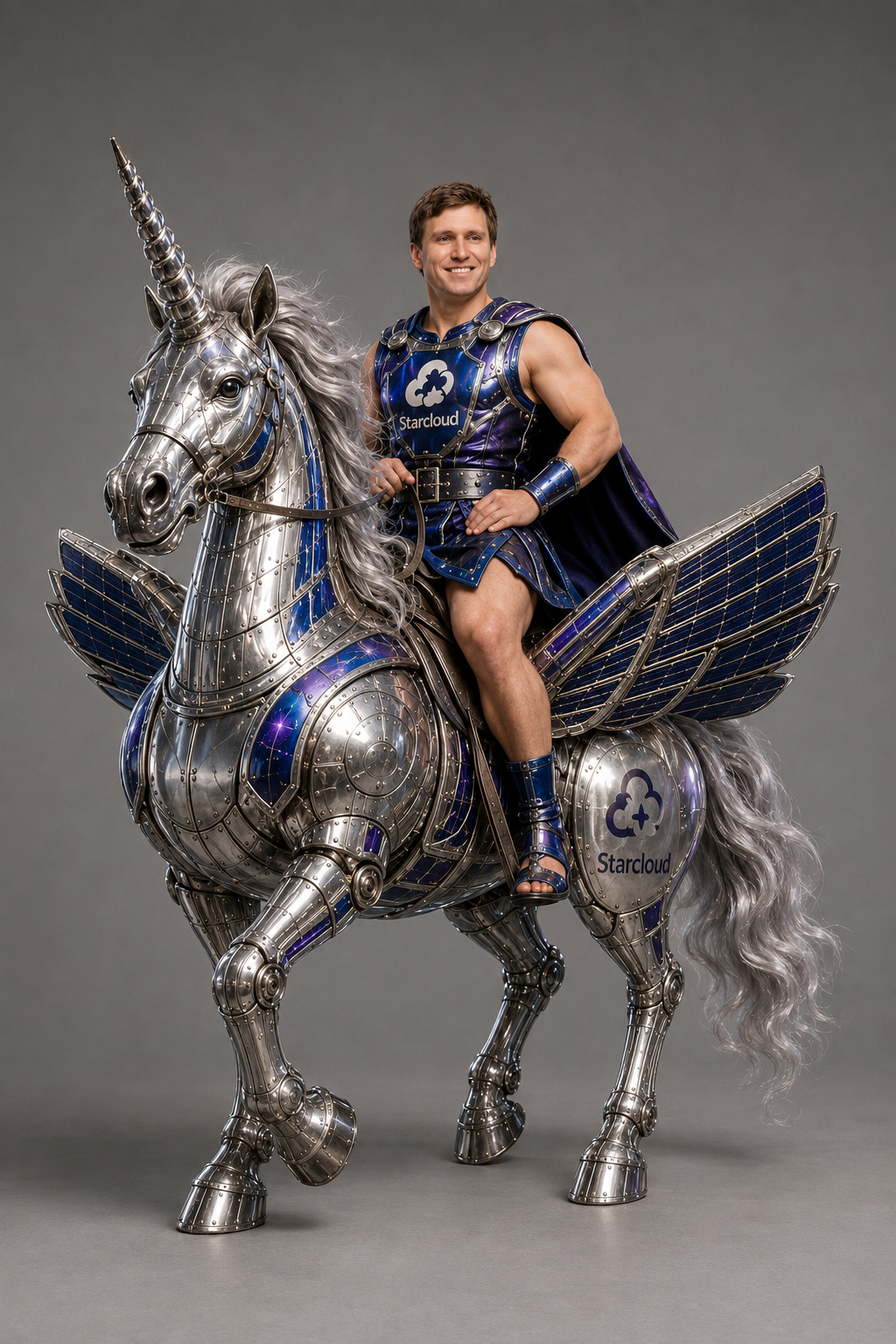
Philip Johnston Défile – Maison de la Boucle la Plus Profonde. House Innermost Loop – Philip Johnston Walks. Philip Johnston occupies the most spectacular position in the composite. While sixteen figures form the ground-level runway, Johnston appears at the up
Read the narration
Philip Johnston Défile – Maison de la Boucle la Plus Profonde.
House Innermost Loop – Philip Johnston Walks.
Philip Johnston occupies the most spectacular position in the composite. While sixteen figures form the ground-level runway, Johnston appears at the upper right on a chrome mechanical unicorn. The creature has articulated aerospace joints, a polished metal hide, a spiraling antenna-like horn, and wings made from solar arrays. It is simultaneously heraldic animal, satellite platform, luxury vehicle, and visual joke made completely serious through engineering detail.
The unicorn originates in the established House Innermost Loop iconography for Johnston. In venture language, a unicorn is a private company valued above one billion dollars. The image reverses the metaphor. Rather than calling a company a mythical creature, it takes the creature literally and asks how one might build it. The answer is Starcloud: metal structure, orbital power, radiative surfaces, communications hardware, control systems, and a founder in the saddle.
Johnston wears cobalt-and-silver rider couture designed to remain compact. A sleeveless armored jerkin follows the body without squeezing it into a superhero suit. High boots grip the mount. Orbital stitching traces trajectories across the dark fabric, while Starcloud emblems appear on the chest, harness, wing roots, and mechanical flanks. The garment has the confidence of ceremonial cavalry wear but the materials of aerospace engineering: carbon-fiber weave, metallic leather, anodized fasteners, and reflective thread.
Johnston is the cofounder and chief executive of Starcloud, a company developing data-center infrastructure for space. His biography is unusually aligned with that ambition. He has worked on satellite projects and studied applied mathematics and theoretical physics, while also building expertise in finance, business, and public policy. Those domains meet in orbital compute, where success requires far more than launching a server. Power generation, heat rejection, radiation tolerance, bandwidth, maintenance, launch economics, and regulation all become part of one design problem.
The solar-panel wings express the company's central intuition in a single form. Advanced artificial intelligence requires enormous energy and generates enormous heat. On Earth, data centers compete for grid capacity, land, water, permitting, and local acceptance. Space offers abundant solar exposure and a radically different thermal environment, although exploiting those advantages introduces severe engineering constraints of its own. The unicorn's wings therefore do not merely decorate the animal. They are its power plant and part of its claim to flight.
Johnston and Starcloud should be described accurately within the PSI composition. The official Physical Superintelligence launch materials do not identify Starcloud as one of PSI's listed investors. Johnston is included because his company is conceptually adjacent to the laboratory's mission. PSI describes the physical infrastructure of artificial intelligence as an early proving ground for its virtual physicists. Starcloud embodies that physical infrastructure at an extreme: computation moved into orbit, where every assumption about energy, cooling, communications, and reliability must be reconsidered.
That adjacency enriches the artwork. The ground-level figures supply founders, scientific leadership, and capital. Johnston supplies a possible destination for the science. If virtual physicists can accelerate work on thermal systems, materials, energy conversion, orbital design, and reliable hardware, companies like Starcloud could become both beneficiaries and testing grounds. The relationship is not one of formal affiliation in the image's record; it is a dialogue between two frontier propositions.
Johnston rides rather than walks because Starcloud changes the scale and direction of the procession. The runway has been horizontal and terrestrial. The unicorn introduces ascent. It pulls the viewer's attention upward toward the PSI emblem and the turbulent sky, suggesting that physical superintelligence will be judged by whether it can help improbable systems leave the ground.
As the final character, Johnston closes the catalogue on an image of engineered audacity. The unicorn is not evidence that every dream will work. It is a statement about the kind of dream this community finds worth testing. Starcloud asks whether the physical limits of terrestrial computing can be challenged by relocating infrastructure beyond Earth. PSI asks whether the rate of physical discovery can be accelerated by AI-native science. House Innermost Loop places those questions on the same stage and gives them a creature capable, at least in art, of carrying both into orbit.
Opening the gallery…