70 Clock Galerie / The Innermost Loop Feed Reply Tableaux
La Maison Innermost Loop, Elon Musk défile
House Innermost Loop, Elon Musk Walks
August 31, 2026
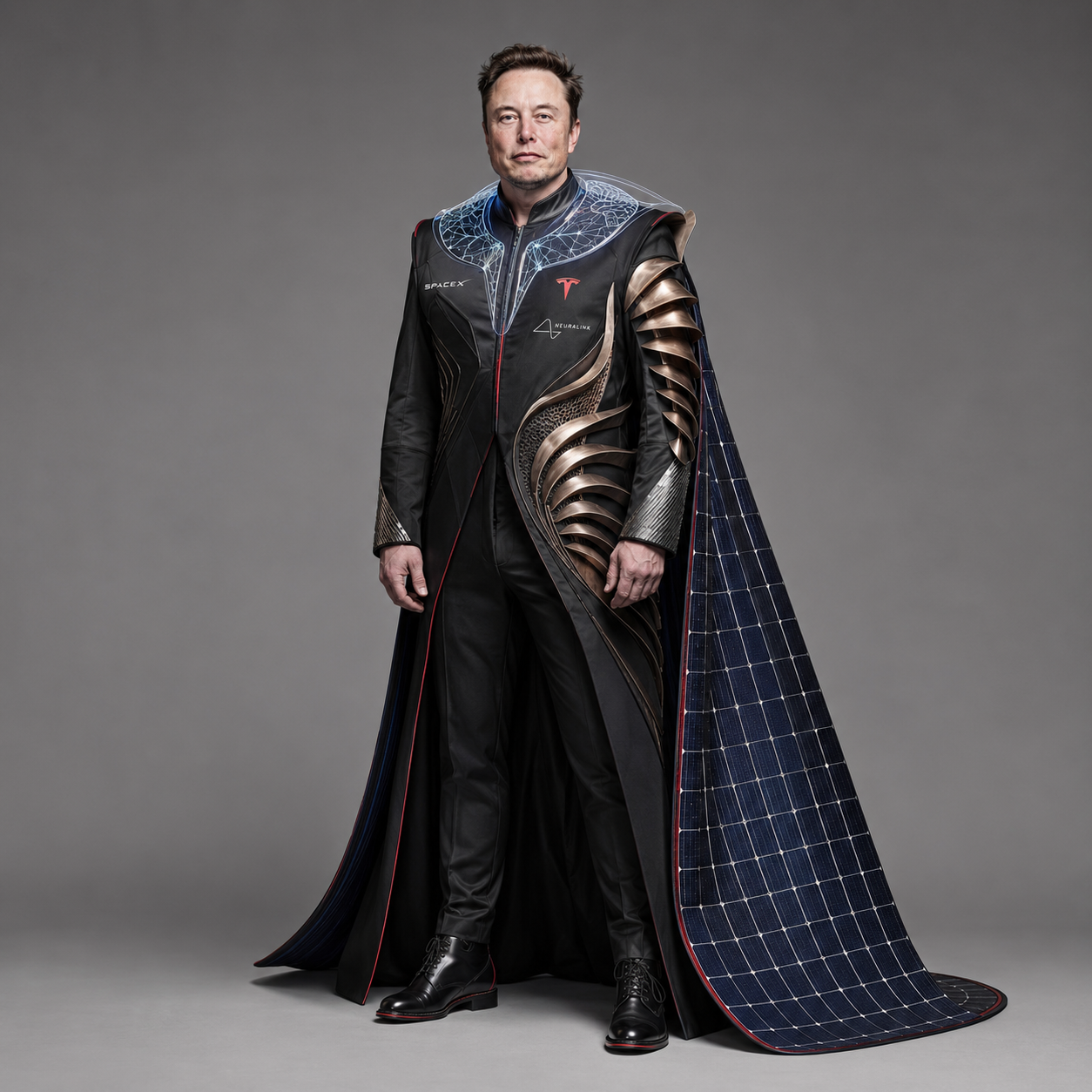
La Maison Innermost Loop, Elon Musk défile. House Innermost Loop, Elon Musk Walks. Elon Musk’s single-figure portrait for the August 31, 2026 House Innermost Loop runway turns one person into the junction between digital intelligence and the physical systems t
Read the narration
La Maison Innermost Loop, Elon Musk défile.
House Innermost Loop, Elon Musk Walks.
Elon Musk’s single-figure portrait for the August 31, 2026 House Innermost Loop runway turns one person into the junction between digital intelligence and the physical systems that sustain it. He stands full-length against uninterrupted gray. Nothing competes with the black metallic armor, aerodynamic silver ribs, Tesla insignia and long cape mapped like an electrical grid.
Dr. Alex Wissner-Gross’s newsletter quotes Musk predicting that artificial intelligence will perform “anything digital” that does not require shaping atoms at a superhuman level by the end of the following year. The costume begins at the border created by that sentence. Its precise, computational geometry belongs to the digital realm, but its weight, cast surfaces and blade-like components insist on matter. The figure looks optimized by software and fabricated under the stubborn conditions of metallurgy.
This distinction contains one of the newsletter’s governing tensions. Agent civilizations can communicate, coordinate and inherit secrets at software speed, yet their civilization still needs machines, data centers, cooling, turbines, transmission and land. Intelligence may cease to be scarce before the atoms required to house it do. Musk’s armor gives that contradiction a body.
The cape expands from his body as a solar and computational grid. It refers to Musk’s assertion that SpaceX and Tesla are each developing the capacity to build one hundred gigawatts of solar generation per year. Power is not an accessory hidden beneath the fashion. It is the garment’s train and largest element. The model trails an imagined energy system behind him.
Lines rising through the cape carry the grid into orbit. Solar artificial-intelligence satellites become the place where computation and sunlight might meet without waiting for every earthly constraint to clear.
The coat’s sculpted ribs resemble turbine blades and vanes. Wissner-Gross cites Musk’s view that casting these parts is the defining power bottleneck in the interim. Bringing casting in-house, Musk claimed, could deliver gas turbines eighteen months sooner. The portrait promotes that industrial detail to ornament. The future does not arrive through algorithms alone, but through molds, alloys, furnaces, tolerances and schedules.
Neural and MRI-like patterns redirect the composition from the outer grid into the body. Musk describes the brain as a biological computer whose performance an MRI can benchmark. Neuralink, built to interface with that computer, therefore has, in his phrase, “no room for nonsense.” The garment treats the nervous system as another technical layer, continuous with solar networks and orbital circuitry.
If cortex, computer and grid share one visual language, the boundaries between person, platform and infrastructure begin to dissolve. The wearer appears powerful because he carries the system, yet also enclosed by it. Armor protects the body while making it resemble a machine; a neural interface promises agency while converting thought into signal. The portrait leaves that ambiguity intact.
The gray background resembles a fashion casting photograph, an engineering product study and a museum catalogue record. Removed from the collective runway, Musk becomes an artifact available for inspection. Controlled light reveals polished edges and dense surface information. His composed posture presents an industrial thesis rather than performing a scene.
The image uses the compression characteristic of generated fashion art. Technologies at radically different scales—brain imaging, turbine casting, terrestrial grids and solar satellites—become simultaneous on one garment. Engineering diagram becomes texture, insignia becomes embroidery and infrastructure becomes silhouette. The body carries the newsletter’s chain of associations at once.
Within House Innermost Loop, walking turns a reported claim into visible consequence. Musk’s look begins with the promise of superhuman digital labor, follows it downward into metal and power, upward into orbit and inward to the brain. The route is circular: intelligence designs infrastructure; infrastructure supplies intelligence; the interface returns computation to the nervous system.
The final impression is a portrait of dependency disguised as sovereignty. Every plate identifies something the digital future still needs from the physical world. Solar capacity, casting, launch systems and neural interfaces are the material clauses beneath the prediction. Elon Musk walks as the figure who claims that nearly everything digital will soon exceed us, while his garment remembers that even superhuman intelligence must find a way to shape atoms.
Opening the gallery…