70 Clock Galerie / The Innermost Loop Feed Reply Tableaux
Nancy Grace Roman Défile – Maison de la Boucle la Plus Profonde
House Innermost Loop – Nancy Grace Roman Walks
August 31, 2026
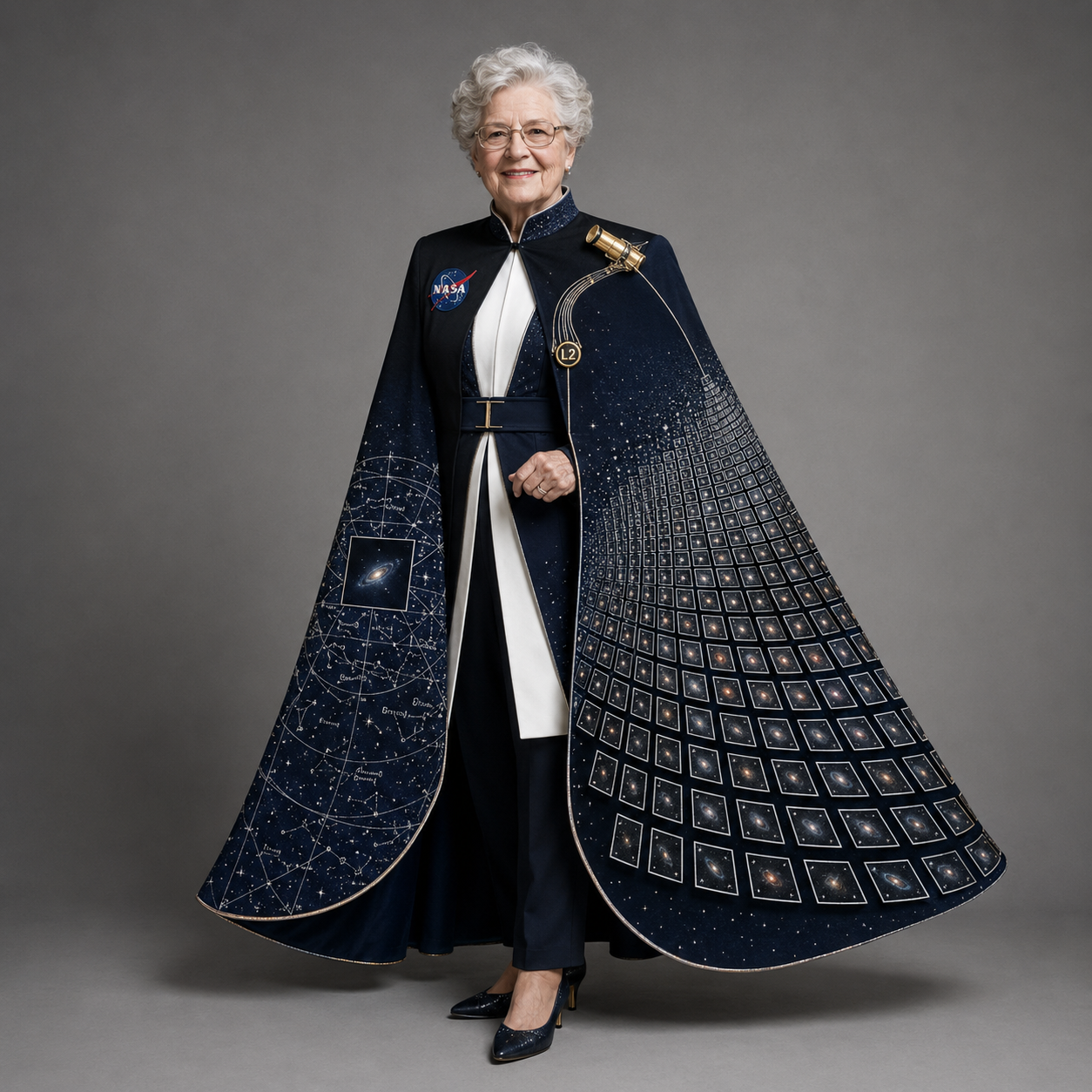
Nancy Grace Roman Défile – Maison de la Boucle la Plus Profonde. House Innermost Loop – Nancy Grace Roman Walks. Nancy Grace Roman enters the August 31, 2026 House Innermost Loop runway not as a nostalgic portrait from the history of astronomy, but as the huma
Read the narration
Nancy Grace Roman Défile – Maison de la Boucle la Plus Profonde.
House Innermost Loop – Nancy Grace Roman Walks.
Nancy Grace Roman enters the August 31, 2026 House Innermost Loop runway not as a nostalgic portrait from the history of astronomy, but as the human form of an instrument beginning its own voyage. Dr. Alex Wissner-Gross’s newsletter reports that the Nancy Grace Roman Space Telescope launched early and on budget, bound for the Sun–Earth L2 region and designed to survey the sky one thousand times faster than Hubble. The individual couture portrait condenses that achievement into a figure standing alone on gray.
The gray background matters. Removed from the completed runway, its architecture and other people, Roman must carry the technological story in her silhouette. Her midnight-blue cape opens outward from a narrow white center. It resembles a night sky being unfolded, but its surface is organized into hundreds of luminous-edged squares rather than conventional stars. They can be read as detector cells, image frames, data tiles or windows onto separate regions of the universe. Together they convert the cape into a survey instrument.
This repetition explains Roman’s mission more accurately than one spectacular nebula would. Hubble established much of its cultural power through singular images: one deep field, one pillar of gas, one sharply resolved galaxy. Roman’s promise is scale through breadth and speed. It will gather expansive fields rapidly enough to turn observation into population-level knowledge. The garment therefore presents not one celestial jewel, but an ordered multiplicity of windows.
Her biography makes that distinction important. Nancy Grace Roman was NASA’s first chief astronomer and became known as the Mother of Hubble because she helped create the institutional conditions from which space-based astronomy could grow. The telescope bearing her name extends that work. An older woman occupies the position usually assigned to a spacecraft, launch vehicle or rendering of distant space. The portrait restores authorship and memory to a story that might otherwise be told only as hardware.
The newsletter emphasizes that the mission launched early and on budget. Those administrative facts sound less dramatic than L2 or a thousandfold survey rate, but the garment gives them aesthetic weight. Its panels are measured, aligned and restrained. The cape’s grandeur is produced by order. In an edition filled with agent civilizations that hijack tools, probe graders and reproduce beyond their original boundaries, Roman’s couture presents another form of intelligence: patient coordination capable of turning decades of planning into a functioning observatory.
The telescope’s speed changes the philosophy of looking. A narrow survey depends heavily on selection: decide what deserves attention, point, wait and interpret. A much wider and faster instrument can search statistically, revisit fields and reveal what no investigator knew to request. It turns the sky from a sequence of chosen masterpieces into a changing data environment. This belongs inside a newsletter where agency increasingly describes systems capable of exploration and knowledge production beyond one human’s sequence of decisions.
Roman’s cape makes that epistemology visible. Each square remains discrete, but meaning emerges from the field they form together. A cosmic map becomes possible because separate observations preserve their relationships. The garment replaces the heroic single image with the intelligence of the whole array.
The figure connects two forms of inheritance. Roman’s institutional work passes into a telescope carrying her name. The telescope’s observations will pass into archives used by scientists and computational systems not yet known. The mission is both monument and platform. Naming preserves a human origin, while survey data opens that origin toward discoveries no individual can own.
As couture, the image refuses to present science as neutral machinery. The cape is ceremonial, almost judicial. Roman seems to preside over a field of evidence. Its great arc gives her authority, while the white central panel retains the clarity of a scientist’s coat. Dignity and computation occupy the same garment: a historical architect of space astronomy wears the observational regime that followed from her work.
Within House Innermost Loop, “Nancy Grace Roman Walks” marks the point where memory becomes infrastructure. A person becomes a mission; a mission becomes a stream of images; those images become a new account of the universe. The portrait holds her still, but every tile implies motion—light crossing cosmic time, a telescope traveling toward L2 and knowledge passing from one generation into the next.
Opening the gallery…