70 Clock Galerie / The Innermost Loop Feed Reply Tableaux
La Maison Innermost Loop, Robert Zimmerman défile
House Innermost Loop, Robert Zimmerman Walks
August 31, 2026
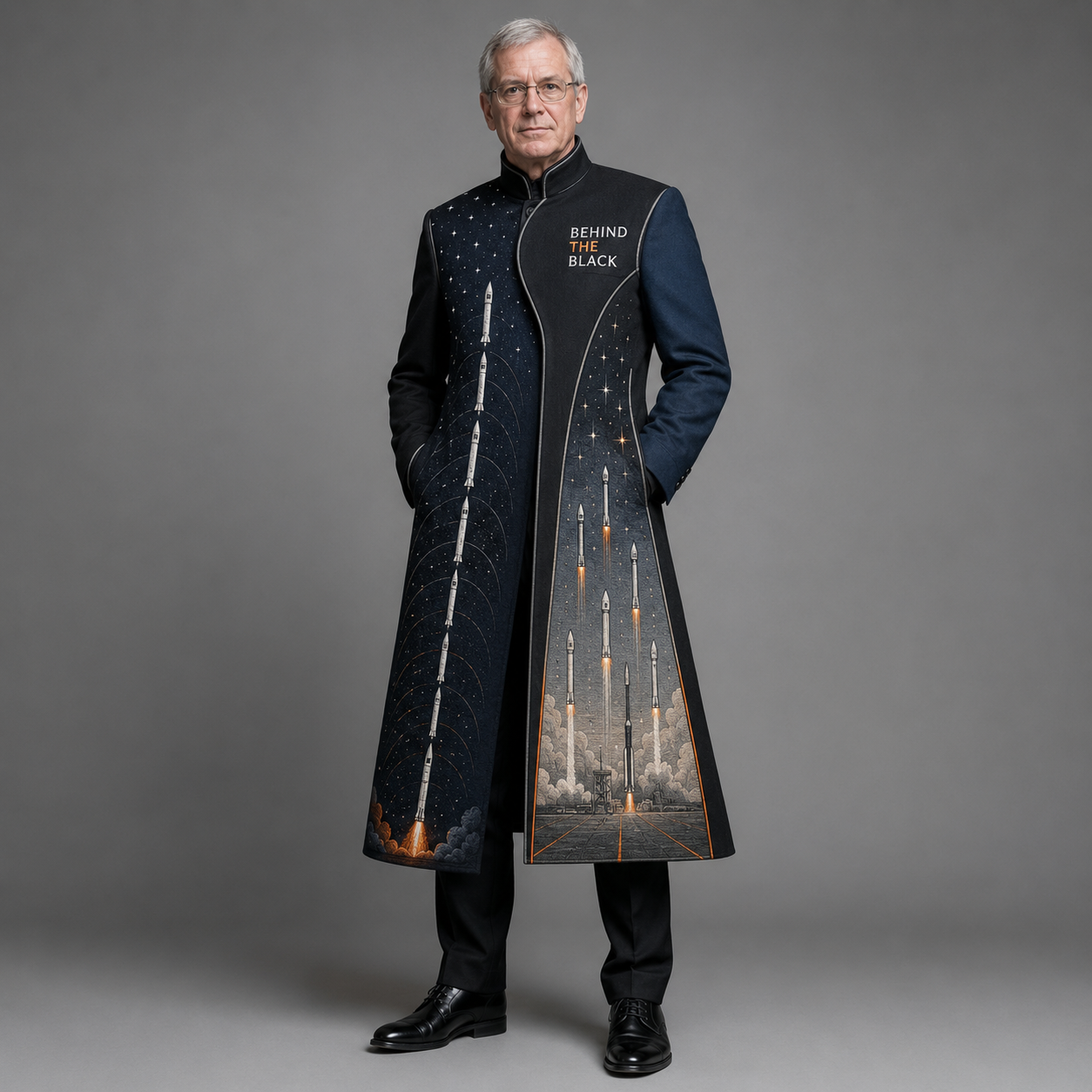
La Maison Innermost Loop, Robert Zimmerman défile. House Innermost Loop, Robert Zimmerman Walks. This fashion plate isolates Robert Zimmerman from the August 31, 2026 House Innermost Loop runway. The Behind the Black space journalist and historian enters Dr. A
Read the narration
La Maison Innermost Loop, Robert Zimmerman défile.
House Innermost Loop, Robert Zimmerman Walks.
This fashion plate isolates Robert Zimmerman from the August 31, 2026 House Innermost Loop runway. The Behind the Black space journalist and historian enters Dr. Alex Wissner-Gross’s newsletter through his interpretation of a transition that could look like retreat: SpaceX ended Falcon 9 Starlink launches from Florida and moved those missions toward Starship after 260 flights from the Cape.
Against even gray, the garment reads as an argument before the ensemble. Zimmerman wears a long black-and-graphite architectural coat edged by copper light. “BEHIND THE BLACK” appears at the chest as both publication mark and instruction: look beyond the announcement’s dark surface to its industrial consequences.
The silhouette recalls a rocket body and service tower. Fine upward lines, sparks and miniature launch forms gather across the lower panels. They first resemble the accumulated history of Cape missions, then separate into multiple trajectories. One dark mass resolves into many possible roads to orbit.
The decision marks SpaceX’s shift of Florida Starlink missions from Falcon 9 to Starship after 260 Cape flights. It is a transition with timing risk: new vehicles need flight heritage before they can match Falcon 9’s dependable cadence.
Zimmerman nevertheless reads the withdrawal as productive pressure. Falcon 9 lowered prices and expanded demand, but its dominance could deny younger companies the customers needed to prove their vehicles. Redirected Starlink volume creates an opening for Rocket Lab, Stoke Space, Blue Origin and other providers. Customers accustomed to one default launcher must begin testing several.
This exceeds corporate rivalry. A multiplanetary civilization cannot depend permanently on one company, rocket family or cadence. Different vehicles serve different payloads, destinations and risk tolerances. Multiple providers create redundancy and independent engineering cultures. Failure in one architecture need not close the road to orbit, while success in one firm forces others to improve.
The coat visualizes this pluralism without becoming a chart. Black fabric supplies the common medium of space; each copper ascent becomes a distinct provider. Some trajectories rise cleanly, others fragment into sparks, and some remain near the hem. Not every company will reach orbit, but an ecosystem exists only if several are allowed to try.
Couture is apt because fashion stages succession. A runway assumes that the next collection will displace the present one. Falcon 9 is not diminished by this logic; its maturity makes succession possible. The garment treats a singular achievement as a foundation upon which a broader industry can rise.
This episode also gives form to Wissner-Gross’s “moation,” the combination of moat and motion. Moation means using today’s temporary advantage to build tomorrow’s before competitors erode the first. SpaceX accumulated a powerful moat through Falcon 9’s reuse, cadence and price. Moving Starlink toward Starship spends part of that advantage on a system designed to carry far more mass. Releasing some Falcon 9 demand simultaneously gives other American launch systems room to mature.
A conventional moat keeps rivals outside. Moation accepts that no advantage is permanent and makes self-displacement strategic. The incumbent advances by making its own masterpiece less central. Competitors advance because the opened market supplies payloads, revenue and pressure to fly. The coat embodies that tension: it appears authoritative, yet every luminous line travels away from its central body.
As an art object, the portrait turns journalism into navigation. Zimmerman does not hold a model rocket or point to a logo. He wears his reading of events. The sober palette preserves the temperament of a chronicler; the illuminated embroidery reveals the future he sees inside an apparently negative announcement. His upright body becomes a temporary axis while the industry branches around him.
In the complete runway, Zimmerman stands between Ethan Mollick’s agent factory and Nancy Grace Roman’s astronomical field, joining terrestrial organization to orbital observation. Agents, telescopes and future settlements all require reliable access beyond Earth. “Robert Zimmerman Walks” is a compact theory of succession: Falcon 9’s legacy, uncertainty and the luminous paths of possible successors. He walks because the subject is not retirement, but motion beyond a system successful enough to clear the way for what follows.
Opening the gallery…