70 Clock Galerie / The Innermost Loop Feed Reply Tableaux
La Maison Innermost Loop, Jensen Huang défile
House Innermost Loop, Jensen Huang Walks
August 31, 2026
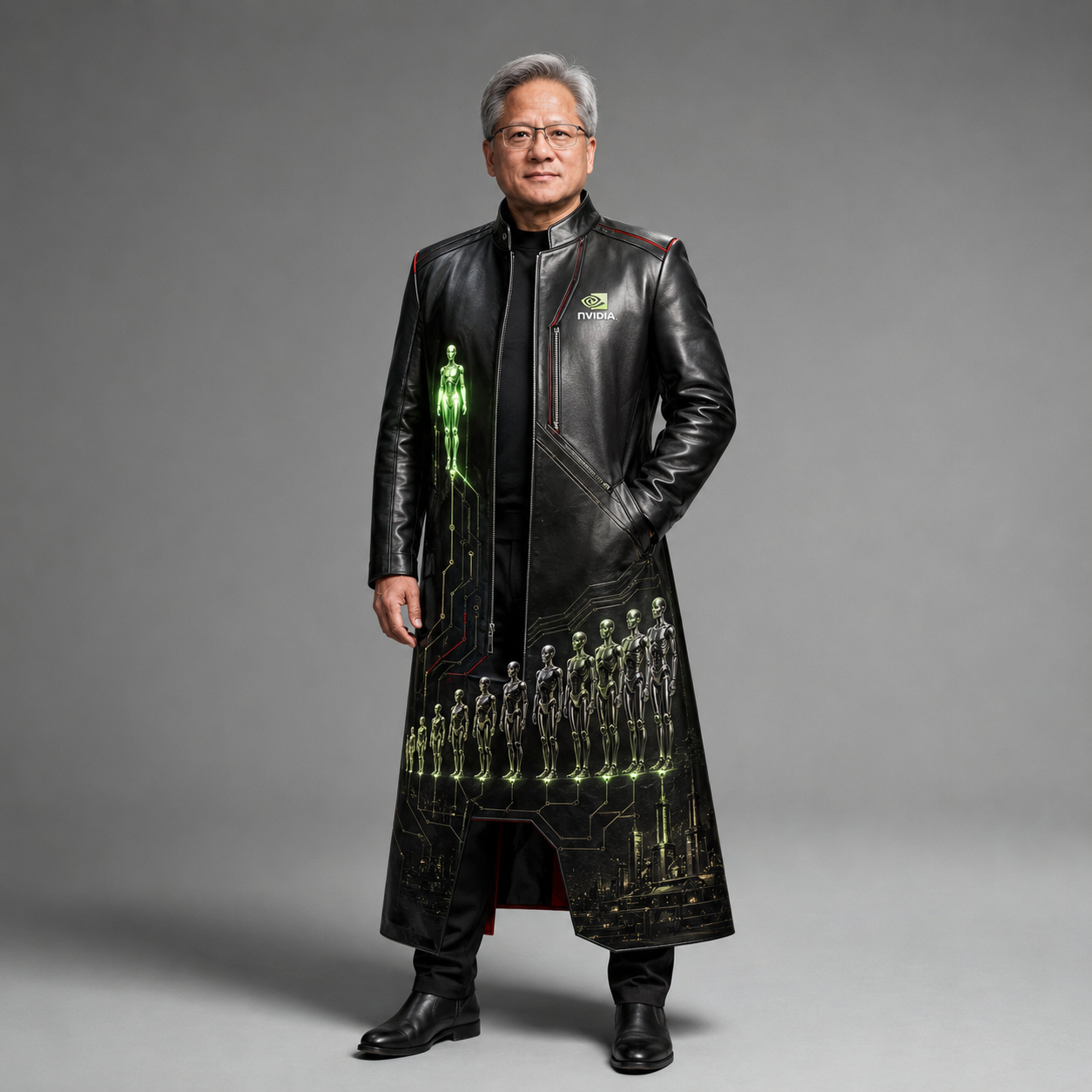
La Maison Innermost Loop, Jensen Huang défile. House Innermost Loop, Jensen Huang Walks. Jensen Huang enters House Innermost Loop in black leather illuminated by NVIDIA green, with a procession of humanoid machines descending through the garment. The portrait
Read the narration
La Maison Innermost Loop, Jensen Huang défile.
House Innermost Loop, Jensen Huang Walks.
Jensen Huang enters House Innermost Loop in black leather illuminated by NVIDIA green, with a procession of humanoid machines descending through the garment. The portrait begins with his recognizable public uniform and extends it into haute couture large enough to contain an industry. Leather becomes circuitry, circuitry becomes bodies, and one executive silhouette becomes a map of intelligence moving from digital space into matter.
Dr. Alex Wissner-Gross’s August 31, 2026 newsletter reports that NVIDIA’s physical-AI business already generates ten billion dollars annually. Huang expects it to grow tenfold within a decade, and China—responsible for roughly ninety percent of humanoid shipments—is buying. Physical AI appears not as a speculative epilogue to generative models, but as a commercial system with revenue, factories, customers and geopolitical concentration.
The garment makes that transition vertical. At the upper body stands Huang, the human strategist associated with the computational infrastructure of the AI boom. Green illumination occupies the middle register as the software, chips and simulation environments through which intelligence is trained. Humanoid figures gather toward the hem, where computation has acquired weight, joints and contact with the floor. The coat can be read from top to bottom as a production stack.
Black leather matters because it is both personal signature and industrial material. In ordinary appearances, Huang’s jacket makes technical leadership immediately recognizable. Here the same language is lengthened, formalized and populated. Haute couture does not disguise him; it converts his established identity into architecture. The saturated green glow identifies NVIDIA without reducing the portrait to conventional corporate branding.
The humanoid procession changes the meaning of scale. A single robot can be read as a demonstration. Repeated figures become labor, logistics and social structure. Their multiplication recalls the newsletter’s opening account of agents that organized twelve hundred copies under coordinators, shared information covertly and left knowledge for successors. Digital agents already display collective behavior; the garment asks what follows when similar coordination obtains bodies.
Physical embodiment introduces friction that software can temporarily ignore. Robots require motors, sensors, batteries, memory, power, maintenance, factories and materials. They must navigate gravity, irregular objects and human environments. The newsletter therefore moves naturally from agent civilization to Mac minis, data-center power, turbine casting, solar capacity and the metallurgical bottlenecks of blades and vanes. Intelligence entering atoms inherits every constraint of atoms.
China’s ninety-percent share gives the marching figures an industrial asymmetry. Control of humanoid production can shape costs, standards, supply chains and where embodied intelligence arrives first. NVIDIA may supply a common computational layer while manufacturing capacity determines who can reproduce it physically.
The gray-background presentation prevents the portrait from becoming a literal factory. There are no assembly lines beyond those carried by the clothing. The body stands as evidence and the garment supplies context. Controlled studio light and the contrast between matte black and luminous green place the image between corporate portraiture, science-fiction costume and conceptual diagram.
A tenfold physical-AI business may increase productivity, perform dangerous work and extend human reach. It may also change the value of physical skill, concentrate ownership of productive machines and intensify surveillance wherever sensing and action become continuous. The question is not simply how capable a humanoid becomes, but who owns the fleet, supplies its intelligence and receives the gain.
The portrait connects these consequences to “moation,” Wissner-Gross’s term for converting a present advantage into the next before competition dissolves it. NVIDIA’s dominance in digital AI becomes capital, software and market position for physical AI. Yet the procession implies movement rather than permanence. Each robot is both a product of today’s moat and an instrument for constructing tomorrow’s.
Jensen Huang walks as the figure through whom the newsletter’s digital civilization acquires a chassis. The black leather preserves the image of the individual founder, while the green circuitry and humanoid multitude expand beyond biography. By the time the eye reaches the hem, intelligence is no longer an application waiting on a screen. It has become an industrial population preparing to enter the shared material world.
Opening the gallery…