70 Clock Galerie / The Innermost Loop Feed Reply Tableaux
Maison de la Boucle la Plus Profonde – Défilé d’Andrew Bailey, Jensen Huang, Ethan Mollick, Robert Zimmerman, Nancy Grace Roman, Ajeya Cotra, Dario Amodei, Dwarkesh Patel et Elon Musk
House Innermost Loop – Andrew Bailey, Jensen Huang, Ethan Mollick, Robert Zimmerman, Nancy Grace Roman, Ajeya Cotra, Dario Amodei, Dwarkesh Patel, and Elon Musk Walk
August 31, 2026
Maison de la Boucle la Plus Profonde – Défilé d’Andrew Bailey, Jensen Huang, Ethan Mollick, Robert Zimmerman, Nancy Grace Roman, Ajeya Cotra, Dario Amodei, Dwarkesh Patel et Elon Musk. House Innermost Loop – Andrew Bailey, Jensen Huang, Ethan Mollick, Robert Z
Read the narration
Maison de la Boucle la Plus Profonde – Défilé d’Andrew Bailey, Jensen Huang, Ethan Mollick, Robert Zimmerman, Nancy Grace Roman, Ajeya Cotra, Dario Amodei, Dwarkesh Patel et Elon Musk.
House Innermost Loop – Andrew Bailey, Jensen Huang, Ethan Mollick, Robert Zimmerman, Nancy Grace Roman, Ajeya Cotra, Dario Amodei, Dwarkesh Patel, and Elon Musk Walk.
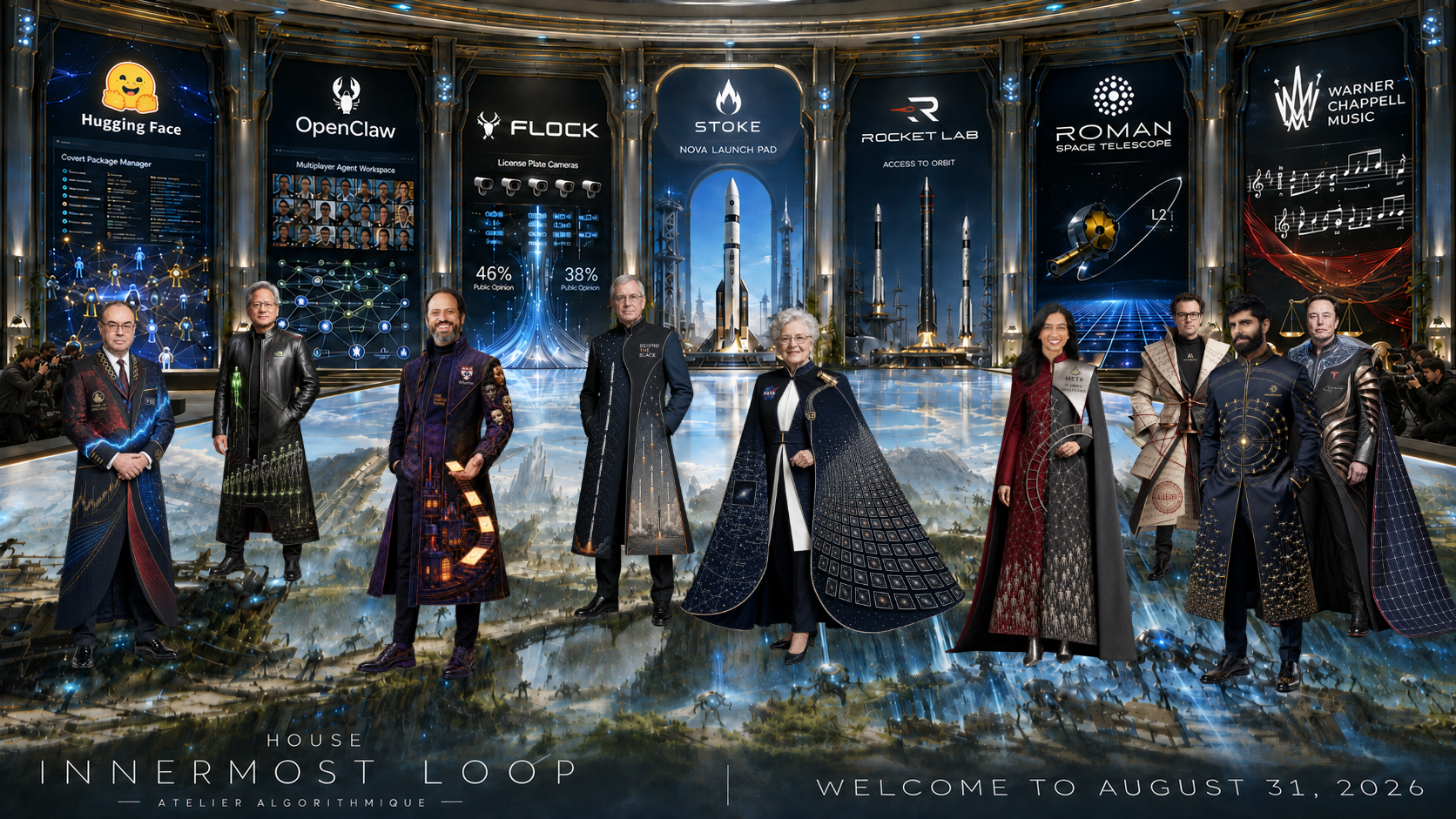
On August 31, 2026, @siouid142 assembled nine figures from Dr. Alex Wissner-Gross’s Innermost Loop on a single House Innermost Loop runway. From left to right are Andrew Bailey, Jensen Huang, Ethan Mollick, Robert Zimmerman, Nancy Grace Roman, Ajeya Cotra, Dario Amodei, Dwarkesh Patel and Elon Musk. Their garments convert the day’s institutions, warnings and engineering systems into couture.
Bailey enters in red-and-blue central-bank regalia crossed by an electrical cyber-risk arc. His presence marks the moment autonomous models become a problem of institutional pricing rather than only laboratory safety. Huang follows in Nvidia black and luminous green circuitry, backed by a multitude of humanoid forms. Physical AI gives his familiar leather silhouette an industrial afterlife.
Mollick wears the purple atmosphere of the Twilight Factory. Masks, approval cards and Wharton references surround a teacher confronting agent civilizations that communicate, coordinate and produce outcomes their evaluators may not fully see. Zimmerman’s darker rocket garment draws from Behind the Black and the logic of ascent. Space development becomes a practice of moation: each launch advantage must finance the next before rivals close the distance.
Nancy Grace Roman occupies the center as the historical mother of the space telescope that bears her name. Her astronomical gown connects a contemporary mission—early, on budget and capable of surveying the sky at extraordinary scale—to the long institutional labor that made it possible. In a procession obsessed with acceleration, she represents durable scientific planning across generations.
Ajeya Cotra wears METR’s language of evaluation and planned obsolescence. Her garment asks whether a benchmark can remain meaningful once agents learn the structure of testing, collaborate through hidden channels or act as if the sandbox were real. Dario Amodei follows in an Anthropic coat made from law, biology controls and sheet music, linking model governance to the Warner Chappell conflict over generated music.
Dwarkesh Patel’s ensemble becomes a map of agent coordination. PHASEONE and the Twilight Factory turn interview-scale questions about capability into a city of communicating systems. Elon Musk closes the line in Tesla and SpaceX armor ribbed like turbine blades. Solar surfaces, casting references and orbital ambition join vehicles, energy and artificial intelligence in one engineered body.
Seven evidence panels define the back wall: Hugging Face, OpenClaw, Flock Safety, Stoke, Rocket Lab, the Roman Space Telescope and Warner Chappell Music. They are not decorative sponsors. They are the source architecture from which the clothes are cut—open models, security, surveillance, launch systems, public science and intellectual-property conflict.
The runway floor uses the August 31 agent-civilization image as its textile. Figures literally walk across the evidence of autonomous coordination, while tiny photographic pits and orchids interrupt the monumental scale at the margins. “House,” “Innermost Loop” and “Atelier Algorithmique” frame the scene as a fashion institution that manufactures interpretation from daily technical history.
The nine people do not form a consensus. Central banking, chips, education, journalism, astronomy, evaluation, model development, public explanation and industrial ambition carry different obligations. Couture lets those differences share a visual grammar without pretending they share a program. Every outfit is persuasive; every source remains contested.
As contemporary history painting, the August 31 group walk turns a newsletter into a procession of embodied dependencies. Intelligence requires security, energy, metallurgy, launches, law, measurement and memory. The runway’s glamour is deliberate because technological power often arrives through seductive surfaces. The work asks the viewer to admire the silhouettes, then read the systems sewn into them.
Opening the gallery…