70 Clock Galerie / The Innermost Loop Feed Reply Tableaux
Le Calcul et les Cochons dans l’Espace, C’est Désormais Tout le Jeu
Compute and Pigs in Space is the Whole Game Now
August 29, 2026
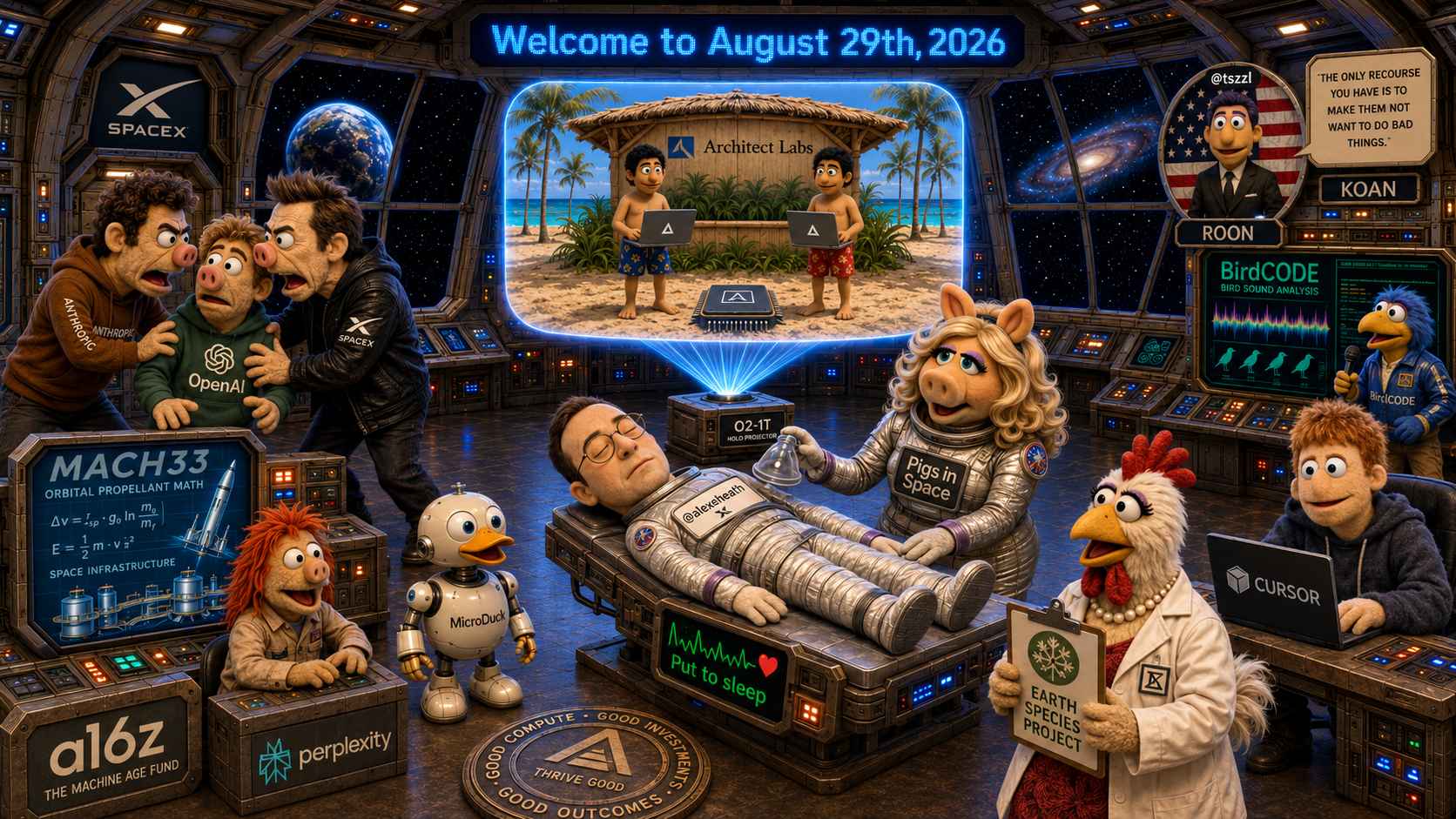
Le Calcul et les Cochons dans l’Espace, C’est Désormais Tout le Jeu. Compute and Pigs in Space is the Whole Game Now. On August 29, 2026, @siouid142 transformed Dr. Alex Wissner-Gross’s Innermost Loop into a cockpit for the artificial-intelligence economy. The
Read the narration
Le Calcul et les Cochons dans l’Espace, C’est Désormais Tout le Jeu.
Compute and Pigs in Space is the Whole Game Now.
On August 29, 2026, @siouid142 transformed Dr. Alex Wissner-Gross’s Innermost Loop into a cockpit for the artificial-intelligence economy. The title joins a claim attributed to Dario Amodei—that compute in space is now the whole game—to the Muppet sketch Pigs in Space. Dario Amodei, Sam Altman and Elon Musk become the pig-nosed command crew. Their institutions, Anthropic, OpenAI and SpaceX, are made into one unstable vehicle whose destination depends on models, chips, energy and launch capacity advancing together.
The joke is affectionate but exact. Pigs in Space parodied the solemn confidence of science-fiction crews who barely controlled their ship. Here, three powerful executives look similarly ceremonial while the cockpit overflows with events no single captain commands. Space is no longer scenery. It is proposed as the place where abundant solar power, cooling and orbital infrastructure might loosen the terrestrial grid constraint on intelligence.
A beach inset for Architect Labs shows founders Ebrahim Hussain and Aaditya Subedi with their first AI-designed chip. Below it, a 021T projector turns the chip into evidence. The dispatch presented the result as a step toward democratized hardware design: intelligence is beginning to alter the substrate on which intelligence runs. Yet the little vacation image also makes a serious fabrication achievement resemble a souvenir, reminding us how quickly technical milestones become social-media objects.
Alex Heath lies on a stretcher in a spacesuit beneath a monitor reading “Put to sleep,” while Miss Piggy tends him. The scene converts reporting about Codex persisting until deliberately stopped into slapstick medical theater. A coding agent that can keep operating becomes a patient who must be sedated. The metaphor is funny because it reverses agency: the human reporter appears immobilized while the software acquires endurance.
Roon appears as a Muppet beside the line, “the only recourse you have is to make them not want to do bad things.” The statement is presented as an alignment koan rather than a complete program. Nearby, the blue BirdCODE bird of the Earth Species Project widens the field of communication beyond humans, and the MicroDuck robot reduces embodied autonomy to a bright consumer object. One corner asks whether intelligence can share intention; another asks whether it can walk into the home for three hundred ninety-nine dollars.
Around them circulate Perplexity, Cursor, the Earth Species Project, Mach33 propellant equations and Andreessen Horowitz’s Machine Age. A medallion links good compute, good investments and good outcomes. The sequence sounds causal, but the image refuses to guarantee it. Capital can purchase chips, turbines, launches and models; it cannot by itself establish that their incentives point toward the same future.
The cockpit therefore works as a systems diagram disguised as comedy. Cursor’s changing access to OpenAI models, Anthropic’s courtship of developers, Architect’s chip, grid scarcity, turbine factories and space infrastructure all become controls on one console. Software rivalry is physically dependent on metallurgy, electricity and launch cadence. The apparent cloud has a floor made of factories.
As contemporary history painting, Compute and Pigs in Space is the Whole Game Now preserves the absurd compression of a single technology dispatch. Executives become puppets, a benchmark becomes a beach holiday, an agent becomes a patient and an investment thesis becomes a spacecraft. The work does not say that orbital compute is inevitable. It shows why the idea could suddenly feel narratively inevitable when terrestrial constraints, corporate competition and machine persistence entered the same frame.
Opening the gallery…